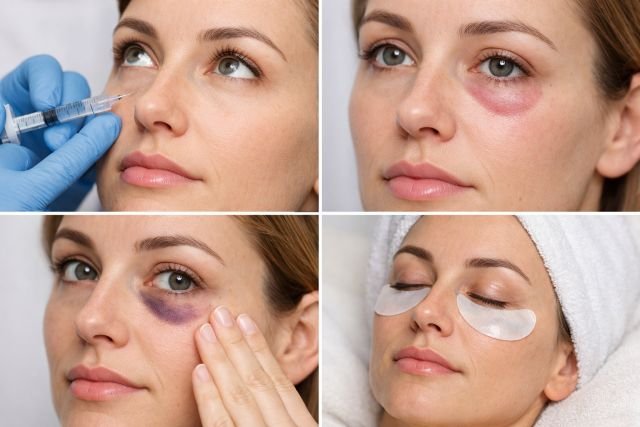
If you’re considering tear trough filler, you’re probably thinking beyond the “after” photo. You’re thinking about the next morning in the mirror. Will you look puffy? Will you bruise? Will people ask if you’re tired, sick, or “had something done”?
- What “tear trough filler” actually means
- Why swelling happens after tear trough filler
- Bruising after tear trough filler: common, dramatic-looking, usually temporary
- Tear trough filler downtime: what recovery really looks like
- What’s normal swelling and what should worry you
- Why some people swell more than others, even with “good technique”
- Technique and product choice can change your downtime
- How to reduce swelling and bruising after tear trough filler
- When swelling doesn’t go away: what persistent puffiness can mean
- How long does tear trough filler last?
- Featured-snippet style Q&A, without the fluff
- Conclusion: plan for real recovery, not perfect next-day photos
The honest truth is that tear trough filler can be one of the most rewarding treatments in aesthetic medicine for the right person, but it’s also one of the easiest to misunderstand. Under-eye tissue is thin, sensitive, and prone to fluid retention. That means swelling and bruising are common, and “no downtime” is not a promise anyone should make about this area.
This article walks you through what swelling, bruising, and downtime actually look like, why they happen, what’s normal, what’s not, and how to plan your schedule so you don’t end up stressed, hiding behind sunglasses, or regretting the timing.
What “tear trough filler” actually means
Tear trough filler usually refers to placing a dermal filler, most commonly hyaluronic acid (HA), in the hollow between the lower eyelid and the upper cheek. The goal is to soften the shadowing that makes under-eyes look sunken or tired. HA fillers are widely used here because they can be dissolved with hyaluronidase if needed, which adds a safety and flexibility advantage in such a delicate region.
Even though the concept sounds simple, the under-eye is not like lips or smile lines. There’s less “room” for product, more visible consequences from tiny irregularities, and higher sensitivity to swelling. This is why the best tear trough results often come from a conservative plan, sometimes staged over more than one visit, rather than trying to do “everything” in one session. Reviews of periocular HA filler complications repeatedly emphasize that most side effects are mild and temporary, but serious complications, while rare, can occur and require prompt, knowledgeable management.
If your site has an educational page explaining the difference between under-eye hollows and under-eye bags, this is a great place to link it internally, because many “bad filler candidates” are actually dealing with puffiness or fat prolapse rather than volume loss.
Why swelling happens after tear trough filler
Swelling is your body’s natural response to micro-trauma from an injection. Even when everything is done perfectly, your tissue reacts to the needle or cannula, the product, and the brief inflammation that follows.
Under-eye swelling has a few special triggers that make it more noticeable than swelling in other areas.
First, the under-eye region is naturally prone to fluid shifts. If you’re someone who wakes up with puffy eyes after salty food, poor sleep, or seasonal allergies, your tissue already demonstrates a tendency to hold fluid.
Second, hyaluronic acid attracts and binds water. That’s part of why HA fillers look smooth and hydrated, but it can also contribute to puffiness if too much product is placed or if it’s placed in a plane that encourages visible swelling. Periocular HA filler resources list swelling as one of the most common mild adverse events.
Third, the lymphatic drainage pathways around the lower eyelid and upper cheek can be sensitive to disruption. This matters because one of the most discussed longer-lasting under-eye issues is persistent edema, sometimes described clinically as periorbital edema, and in some contexts as malar edema when it collects in the upper cheek/lower lid region. A 2024 publication discussing late-onset periorbital edema highlights that periorbital swelling is a recognized complication in patients with a history of facial HA injections.
Bruising after tear trough filler: common, dramatic-looking, usually temporary
Bruising happens when a small blood vessel is nicked. The under-eye has many tiny superficial vessels and very thin skin, which is why even a small bruise can look darker and larger than you’d expect.
The key thing to know is that bruising often looks worse before it looks better. It can deepen in color over the first day or two, then gradually fade. Periocular complication references describe bruising as a common mild adverse event, alongside redness and swelling.
In practical terms, bruising is usually a cosmetic inconvenience rather than a medical problem. The bigger risk is scheduling the treatment too close to an important event and then feeling stuck.
Tear trough filler downtime: what recovery really looks like
A lot of clinics describe filler as “lunchtime treatment,” and that can be true for some people. But tear trough filler recovery exists on a spectrum.
Most people can return to normal daily activities quickly. The American Society of Plastic Surgeons notes that most activities can be resumed right away, with a general recommendation to avoid intense physical activity for the first 24 to 48 hours to minimize swelling and bruising.
That said, being “back to life” is different from being “camera-ready.” If you’re planning around work, travel, weddings, or photo-heavy events, a more realistic planning window is helpful.
Many patients experience mild swelling immediately, with swelling peaking in the first one to three days. Bruising, if it happens, often becomes most visible within the first 24 to 72 hours. The under-eye then tends to settle across the first one to two weeks, and subtle refinements can continue beyond that.
A smart, low-stress approach is to plan as if you’ll want at least a week before a major event, and preferably two weeks if you are prone to bruising or you’ve never had under-eye injections before.
What’s normal swelling and what should worry you
It’s easy to overthink the under-eye area because it’s so visible. But it’s also important not to dismiss warning signs.
Normal post-treatment changes include swelling, mild tenderness, and bruising that gradually improves. Temporary unevenness can also happen because the left and right sides rarely swell identically, especially during the first few days.
The red flags are different. Severe pain, marked skin color change (such as blanching or dusky discoloration), and any visual symptoms should be treated as urgent. Eye-focused references on HA filler complications highlight that while most adverse events are mild and transient, serious outcomes including skin necrosis and even vision loss can occur, and require immediate action.
Why some people swell more than others, even with “good technique”
This is where patients often feel confused. They see a friend’s perfect next-day result and wonder why their own swelling looks bigger or lasts longer.
The difference is usually not willpower or luck. It’s anatomy and physiology.
People who tend to retain fluid, wake up puffy, have allergies or sinus congestion, or have certain under-eye structural patterns may be more likely to develop persistent puffiness after filler. In other words, the same filler that beautifully smooths a hollow can worsen puffiness in someone whose “problem” is not true volume loss.
This is why consultation matters. Tear trough filler works best when shadowing is driven by a hollow and contour deficit, not when the main issue is prominent under-eye bags, skin laxity, or chronic edema patterns. Periocular complication literature discusses risk factors and the importance of understanding pathophysiology and treatment methods for complications.
Technique and product choice can change your downtime
Patients often focus on brand names, but in the under-eye, placement depth and dosing strategy matter just as much as the product.
If filler is placed too superficially, it can create visible contour irregularities and sometimes a bluish-gray hue under thin skin, often discussed clinically in relation to superficial filler placement issues in the periocular region.
Overfilling is another common cause of prolonged puffiness. The best under-eye results are often subtle. An injector who aims for “perfect” in a single session may unintentionally create a puffy or heavy look that takes longer to settle, or that doesn’t settle the way the patient expected.
As for needle versus cannula, there are pros and cons to both. Some clinicians use cannulas to reduce vessel injury risk in certain contexts, but neither approach eliminates bruising risk entirely. What matters most is the injector’s anatomical knowledge, comfort level with the under-eye, and willingness to use conservative amounts.
How to reduce swelling and bruising after tear trough filler
You can’t control every variable, but you can meaningfully reduce risk with smart prep and aftercare.
In the day or two after treatment, one of the simplest evidence-aligned ideas is to avoid strenuous exercise briefly, since many professional sources recommend avoiding intense activity for 24 to 48 hours to minimize swelling and bruising.
Sleep position can also help. Keeping your head slightly elevated for the first couple of nights can reduce morning puffiness. Gentle cold compresses can be soothing early on, but pressure should be minimal because aggressive pressing can irritate tissue.
Also, treat your calendar like part of your aftercare. If you have a high-visibility event coming up, schedule your filler far enough in advance that you aren’t emotionally “watching” every tiny change day by day.
If you want to strengthen E-E-A-T on the page, you can link internally to your aftercare instructions page and externally to authoritative guidance on filler recovery and risks. A solid external link here is the ASPS recovery guidance.
When swelling doesn’t go away: what persistent puffiness can mean
Not all lingering swelling is the same, and this is where a nuanced explanation adds real value.
Sometimes the area is simply healing slowly. If swelling is steadily improving week by week, that is usually reassuring.
Sometimes swelling behaves more like fluid retention. It looks better later in the day, worse in the morning, and flares with salty meals, alcohol, or allergies. This pattern can suggest an edema-prone under-eye region interacting with filler.
And sometimes persistent puffiness is a placement or dosing issue. The under-eye can’t always “hide” extra product. In these cases, HA filler’s reversibility becomes an important safety net. Eye-focused complication resources discuss management strategies that can include hyaluronidase, along with other supportive measures, depending on the situation.
How long does tear trough filler last?
Duration varies by product, placement, and individual metabolism. Many patients hear “about a year,” and that can be a reasonable planning estimate, but it’s not guaranteed.
A 2025 paper in the Journal of Clinical and Aesthetic Dermatology discussing tear trough HA filler notes that the duration of effect reported in literature ranges from 8 to 12 months, with an average of 10.8 months.
That range is useful for planning, especially if you’re timing filler around seasonal events, travel, or major life moments.
Featured-snippet style Q&A, without the fluff
How long does swelling last after tear trough filler? Most swelling tends to peak in the first one to three days and improves over one to two weeks, but under-eye tissue can be slower to settle in people prone to puffiness, and persistent periorbital edema is a recognized complication in some cases.
How long does bruising last after under-eye filler? Bruising commonly fades across about one to two weeks. Under-eye bruises often look more dramatic because the skin is thin, even when the bruise itself is small.
Is tear trough filler downtime worse than filler in other areas? It can be, because the under-eye is thin-skinned and prone to fluid retention. Even mild swelling can look significant compared with the cheeks or jawline.
What symptoms are an emergency after tear trough filler? Severe pain, notable skin color changes, or any visual symptoms should be treated as urgent, because serious periocular filler complications, though rare, are well documented.
Conclusion: plan for real recovery, not perfect next-day photos
Tear trough filler can look beautifully natural when the candidate is right, the dosing is conservative, and placement is precise. Swelling and bruising are common and usually temporary, and most people can resume everyday life quickly, with many professional sources recommending that you avoid intense activity for 24 to 48 hours to reduce swelling and bruising.
The smartest mindset is to plan for a short recovery window, choose an injector with true under-eye experience, and prioritize safety and subtlety over “maximum correction” in one visit. In the under-eye, less is very often more, and the best results are the ones that make you look rested without anyone being able to name why.