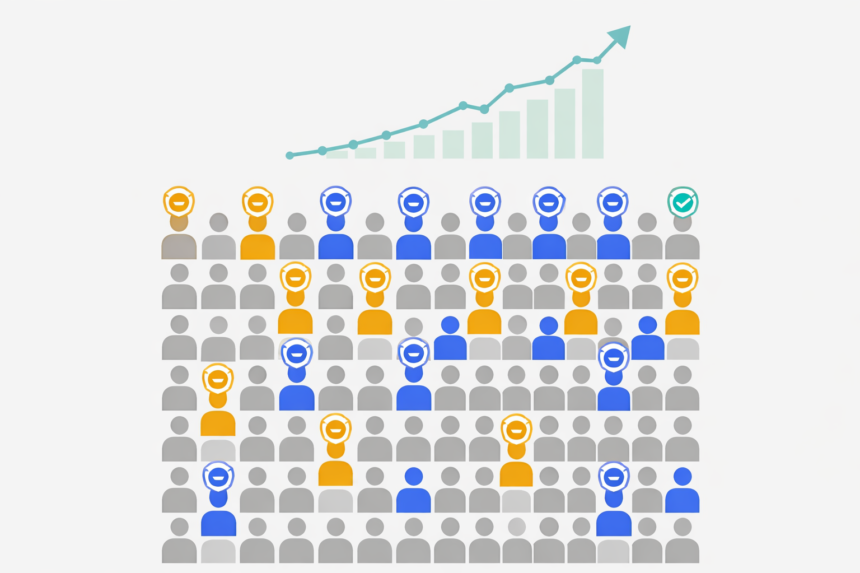
There is a dividing line running through the labour market that most people cannot see on a CV but that shows up immediately on a payslip. On one side are workers who hold a professional licence or certification—a verified, exam-tested credential that proves they can do a specific job to a measurable standard. On the other side is everyone else. According to the Bureau of Labor Statistics, the first group earns roughly 16 per cent more than the second, even when you control for occupation and education level.
That gap is not a rounding error. On a $50,000 salary, 16 per cent is $8,000 a year. Over a decade, it compounds into a six-figure difference in lifetime earnings. And the credential that opens the gap typically costs a few hundred dollars and takes three to six months to earn. By almost any financial measure, it is the most efficient career investment available to a working adult.
The Numbers Behind the Credential Economy
The Bureau of Labor Statistics began tracking certification and licensing data through its Current Population Survey in 2015, and the pattern has been consistent every year since. Roughly 25 per cent of employed Americans hold either a professional certification or a government-issued licence. The prevalence varies by industry—it exceeds 70 per cent in healthcare and education, and sits closer to 15 per cent in retail and hospitality—but the wage premium holds across virtually every sector.
The premium also holds across demographics, though not equally. White workers hold certifications at a rate of about 25 per cent. Hispanic and Latino workers hold them at roughly 15 per cent. That 10-point gap does not reflect a difference in ability or ambition. It reflects structural barriers—access to training, awareness of credentialing pathways, language challenges on exams, and the cost of preparation—that are beginning to receive serious policy attention.
Why Employers Pay More for Credentials
The wage premium is not charity. Employers pay more for certified workers because the credential reduces risk. Hiring an uncertified candidate for a role that involves safety, compliance, clinical care, or technical precision is a gamble on their self-reported competence. Hiring a certified one is a bet on a standardised, proctored, third-party validation. In industries where mistakes carry legal, financial, or human consequences—construction, healthcare, finance, education, public safety—that distinction directly affects the bottom line.
For workers navigating the certification landscape, the challenge is not finding a relevant credential. It is passing the exam. The tests are standardised, scenario-heavy, and designed to verify applied competence. Candidates who prepare through structured test prep resources consistently pass at higher rates because they have practised under conditions that mirror the real assessment—timed, multiple-choice, and focused on application rather than memorisation.
The Industries Driving Demand
Healthcare leads the credentialing economy by sheer volume. Nurses, EMTs, phlebotomists, medical coders, radiologic technicians, and clinical counsellors all require licensing exams to practise. Construction follows closely, with safety certifications, electrical licences, and trade credentials gating access to virtually every jobsite. Information technology has embraced certifications as a hiring filter at every level, from the entry-level CompTIA A+ to the advanced CISSP. Education, finance, real estate, and public safety all maintain robust credentialing frameworks that determine who works and who does not.
The common thread is regulation. In fields where the consequences of incompetence are serious—patient harm, building failure, financial fraud, student safety—the licensing exam exists to protect the public. The wage premium exists because the credential restricts supply to qualified individuals, and demand for those individuals consistently exceeds the available pool.
The Most Overlooked Career Decision
Most career advice focuses on education, networking, and interview skills. All of it matters. But the single highest-impact action most working adults can take to increase their earnings—an action that costs less than a weekend break and takes less time than a Netflix binge—is earning a professional certification in their field. It is the most overlooked career decision in the modern labour market. And for the 75 per cent of workers who do not hold one, the gap is not shrinking. It is compounding.