The zebra crossing sign plays a vital role in modern road safety by clearly indicating where pedestrians have priority to cross the road. It serves as a universal warning for drivers to slow down and remain alert while also giving pedestrians a defined, safer place to cross. Understanding how this sign works is essential for reducing accidents and creating safer streets for everyone.
- What Is a Zebra Crossing Sign?
- Why the Zebra Crossing Sign Is So Important for Road Safety
- What a Zebra Crossing Sign Looks Like
- Zebra Crossing Sign Rules for Drivers
- Zebra Crossing Sign Rules for Pedestrians
- Zebra Crossing Sign Compared to Other Pedestrian Crossings
- Where Zebra Crossing Signs Are Commonly Installed
- Real-World Scenario Highlighting Their Importance
- Common Mistakes Around Zebra Crossing Signs
- How Zebra Crossing Signs Improve Urban Environments
- Legal Consequences of Ignoring a Zebra Crossing Sign
- Frequently Asked Questions About Zebra Crossing Signs
- Conclusion
In this comprehensive guide, you’ll learn exactly what a zebra crossing sign means, how drivers and pedestrians should behave around it, why it is so important for road safety, and how it is used across different regions. This article is written to be practical, informative, and fully optimized for search engines while remaining easy to read on mobile devices.
What Is a Zebra Crossing Sign?
A zebra crossing sign identifies a designated pedestrian crossing marked by bold white stripes painted across the road surface. The sign alerts approaching drivers that pedestrians may be entering or already using the crossing and that they must be prepared to stop. Unlike traffic-light-controlled crossings, zebra crossings rely heavily on visibility, signage, and driver awareness to function safely.
These crossings are commonly installed in areas with frequent pedestrian movement, such as near schools, residential streets, shopping areas, and public transport stops. The design is intentionally simple and highly visible so that it can be recognized quickly, even from a distance.
Why the Zebra Crossing Sign Is So Important for Road Safety
Pedestrians are among the most vulnerable road users. According to the World Health Organization, hundreds of thousands of pedestrians lose their lives each year in road traffic incidents worldwide. One of the main causes is poor visibility and unclear right-of-way rules. The zebra crossing sign addresses this issue by clearly defining where pedestrians should cross and by legally obligating drivers to yield.
Research from the UK Department for Transport has shown that well-designed pedestrian crossings, including zebra crossings, can significantly reduce pedestrian-related accidents in urban areas. By encouraging predictable behavior from both drivers and pedestrians, zebra crossing signs help reduce confusion, hesitation, and dangerous last-minute decisions.
What a Zebra Crossing Sign Looks Like
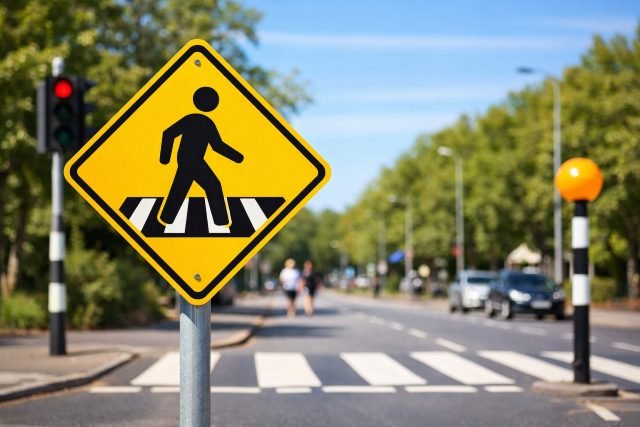
Although the exact design may vary slightly between countries, the zebra crossing sign usually features a clear pedestrian symbol displayed on a contrasting background. The sign is often placed on both sides of the road to ensure maximum visibility. Reflective materials are commonly used so that the sign remains visible at night and during poor weather conditions.
On the road itself, the crossing is marked by wide white stripes laid across the carriageway. These stripes are designed to stand out clearly against the darker road surface, helping drivers identify the crossing even before they notice the sign.
Zebra Crossing Sign Rules for Drivers
When approaching a zebra crossing sign, drivers are expected to reduce speed and remain prepared to stop at any moment. In most regions, the law requires drivers to stop as soon as a pedestrian steps onto the crossing or clearly indicates an intention to cross. Drivers must remain stopped until the pedestrian has fully crossed the road and reached the pavement.
Ignoring a zebra crossing sign is treated as a serious traffic offense in many countries. Penalties may include fines, penalty points on a driving license, increased insurance premiums, or even criminal charges if an accident occurs. These strict rules highlight the importance authorities place on pedestrian safety.
Zebra Crossing Sign Rules for Pedestrians
Pedestrians generally have priority at zebra crossings, but this does not mean they should cross without caution. Safe use of a zebra crossing involves making sure approaching drivers have seen you and have enough time to stop. Sudden movements or distractions, such as using a mobile phone, can increase the risk of accidents even at marked crossings.
By staying alert and crossing confidently but carefully, pedestrians help reinforce predictable behavior, which is essential for the safe operation of zebra crossings.
Zebra Crossing Sign Compared to Other Pedestrian Crossings
The zebra crossing sign differs from signal-controlled crossings in one key way: it does not use traffic lights. Instead, it relies on road markings, signage, and driver awareness. This makes zebra crossings especially suitable for roads with lower traffic speeds and moderate vehicle flow.
In contrast, crossings controlled by traffic signals are better suited for busy roads where continuous traffic would make it difficult for pedestrians to cross safely without stopping vehicles through lights.
Where Zebra Crossing Signs Are Commonly Installed
Zebra crossing signs are typically placed in locations where pedestrian demand is high and vehicle speeds are relatively low. Local authorities often carry out traffic and safety assessments before installing them to ensure they are appropriate for the area. Poor placement or lack of visibility can reduce their effectiveness, which is why planning and maintenance are critical.
Real-World Scenario Highlighting Their Importance
Imagine a driver approaching a zebra crossing sign on a rainy evening. Visibility is reduced, and reflections from wet roads make it harder to see pedestrians. A well-maintained zebra crossing with clear signs and bright road markings allows the driver to recognize the crossing early and stop safely. Without that visibility, the risk of a serious accident would increase significantly.
This scenario demonstrates why both the sign and the road markings must be clearly visible at all times.
Common Mistakes Around Zebra Crossing Signs
Many accidents near zebra crossings occur due to misunderstandings or poor attention. Drivers sometimes assume pedestrians will wait, while pedestrians may assume drivers will always stop. These incorrect assumptions can lead to dangerous situations. Awareness, patience, and clear communication through eye contact are essential for avoiding such risks.
How Zebra Crossing Signs Improve Urban Environments
Cities that invest in pedestrian-friendly infrastructure often experience broader benefits beyond safety. Improved crossings encourage walking, reduce vehicle speeds, and contribute to calmer, more livable streets. Transport for London has reported that clear pedestrian crossings play a significant role in reducing serious injuries and improving overall road user behavior.
Legal Consequences of Ignoring a Zebra Crossing Sign
Failing to obey a zebra crossing sign can have severe legal consequences. In many jurisdictions, striking a pedestrian on a zebra crossing is considered a serious offense that can result in heavy fines, license suspension, or imprisonment. These penalties reflect the high duty of care drivers have toward pedestrians at designated crossings.
Frequently Asked Questions About Zebra Crossing Signs
A zebra crossing sign indicates a location where pedestrians have the right to cross the road and where drivers must give way. Pedestrians generally have priority once they step onto the crossing, although they should still ensure it is safe to do so. Drivers are not allowed to stop or park on a zebra crossing, as this blocks visibility and creates danger. Zebra crossings are most effective on roads with moderate traffic and lower speeds, where driver compliance can be reasonably expected.
Conclusion
The zebra crossing sign is a simple yet powerful tool that saves lives by clearly defining pedestrian priority and encouraging responsible driving behavior. When drivers understand their obligations and pedestrians remain alert, zebra crossings become highly effective safety features in both urban and residential areas.
By respecting the zebra crossing sign and using it correctly, we all contribute to safer roads, reduced accidents, and more walkable communities. Understanding this sign is not just about following the law; it is about protecting lives and sharing the road responsibly.