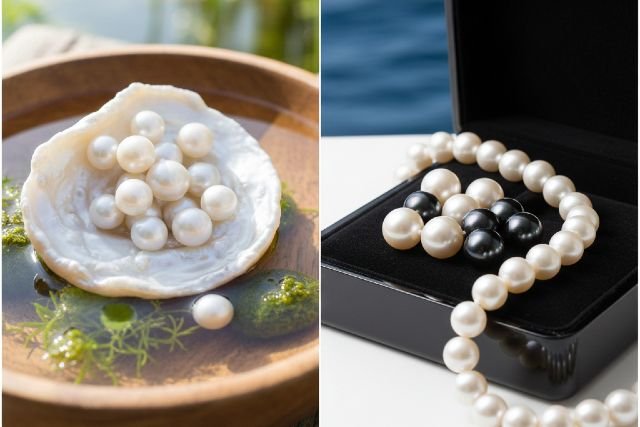
If you’ve ever shopped for cultured pearls, you’ve probably asked the big question: freshwater vs saltwater—which is better? The honest answer is that both can be excellent, but each type shines in different ways. Freshwater cultured pearls are popular for their value, variety, and everyday wearability. Saltwater cultured pearls often stand out for sharper luster, more consistent roundness, and a premium reputation, especially in Akoya, Tahitian, and South Sea varieties. In this guide, you’ll learn how to compare them correctly using widely recognized quality factors such as luster, surface, shape, and nacre, which are commonly used in professional pearl evaluation.
- What Are Cultured Pearls?
- Freshwater vs Saltwater Cultured Pearls: What’s the Main Difference?
- Cultured Pearls Freshwater vs Saltwater – Quick Comparison
- H2: Cultured Pearls Freshwater vs Saltwater – Which Is Better?
- Understanding Pearl Quality: How Experts Grade Cultured Pearls
- Freshwater Cultured Pearls: What Makes Them Special?
- Saltwater Cultured Pearls: Why They Feel More Luxurious
- Nacre Thickness and Durability: Which Holds Up Better?
- Why Saltwater Cultured Pearls Usually Cost More
- Best Cultured Pearls for Earrings, Necklaces, Rings, and Bracelets
- A Simple Framework to Choose the Best Cultured Pearls
- Real-World Scenarios That Help You Decide Quickly
- Common Mistakes to Avoid When Buying Cultured Pearls
- Featured Snippet Summary: Freshwater vs Saltwater Cultured Pearls in 7 Points
- FAQ: Cultured Pearls (Freshwater vs Saltwater)
- Conclusion: Freshwater vs Saltwater Cultured Pearls — Which Is Better?
What Are Cultured Pearls?
Cultured pearls are real pearls formed inside a mollusk with human assistance. Farmers initiate the pearl-forming process by inserting a nucleus or tissue into an oyster or mussel, encouraging it to coat the irritant with layers of nacre over time. Cultured pearls are not imitation pearls. They are nacre-based gems and make up the majority of pearls sold in the modern jewelry market. Industry terminology and classification guidance is also supported by organizations such as CIBJO, which helps standardize definitions for natural and cultured pearls across international trade.
Freshwater vs Saltwater Cultured Pearls: What’s the Main Difference?
The main difference is the environment and the mollusk species that produces the pearl. Freshwater cultured pearls grow in lakes and rivers and are produced mainly by mussels. Saltwater cultured pearls grow in oceans and seas and are produced mainly by oysters. That difference influences luster, shape consistency, nacre structure, size availability, color range, and price. It also affects how pearls are farmed, how long they take to produce, and how consistent they are in matching sets, such as necklaces and bracelets.
Cultured Pearls Freshwater vs Saltwater – Quick Comparison
Freshwater cultured pearls generally offer more variety in shape and color at a more accessible price point. Saltwater cultured pearls tend to offer sharper, more reflective luster and more consistent roundness, especially in well-matched strands. Freshwater pearls are often seen in modern, fashion-forward designs because baroque and oval shapes can look artistic and distinctive. Saltwater pearls are often favored for classic luxury jewelry, with Akoya pearls in particular known for strong luster and uniform appearance.
Professional evaluation frameworks, such as those discussed by GIA, commonly emphasize luster, surface, shape, size, color, nacre, and matching as the primary factors that determine value across all cultured pearl types.
H2: Cultured Pearls Freshwater vs Saltwater – Which Is Better?
The better choice depends on your priorities. If you want the best price-to-beauty value, wide variety, and pearls you can wear daily without anxiety, freshwater cultured pearls are often the smartest choice. If you want a highly reflective, classic look with consistent round pearls and luxury prestige, saltwater cultured pearls are usually the better option. Neither one is automatically superior; quality grade matters more than pearl origin. High-grade freshwater pearls can look stunning, while lower-grade saltwater pearls may not meet expectations.
Understanding Pearl Quality: How Experts Grade Cultured Pearls
If you want to compare cultured pearls properly, focus on measurable quality traits rather than labels. Luster is typically the most noticeable factor because it affects how bright and “alive” the pearls look. Surface quality matters because pearls are organic and natural markings can appear, but clean surfaces usually command higher value. Shape affects style and price, with round pearls generally being more expensive because they are rarer to produce consistently. Size also matters, but it must be balanced with luster and surface. Color impacts preference and rarity, particularly for Tahitian and South Sea pearls. Nacre influences durability and the depth of glow, and matching becomes important when pearls are strung into strands or assembled into sets. These value factors are widely discussed in pearl education resources from major gem authorities such as GIA.
Freshwater Cultured Pearls: What Makes Them Special?
Freshwater cultured pearls are popular because they can provide excellent beauty for the price. They are commonly produced in mussels, and many freshwater pearls are built predominantly of nacre, which contributes to a rich, layered glow. They also come in a broad range of colors, including white, cream, pink, peach, and lavender, and they appear in many shapes. This makes them ideal for people who want unique jewelry designs, layered looks, and affordable elegance. While older freshwater pearls were often associated with lower luster, modern farming and sorting has improved quality significantly, and premium freshwater pearls can display strong shine and smooth surfaces.
Saltwater Cultured Pearls: Why They Feel More Luxurious
Saltwater cultured pearls include some of the most iconic pearl types in the jewelry world. Akoya pearls are known for classic white round strands with high luster. Tahitian pearls are prized for their naturally dark body colors and overtones that can appear green, blue, or aubergine. South Sea pearls are valued for their large size and soft, satiny luster and are often seen in high jewelry. Saltwater pearls are typically produced at lower volumes, require careful farming conditions, and are often graded with stricter expectations around roundness, surface quality, and matching, which contributes to higher prices. GIA has discussed market conditions, supply constraints, and quality considerations for saltwater cultured pearls such as Akoya and South Sea, reinforcing how farming realities impact availability and cost.
Nacre Thickness and Durability: Which Holds Up Better?
Nacre is the material that gives pearls their glow and iridescence. It also contributes to durability, because pearls with thicker nacre typically resist wear better over time. Many freshwater cultured pearls are nacre-rich due to their cultivation methods, and that can support strong long-term wear. Saltwater cultured pearls are often bead-nucleated, meaning there is a bead inside, and the pearl is formed by nacre layering around it. In these cases, nacre thickness becomes especially important because it influences durability and how well the pearl retains its finish. GIA and other gem education sources have repeatedly emphasized nacre quality as a key long-term value and durability factor.
Why Saltwater Cultured Pearls Usually Cost More
Saltwater cultured pearls tend to cost more because the production process is slower, yields are lower, and environmental conditions are harder to control. Saltwater pearl farms also depend on ocean health, skilled nucleation, and often stricter sorting and matching for premium jewelry standards. Akoya pearls, for example, are valued for uniform roundness and high luster, which increases the cost of producing well-matched strands. Tahitian and South Sea pearls are often larger and rarer, which further increases price. GIA has noted how supply and market conditions shape pricing and availability across major pearl categories.
Best Cultured Pearls for Earrings, Necklaces, Rings, and Bracelets
For earrings, saltwater cultured pearls often shine because luster is easy to notice on the face, making Akoya and South Sea pearls popular choices. Freshwater pearls are also excellent for earrings, especially for everyday wear and budget-friendly studs. For necklaces, saltwater pearls are often chosen for their consistent roundness and matching, while freshwater pearls are great for layered styles and baroque designs that feel artistic and modern. For rings, South Sea and Tahitian pearls create dramatic statement pieces, while premium freshwater pearls can also be impressive when set properly. For bracelets, freshwater pearls are popular because they are affordable and comfortable, while saltwater pearls are favored when you want a premium, well-matched look.
A Simple Framework to Choose the Best Cultured Pearls
A practical way to choose is to start with budget, then decide what look you love, then consider how frequently you’ll wear them. If your budget is limited and you want a beautiful piece you can wear often, high-quality freshwater cultured pearls usually offer the best value. If you want a timeless luxury look, are willing to invest more, and care deeply about luster and matching, saltwater cultured pearls may be the better choice. If your style is modern and expressive, baroque freshwater pearls can often look more unique than round pearls, even at higher price points.
Real-World Scenarios That Help You Decide Quickly
If you are shopping for bridal jewelry and want the classic pearl look under a controlled budget, high-grade freshwater cultured pearls can deliver a soft, elegant aesthetic that photographs beautifully. If you are buying a milestone gift for a professional setting and want a traditional luxury feel, Akoya saltwater cultured pearls are often considered a premium classic. If you love fashion-forward jewelry and want something visually distinctive, baroque freshwater cultured pearls offer organic shapes and creative designs that look modern and intentional.
Common Mistakes to Avoid When Buying Cultured Pearls
One major mistake is comparing average freshwater pearls to high-grade saltwater pearls and concluding one type is always better. Another is prioritizing size over luster, because a smaller pearl with exceptional luster can look more luxurious than a larger pearl with dull shine. Many buyers also underestimate the importance of surface quality, especially when purchasing strands where blemishes become more noticeable. It is also common to assume saltwater pearls are automatically superior, when in reality quality grading and individual pearl characteristics matter more. Finally, always verify terminology because organizations like CIBJO publish guidance intended to reduce misleading descriptions and help standardize pearl classification language globally.
Featured Snippet Summary: Freshwater vs Saltwater Cultured Pearls in 7 Points
Freshwater cultured pearls grow in mussels and are typically more affordable, with greater variety in shape and color. Saltwater cultured pearls grow in oysters and often have sharper luster and more consistent roundness. Freshwater pearls can be nacre-rich and durable, while saltwater pearls may be bead-nucleated, making nacre thickness an important quality factor. Both are real pearls, and the best choice depends on your budget, desired look, and how you plan to wear them.
FAQ: Cultured Pearls (Freshwater vs Saltwater)
Are cultured pearls real pearls?
Yes. Cultured pearls are real pearls formed of nacre inside a mollusk. The difference is that humans initiate the process, while the pearl forms naturally afterward. CIBJO distinguishes cultured pearls from imitation pearls in terminology guidance.
Which cultured pearls have the best luster?
Saltwater cultured pearls, especially Akoya, are known for sharp, mirror-like luster. However, premium freshwater cultured pearls can also have excellent luster depending on grading and selection.
Are freshwater cultured pearls less durable?
Not necessarily. Many freshwater pearls are nacre-rich, and nacre contributes to durability and long-term wear. Saltwater pearls can also be durable, but nacre thickness is an important factor, especially in bead-nucleated pearls.
Why are saltwater cultured pearls more expensive?
Saltwater pearls often cost more because of lower production yield, specialized farming requirements, longer cultivation periods, and stricter matching standards for premium jewelry pieces.
What’s the best cultured pearl type for everyday wear?
High-quality freshwater cultured pearls are often the best choice for everyday wear due to affordability, variety, and strong value. If you prefer a sharper luster and classic uniform look, Akoya saltwater pearls are also a good option if your budget allows.
Conclusion: Freshwater vs Saltwater Cultured Pearls — Which Is Better?
When choosing cultured pearls, freshwater vs saltwater is not about which one is “good” and which one is “bad.” It is about which one fits your budget, style, and quality expectations. Freshwater cultured pearls are ideal for buyers who want excellent value, variety, and wearable elegance. Saltwater cultured pearls are perfect for those who want premium luster, classic roundness, and luxury prestige, especially in Akoya, Tahitian, and South Sea varieties. The smartest way to buy is to focus on luster, surface quality, nacre, and matching—because in cultured pearls, quality always beats category.