If your gap wedge is the club you trust from 40–100 yards, but you still blade chips across the green (or chunk them embarrassingly short), there’s a good chance the problem isn’t your hands. It’s often a mismatch between gap wedge bounce, how you deliver the club, and the type of turf you play on.
- What wedge bounce means in plain English
- Why a gap wedge makes bounce feel even more important
- The real reason golfers blade chips with a gap wedge
- Gap wedge bounce and turf conditions: firm vs soft changes everything
- Swing style matters: digger vs sweeper
- A simple way to choose gap wedge bounce without guessing
- Bounce vs grind: why the stamped number can lie to you
- How to use bounce correctly with a gap wedge (the strike change you’ll feel immediately)
- Why dialing in your gap wedge bounce lowers scores
- Real-world examples of when bounce fixes the shot
- Featured-snippet definitions you can steal
- FAQ: quick answers about gap wedge bounce
- Conclusion: make your gap wedge bounce work for you
Bounce sounds technical, but it shows up in the simplest places: that tight lie where you feel like you must be perfect, the slightly fluffy collar where the ball sits up just enough to tempt you into “helping it,” and those damp fairways where your wedge feels like it gets swallowed.
This article breaks down what bounce really does, why it changes your strike so dramatically, and how to pick a gap wedge bounce that makes chipping and pitching feel predictable instead of stressful. You’ll also learn how to actually use bounce, because even the “perfect” wedge can betray you if you set it up in a way that cancels its design.
What wedge bounce means in plain English
Wedge bounce is the angle created between the leading edge and the lowest point of the sole (or trailing edge) of the wedge. In practical terms, it’s what helps the club “bounce” or resist digging as it moves through the turf. As bounce increases, the leading edge tends to sit higher off the ground at address, and the sole becomes more forgiving when you strike the ground a fraction early.
That’s the reason two chips that look identical on video can produce totally different results. On one swing, the sole glides and you clip the ball clean. On the other, the leading edge digs or rebounds and you either chunk it or blade it. Bounce is the design feature that decides which one happens more often.
Why a gap wedge makes bounce feel even more important
A gap wedge lives in the middle of your wedge setup, bridging the yardage space between your pitching wedge and sand wedge. Because it’s used for both fuller swings and finesse shots, the “right” bounce for a gap wedge isn’t just about one kind of lie or one kind of motion.
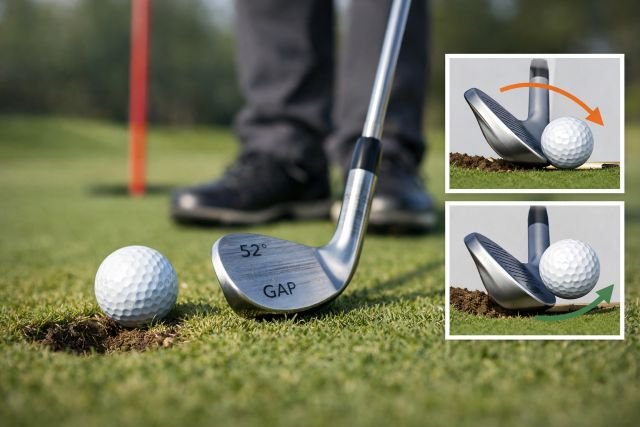
On full swings, many golfers naturally lean the shaft forward and compress the ball. Around the green, that forward lean often gets exaggerated because golfers are trying to “hit down” to avoid blading it. Ironically, that excessive handle-forward setup is one of the fastest ways to make blading more likely, because it exposes the leading edge and effectively removes bounce from the strike.
This is why “gap wedge bounce explained” matters for real scoring. You’re not just buying a number stamped on the sole. You’re choosing how much help your wedge gives you when your contact is slightly imperfect—which is basically every short-game shot under pressure.
The real reason golfers blade chips with a gap wedge
Most bladed chips are not caused by lifting your head or “coming out of it.” They’re caused by the leading edge getting to the ball before the sole can interact with the turf in a helpful way.
Here’s the typical pattern. A golfer sets up with the hands far ahead, trying to guarantee ball-first contact. That de-lofts the face, lowers the leading edge, and reduces effective bounce. When the club meets the ground, the leading edge either skips into the ball (thin) or digs and slows down (chunk). The worse the lie or the firmer the turf, the more dramatic the outcome.
Bounce is designed to prevent that by helping the wedge resist digging and glide through the turf more consistently. That’s exactly how Titleist/Vokey describes bounce: the angle forces the club to “bounce” or skip out of the turf more quickly and easily as it contacts the ball.
If you’ve been trying to “fix” blading by leaning the shaft even more forward, you’ve probably been making your wedge less forgiving.
Gap wedge bounce and turf conditions: firm vs soft changes everything
Bounce is a turf-interaction tool, so the ground you play on is not a minor detail. It’s a deciding factor.
On soft turf, wet fairways, or fluffy lies, the club wants to dig. More bounce generally helps because it gives the sole more ability to resist that dig and keep moving. Vokey’s bounce explanation highlights that as bounce increases, the leading edge sits higher and the sole becomes more protective against the ground.
On tight, firm lies, the ground doesn’t “give” as much. Many golfers fear chunking here and either get too careful or try to pick the ball cleanly. Lower bounce can feel easier to slide under the ball on very firm turf, but it also demands a cleaner delivery. If your swing is even slightly steep, low bounce on firm turf can still dig or create that knifey leading-edge contact that produces a low, hot blade.
A useful way to think about it is this: bounce is forgiveness, but the “type” of forgiveness depends on the surface. Soft conditions forgive steepness if you have enough bounce. Firm conditions forgive indecision only if your technique lets the sole skim.
Swing style matters: digger vs sweeper
You’ve probably heard the terms “digger” and “sweeper.” They’re not insults. They’re just shorthand for how your club enters and exits the turf.
If you take deeper divots or your wedge tends to enter the ground sharply, you’ll usually benefit from more bounce because it helps prevent the leading edge from burying. If you’re shallow and tend to clip the ball cleanly with minimal divot, you can often play less bounce without getting punished.
But here’s the important nuance. Many golfers aren’t one or the other all the time. Under pressure, a normally shallow player can get steep. On soft turf, a normally solid chipper can start digging. Bounce is basically your insurance policy for those moments.
This is also why a gap wedge is tricky. You might be shallow on full swings, but steep on little pokey chips. Or the other way around. That’s why choosing gap wedge bounce based on one swing video can be misleading. It’s smarter to base it on your common misses and your usual turf.
A simple way to choose gap wedge bounce without guessing
If you want one guiding principle that actually holds up, it’s this: choose bounce based on your worst miss and your most common conditions.
If your worst miss is chunking and you play any amount of soft turf, you typically want more bounce help. If your worst miss is blading, you may think you need less bounce, but many golfers actually need a setup change that stops them from removing bounce at address. Once the setup is healthier, a mid-bounce gap wedge often becomes the easiest wedge in the bag to chip with, because it has enough sole to protect you but not so much that it feels bulky.
If you use your gap wedge for a lot of full shots and “standard” chips, mid bounce is often the most versatile middle ground. Vokey’s guidance frames bounce in low, mid, and high categories, reinforcing that bounce selection is about matching sole interaction to your needs rather than chasing a single perfect number.
Bounce vs grind: why the stamped number can lie to you
Two wedges can have the same bounce number and still behave very differently. That’s where grind comes in.
Grind is the shaping of the sole, including heel relief, toe relief, and trailing-edge relief. It changes how the wedge sits when you open the face, how it reacts when you lean the shaft forward, and how much of the sole actually touches the turf.
If you like to play your gap wedge square-faced and mostly use it for full swings and straightforward chips, the bounce number will feel pretty honest. If you manipulate the face a lot, grind can make a “higher bounce” wedge still sit low and playable, or make a “low bounce” wedge feel even sharper than expected. Vokey’s bounce-and-grind explanations emphasize that both work together to influence contact and control.
A practical takeaway is that if you’re buying wedges, bounce is the first filter and grind is the fine-tuner.
How to use bounce correctly with a gap wedge (the strike change you’ll feel immediately)
This part matters as much as selection, because you can accidentally “turn off” bounce with your setup.
Start by placing your gap wedge behind the ball and letting the sole rest naturally. Notice what happens if you press the hands forward aggressively: the leading edge creeps closer to the ground, and the club starts to look like a knife. That’s the exact look that produces thin shots when your low point drifts even slightly behind the ball.
For most simple chips, a modest amount of shaft lean is fine, but the goal is to keep enough sole engaged that the club can brush the ground instead of stabbing it. When bounce is working, you’ll often feel a soft, shallow “thump” as the sole interacts with the turf, followed by the click of the ball. When bounce is not working, you’ll either hear a sharp click (thin) or a heavy thud (chunk).
The motion that helps most golfers is letting the chest turn the club through, keeping the handle from racing too far forward. You’re not trying to scoop. You’re trying to brush the turf with the sole. It feels calmer, and it produces a lower-effort strike that’s surprisingly consistent.
If you’ve been told to “keep the wrists firm,” you can keep that idea, but you don’t want it to turn into a locked, jabby action. Bounce needs the club to keep moving. Tension and stabbing are bounce-killers.
Why dialing in your gap wedge bounce lowers scores
Short game is one of the fastest ways to save strokes, especially because most amateurs miss a lot of greens. For example, Golf Monthly cites average greens-in-regulation numbers showing that a 15-handicapper hits about 23% of greens, while a scratch golfer hits about 52%.
When you miss that many greens, you don’t need a magical short game. You need a predictable one. A gap wedge that interacts with the turf the way you expect helps you keep the ball on the green, control rollout, and avoid the big miss that turns a routine up-and-down chance into a double bogey situation.
Even at the highest level, the PGA TOUR emphasizes around-the-green performance through categories like “Strokes Gained: Around-the-Green” and scrambling-related stats, underscoring how much short-game execution contributes to scoring outcomes.
You don’t need Tour-level touch to benefit from the same principle. You just need equipment and technique that reduce randomness.
Real-world examples of when bounce fixes the shot
Imagine a common collar chip where the ball sits slightly up and you’re tempted to lean the handle forward and punch it. That’s one of the easiest shots to blade because the ball position and lie trick you into exposing the leading edge. A gap wedge with enough bounce, combined with a more neutral handle position, turns that same chip into a simple brush-and-go motion.
Now imagine a soft fairway after rain. You make your normal chipping motion, but the club grabs and the ball goes nowhere. If your gap wedge has too little bounce for those conditions, it can feel like the turf is winning. A little more bounce gives the sole a chance to resist digging, maintain speed, and create consistent contact.
Finally, picture a tight lie on firm ground. Many golfers get scared of chunking and subconsciously lift the club through impact, which produces the thin rocket. This is where a calm brush and a stable low point matter most. Lower bounce can help some players here, but it’s rarely the whole solution. The more reliable fix is learning to let the sole skim without trying to “pick” the ball off the turf.
Featured-snippet definitions you can steal
Gap wedge bounce is the angle between the leading edge and the lowest point of the sole that helps the club resist digging and glide through turf for cleaner contact.
High bounce generally helps more on softer turf or steeper swings by resisting digging, while low bounce can sit tighter on firm lies but requires cleaner delivery.
FAQ: quick answers about gap wedge bounce
What bounce should a gap wedge have? Many golfers do best with a mid-bounce gap wedge because it’s used for both fuller swings and greenside shots, and mid bounce tends to handle a wider range of turf conditions without feeling extreme.
Is more bounce better for chipping? More bounce can be more forgiving when the turf is soft or when you tend to get steep, because it helps prevent the leading edge from digging too much and keeps the club moving.
Why do I blade chips with my gap wedge? Bladed chips usually happen when you remove bounce through excessive forward shaft lean and a jabby motion, exposing the leading edge. A slightly more neutral setup that lets the sole brush the turf often fixes it quickly.
Does wedge bounce matter on full swings? Yes, because the sole still interacts with the ground, and bounce influences how much the club digs or glides through impact, especially for players with steeper delivery.
Conclusion: make your gap wedge bounce work for you
Your gap wedge should be the club that makes short-game shots feel simple, not fragile. Bounce is a core reason why. It’s the design angle that helps the club resist digging and glide through the turf, and when you match it to your conditions and stop removing it with excessive handle-forward setup, you immediately reduce both chunks and blades.
If you want to build a smart wedge system, link this article internally to related pages like “Wedge Fitting Guide,” “How to Chip Using the Bounce,” and “Gap Wedge vs Sand Wedge Distance Gapping,” then point externally to authoritative bounce explanations from Vokey/Titleist and short-game performance categories on PGA TOUR stats for credibility.