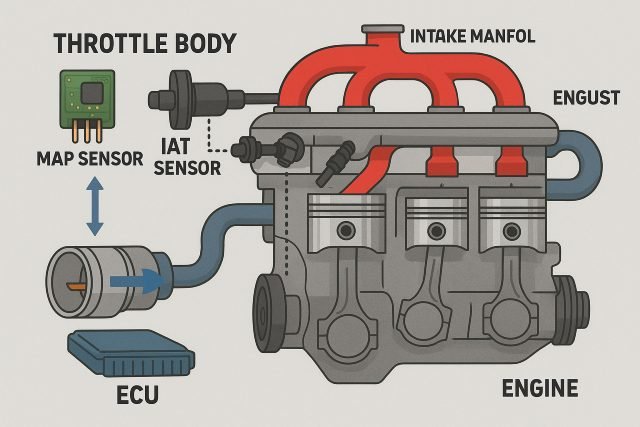
The speed density system has become one of the most important airflow management strategies in modern automotive engineering. Within the first moments of examining its operation, it becomes clear why engine builders, tuners, and manufacturers increasingly rely on it. By calculating airflow through manifold pressure, air temperature, engine speed, and volumetric efficiency, the system delivers finely tuned fuel control. Its role continues to grow as today’s engines demand higher performance, improved efficiency, and greater adaptability.
This article explains how speed density works, why it outperforms traditional airflow measurement methods, and what makes it ideal for both factory and modified engines.
What the Speed Density System Actually Does
The speed density system functions by calculating the mass of incoming air rather than measuring it directly. Whereas a mass airflow (MAF) sensor physically reads the air passing through an intake tube, speed density determines airflow using manifold absolute pressure, intake air temperature, engine RPM, and volumetric efficiency tables stored inside the ECU. These values allow the engine control unit to apply the ideal gas law to determine how much air reaches each cylinder. As a result, fueling becomes extremely responsive and reliable, even when airflow fluctuates rapidly.
Why Speed Density Enhances Modern Engine Performance
Improved Throttle Response and Power Delivery
Modern engines benefit significantly from speed density because they no longer rely on a physical sensor placed in the intake tract. A hot-wire MAF sensor can disrupt airflow and introduce a slight restriction. Speed density eliminates this obstruction entirely. Since the system calculates airflow using pressure data, it reacts immediately to sudden throttle changes. In high-RPM environments or boosted applications, this leads to noticeably sharper throttle response and more predictable power delivery. Studies such as those published in SAE Technical Papers demonstrate airflow improvements of several percentage points simply by removing restrictive MAF housings, validating the real-world impact of the system.
Superior Adaptability to Modifications
One of the greatest strengths of speed density is its compatibility with engine modifications. When engines receive aggressive camshafts, ported heads, larger throttle bodies, or forced-induction components, airflow becomes turbulent and unpredictable. MAF sensors struggle with this instability, often causing drivability issues or incorrect fuel trims. Because speed density relies on pressure readings and mathematical modeling rather than air stream consistency, it adapts easily to these changes. This is why many high-performance platforms, including racing applications, rely on speed density from the factory.
Enhanced Reliability and Fewer Sensor Failures
The speed density system eliminates the fragile hot-wire element found in MAF sensors. This design greatly reduces the likelihood of contamination from oil vapors, dust, moisture, or engine blow-by. MAP and IAT sensors are far more durable and continue to operate accurately even in harsh environments. For drivers who operate vehicles in dusty, wet, or high-boost conditions, speed density offers long-term reliability with fewer maintenance concerns.
Stronger Performance Under Boost
Turbocharged and supercharged engines operate under conditions that can easily overwhelm a traditional MAF system. When boost levels rise, airflow increases rapidly and sometimes exceeds the MAF sensor’s measurable range. Speed density excels in these situations because MAP sensors are designed to handle both vacuum and positive pressure. The fueling transitions between off-boost cruising and full-boost acceleration become smoother, more stable, and more predictable. This is one reason turbocharged LS platforms, EcoBoost systems, and performance-oriented imports often use or convert to speed density for high-power applications.
More Efficient Tuning and Calibration
Speed density tuning in modern ECUs is based on refining volumetric efficiency tables. This structure gives tuners greater control over how the engine predicts airflow across the entire operating range. Instead of dealing with MAF scaling, sensor housings, and airflow turbulence, tuners focus on real engine behavior. The result is a more direct, intuitive tuning process that leads to cleaner idle quality, improved drivability, and enhanced stability at all load levels. For modified engines, this level of control is especially valuable.
How the Speed Density Algorithm Works Internally
At a technical level, speed density relies on a mathematical model rooted in the ideal gas law. The ECU combines manifold absolute pressure, air temperature, displacement, volumetric efficiency, and engine speed to compute the mass of air entering each cylinder. Although the equation itself is complex, the benefit is straightforward. The system adapts instantly to changes in pressure, temperature, or altitude. It scales with engine RPM naturally. It evolves with the engine’s real volumetric efficiency as represented in the VE tables. In everyday driving, this method allows the ECU to maintain accurate fueling during rapid acceleration, gear changes, and sudden load variations.
Myths and Misconceptions About Speed Density
Many enthusiasts initially believe the speed density system is less accurate than a MAF setup. This misconception stems from early implementations where VE tables were less sophisticated. Modern ECUs, however, offer highly refined VE mapping that rivals or exceeds the accuracy of MAF systems in performance-oriented applications. Another common myth is that speed density struggles during weather or altitude changes. In reality, modern IAT and barometric pressure compensation tables allow excellent adaptation to environmental conditions. Finally, some assume speed density is suitable only for race cars, but numerous OEMs such as Honda, GM, Dodge, and Subaru use it in daily-driven vehicles due to its reliability and performance consistency.
Real-World Example: Turbocharged LS Engine Conversion
A practical example comes from a tuner working with a turbocharged 6.0-liter LS engine originally running a MAF-based setup. After converting to speed density, the engine demonstrated a smoother idle, improved throttle response during turbo spool, and a more stable air-fuel ratio above 15 psi of boost. The previous MAF sensor had been nearing its limit, causing inconsistent fueling at high load. Speed density eliminated these issues entirely and offered a cleaner, more predictable tuning process. This example mirrors the broader trend in high – boost LS builds where speed density provides both simplicity and performance benefits.
Frequently Asked Questions (Snippet-Optimized)
What is the speed density system?
The speed density system is an engine airflow calculation method that determines air mass using manifold pressure, air temperature, RPM, and volumetric efficiency rather than relying on a mass airflow sensor.
Why is speed density preferred for modified engines?
It handles airflow instability from modifications such as large camshafts, ported heads, or high-boost setups more effectively because it does not depend on consistent sensor-based airflow readings.
Does speed density increase engine horsepower?
It can contribute to increased power by removing intake restrictions and improving throttle response, which helps the engine operate more efficiently across the RPM range.
Is speed density suitable for daily-driven vehicles?
Yes. Many factory vehicles use speed density because it offers strong reliability, smooth drivability, and precise fueling when properly calibrated.
Conclusion
The speed density system improves performance in modern engines by delivering sharper throttle response, minimized airflow restriction, superior reliability, and improved adaptability to modifications. Its ability to model airflow mathematically rather than depend on a physical sensor makes it highly efficient for both stock and heavily modified powerplants. As technology advances, speed density continues to stand out as a flexible and powerful strategy for extracting more performance, stability, and efficiency from today’s engines.