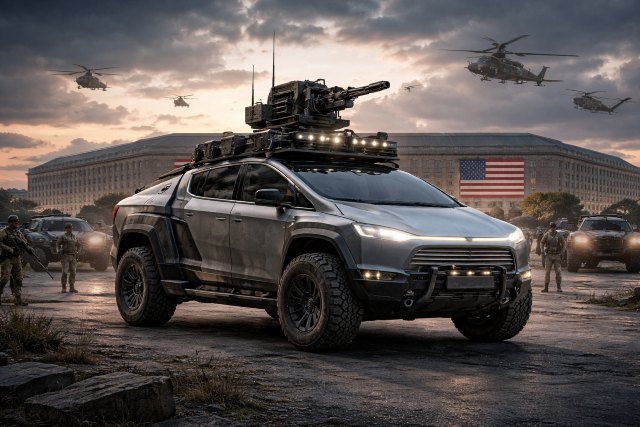
The phrase Pentagon Big Tech Tesla Cybertruck sounds like a sci-fi headline, but it captures something real: the U.S. defense ecosystem is increasingly shaped by commercial technology cycles, not slow, bespoke military-only programs. In that world, even a polarizing consumer vehicle like Tesla’s Cybertruck can end up on a Pentagon-adjacent procurement list — not necessarily as a troop carrier, but as a test article, a threat proxy, or a learning tool for modern battlefields.
- Why the Pentagon keeps leaning into Big Tech
- Pentagon Big Tech Tesla Cybertruck: why this vehicle shows up at all
- The bigger story: commercial tech in the JADC2 era
- Could Cybertruck ever be used operationally (not just as a target)?
- Real-world scenario: why “threat realism” is suddenly a priority
- Where “Big Tech” truly changes defense outcomes
- Actionable takeaways: what to watch next
- FAQs
- Conclusion: is this a new era — or just a headline?
So is this truly “a new era of military innovation,” or just an eye-catching mashup of brands and buzzwords?
The answer is nuanced. The Pentagon’s modernization push is absolutely real — especially around cloud, AI, and networking. And the Cybertruck’s appearance in defense reporting is real too, but (so far) tied to weapons testing and threat realism, not a wholesale adoption of Cybertrucks as frontline military vehicles. Reports in 2025 described the U.S. Air Force seeking to acquire Cybertrucks for missile target practice at White Sands Missile Range, citing the vehicle’s distinctive materials and design as relevant to future threat scenarios.
Let’s unpack what’s actually happening — and what it could mean next.
Why the Pentagon keeps leaning into Big Tech
For decades, cutting-edge capability often meant defense primes building custom systems. Today, many of the most important building blocks — cloud computing, AI tooling, autonomy stacks, chips, satellite services, zero-trust security patterns — advance fastest in the commercial sector.
That’s why you see the Department of Defense repeatedly emphasizing faster adoption pathways through organizations like the Defense Innovation Unit (DIU) and the Chief Digital and Artificial Intelligence Office (CDAO). DIU frames its mission explicitly around bringing commercial technologies into DoD at the speed and scale needed for strategic effect.
A concrete example: DoD stood up an AI Rapid Capabilities Cell (AI RCC) with DIU to accelerate and scale deployment of advanced AI-enabled tools across the department.
This shift isn’t about “Big Tech running the Pentagon.” It’s about a practical reality: in AI and cloud especially, the innovation curve is steep, and defense needs mechanisms to adapt quickly.
Cloud as the backbone: JWCC and multi-cloud reality
The Joint Warfighting Cloud Capability (JWCC) is often cited as a centerpiece of this commercial-collaboration approach. DoD’s CIO documentation and memos describe JWCC as a multi-vendor vehicle designed to meet enterprise cloud requirements and enable acquisition of commercial cloud services across classification levels and down to the tactical edge.
The takeaway: “Big Tech” here often means cloud hyperscalers and the ecosystem around them — because modern military data and AI workloads need secure, resilient compute and storage at global scale.
Pentagon Big Tech Tesla Cybertruck: why this vehicle shows up at all
Let’s be precise about what’s been reported: the Cybertruck isn’t (publicly) being adopted as the U.S. military’s next tactical vehicle fleet. The most credible reporting points to something more specific — the Air Force wanting Cybertrucks as target vehicles for live-fire testing and training, as part of a broader set of vehicles used to measure weapon effectiveness against real-world platforms.
That matters, because “innovation” here is less about “Tesla becomes a defense contractor,” and more about how the Pentagon models future threats in a world where commercial platforms can be repurposed, armored, or weaponized.
What makes Cybertruck interesting as a threat proxy?
Cybertruck differs from typical pickups in ways that defense testers might care about:
- Body material and exterior geometry: the distinctive stainless-steel exterior and angular surfaces could change fragmentation patterns, sensor returns, or munition effects compared with common sheet-metal designs (even if not “armor” in a military sense). Reporting on the Air Force interest highlights the unique design/material rationale.
- Electrical architecture and power: modern vehicles (especially EVs) introduce different fire risks, thermal behavior, and electrical subsystems compared to older ICE platforms.
- Visibility and proliferation: as more non-military actors adopt novel platforms, the military may want to understand “what happens if…” scenarios.
Tesla’s own Cybertruck page emphasizes its distinct exterior and positioning as a durable utility truck, though it’s still fundamentally a commercial product.
The bigger story: commercial tech in the JADC2 era
If you want the real “new era” signal, it’s less about a specific truck and more about how DoD is trying to connect sensing, decision-making, and action across services and domains — often summarized under Joint All-Domain Command and Control (JADC2).
DoD’s JADC2 strategy summary describes the urgency of empowering commanders to operate across domains and the electromagnetic spectrum, with a focused departmental push.
A Congressional Research Service explainer frames JADC2 as connecting sensors across services into a single network — because future conflicts compress decision timelines dramatically.
In that context, “Big Tech” contributions can include:
- secure cloud and edge compute,
- AI models and data platforms,
- resilient communications and networking,
- cybersecurity tooling,
- commercial space services,
- autonomy stacks and simulation.
And the Cybertruck storyline slots in as a reminder: commercial platforms can become operationally relevant faster than defense acquisition cycles, whether as threats, test objects, or opportunistic capability.
Could Cybertruck ever be used operationally (not just as a target)?
It’s possible in limited ways — but there are big constraints.
Where it could fit (in theory)
- Base support and logistics on secure installations
EVs can be attractive for predictable routes, lower maintenance profiles, and on-base charging control — especially for non-tactical duties. - Testbed for electrification and power concepts
DoD interest in energy resilience and electrification isn’t new. A vehicle like Cybertruck could be used to explore fleet charging, microgrid integration, or power export concepts — though that would depend on validated requirements and safety cases. - Red-team / threat emulation
This is the most consistent with current reporting: use it to simulate an adversary’s improvised armored pickup or a civilian platform used in conflict zones.
Why it’s hard as a tactical military vehicle
- Survivability standards: military tactical vehicles require rigorous blast, ballistic, and maintainability standards that commercial vehicles typically don’t meet without major redesign.
- Repairability under stress: field repair networks, parts interoperability, and maintainability matter as much as performance.
- Cybersecurity and supply chain: connected vehicles expand attack surfaces; defense programs demand strict security controls and vetted supply chains.
- Procurement realities: even if a platform is compelling, acquisition pathways, contracting vehicles, and sustainment planning are decisive.
That’s why the most believable near-term role is what’s already being described publicly: testing and learning.
Real-world scenario: why “threat realism” is suddenly a priority
Imagine an adversary (or proxy force) in 2027 buys a fleet of commercial EV pickups, adds improvised armor kits, and uses them as:
- mobile launch platforms for small drones,
- fast resupply vehicles in urban terrain,
- decoys to soak up precision munitions,
- mobile power sources for electronic warfare equipment.
Even if Cybertruck itself isn’t the dominant platform, the trend is the point: commercial vehicles evolve quickly, and the battlefield adapts.
Live-fire testing on representative vehicles helps answer practical questions:
- How do current munitions perform against modern materials and battery packs?
- What’s the secondary hazard profile (fire, toxic smoke, thermal runaway)?
- How do sensors classify and track these shapes and surfaces?
The Air Force-target reporting suggests this exact kind of “prepare for realistic future threats” logic.
Where “Big Tech” truly changes defense outcomes
If you’re evaluating Pentagon Big Tech Tesla Cybertruck as a keyword, the Cybertruck is the hook — but the substance is the modernization stack behind it.
1) Faster AI adoption pathways
DoD’s AI RCC effort signals an explicit desire to move from pilot projects to scaled deployments of AI-enabled tools, including modern model approaches.
2) Cloud + edge as a single operational fabric
DoD CIO guidance around JWCC emphasizes the ability to acquire services across classification levels and down to the tactical edge — because warfighting data can’t live only in a rear HQ.
3) JADC2-driven integration pressure
The JADC2 strategy documents underscore that multi-domain operations require integrated networks and faster decision loops.
In other words: the “new era” is the Pentagon trying to behave more like a platform integrator — pulling in commercial capabilities, hardening them, and deploying them faster.
Actionable takeaways: what to watch next
If you’re tracking this space (as an investor, policy analyst, defense technologist, or just curious), here are the signals that would confirm whether this remains a one-off curiosity or becomes a broader pattern:
1) Follow contracting language, not headlines.
If future solicitations describe “electric pickup trucks with stainless exteriors” or “commercial EV platforms” (instead of naming Cybertruck), it indicates the requirement is broader than Tesla.
2) Watch DoD guidance around tactical-edge compute and autonomy.
When cloud + AI programs mature, you often see spillover into mobility, drones, and robotics programs because they share sensing and compute needs.
3) Pay attention to test ranges and evaluation briefs.
If test communities start publishing more about EV hazards, power systems, and modern vehicle materials, it’s a clue that commercial vehicles are becoming a regular part of threat modeling.
FAQs
What does “Pentagon Big Tech Tesla Cybertruck” actually mean?
It’s shorthand for the Pentagon’s growing reliance on commercial tech ecosystems (cloud, AI, networks) and the surprising appearance of a high-profile consumer platform (Cybertruck) in defense-related reporting — so far tied to testing and threat realism, not mass military adoption.
Is the U.S. military buying Tesla Cybertrucks to use in combat?
Public reporting has focused on the U.S. Air Force seeking Cybertrucks as target vehicles for missile testing to simulate future threats, rather than buying them as operational combat vehicles.
Why would the Air Force test missiles on Cybertrucks?
Because novel commercial designs and materials can change how weapons effects play out. If adversaries adapt commercial vehicles for conflict, testers want realistic targets to validate performance and tactics.
How does Big Tech connect to military innovation?
Big Tech contributes core infrastructure — especially cloud computing and AI tooling — that DoD is trying to deploy at scale, including via efforts like DIU/CDAO programs and enterprise cloud acquisition frameworks.
What is JADC2 and why does it matter here?
JADC2 is DoD’s push to connect sensors and forces across services into an integrated command-and-control approach, compressing decision time and enabling operations across domains — an effort that relies heavily on modern data, cloud, and AI foundations.
Conclusion: is this a new era — or just a headline?
Pentagon Big Tech Tesla Cybertruck is a useful lens because it forces a modern question: what happens when commercial technology evolves faster than military procurement cycles?
The Cybertruck itself is not (so far) the main story. The deeper shift is the Pentagon’s accelerating integration of commercial cloud and AI foundations, plus a growing need to test and plan against threats that may be built from commercial parts. The Air Force’s reported interest in Cybertrucks as missile targets fits that logic: it’s about realistic evaluation in a world where civilian platforms can become militarily relevant quickly.