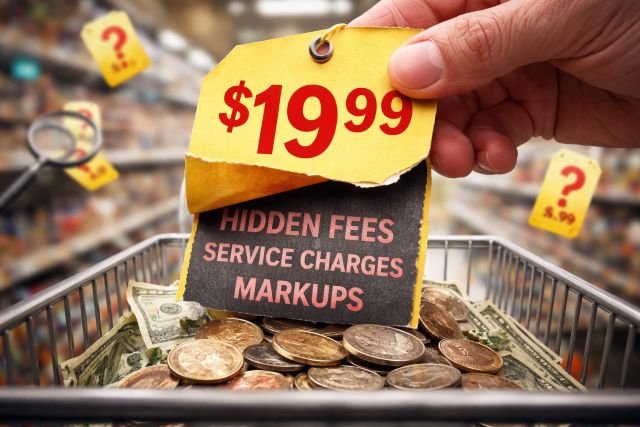
Walk into any store and the deal seems obvious: bold price tags on shelves, end caps, and signs that look like they tell the full story. In reality, that number is often only the opening line. The final cost can creep up through late-added fees, smaller package sizes, confusing comparisons, and subtle psychology that makes a price “feel” cheaper than it is.
- What “hidden costs” really mean when you look at price tags
- Drip pricing: when the real total appears after you’re committed
- Shrinkflation: the price tag stays the same, but you get less
- Unit pricing: your best defense against misleading price tags
- Psychological pricing: why .99 works on your brain
- Discount theater: when the “sale” is the strategy
- Add-ons that quietly inflate the final total
- Returns and policies: the hidden cost you notice too late
- A real-world scenario: the “same price” item that costs you 14% more
- FAQs for featured snippets
- Conclusion: read price tags like a pro, not like a target
This article unpacks the hidden costs behind everyday pricing, explains why these tactics work, and shows you how to spot them quickly — without turning shopping into a full-time job.
What “hidden costs” really mean when you look at price tags
Hidden costs are anything that makes you pay more than the headline price suggests, or makes the value you receive lower than you assumed. Sometimes the extra money appears later, like fees at checkout. Sometimes it’s built into the product, like a downsized package. Sometimes it’s mental, like a discount display that anchors your perception.
Even when disclosures exist, the way information is presented matters. Research on “drip pricing” finds that revealing fees later (instead of upfront) can push consumers toward suboptimal choices and lower satisfaction, largely because people anchor on the first price they see.
Drip pricing: when the real total appears after you’re committed
Drip pricing happens when a store highlights a base price first, then reveals mandatory or quasi-mandatory charges later in the process. It’s most visible online, but versions exist in physical retail too. You might see a low headline price on an appliance display, then learn that delivery, installation, a required accessory, or an “activation” fee is necessary to actually use it the way you expected.
The hidden cost isn’t only the money. It’s also the time and mental effort you’ve already invested. Once you’ve chosen a product and imagined owning it, it’s harder to walk away — even when the final total no longer looks like a bargain.
A UK government-backed analysis notes that drip pricing can negatively affect consumer decision-making because shoppers begin with the lower base price and often proceed even after added fees raise the final cost above alternatives.
How to protect yourself from drip pricing without overthinking it
Ask for the out-the-door price before you mentally “buy in.” That means the full total you’ll pay to get the product home and working as intended. If the salesperson can’t clearly tell you what that includes, treat the purchase as incomplete information rather than a good deal.
If you’re shopping online, check the final cart total early. Don’t wait until you’ve entered your address and payment details. The earlier you see the full cost, the less anchored you are to the initial number.
Shrinkflation: the price tag stays the same, but you get less
Shrinkflation is product downsizing without a matching price drop. The shelf price might look unchanged, but the per-unit cost rises because the package contains fewer ounces, grams, sheets, or servings.
A U.S. Government Accountability Office report defines downsizing as a quantity decrease without a commensurate price drop, which raises the per-unit price. Using 2019–2024 Bureau of Labor Statistics data, GAO found downsizing contributed less than one-tenth of a percentage point to the overall consumer price increase measured over that period, partly because downsized products are a small share of items tracked in inflation measures. That finding can be true in aggregate while still feeling very real in your weekly grocery basket.
The BLS also publishes a research series designed to estimate the impact of product size changes on CPI, reflecting how seriously measurement agencies treat package resizing as a pricing phenomenon.
The fastest shrinkflation check you can do in 3 seconds
Look at net weight or net volume before you look at price. Brands often refresh packaging when they resize. A “new look” can be harmless, but it’s also a common moment for “same price, smaller package” moves.
If you regularly buy the same item, take a quick photo of the old size and price in your phone once. That single reference can save you money for months.
Unit pricing: your best defense against misleading price tags
Unit pricing is the small “price per ounce,” “price per 100g,” or “price per count” number that makes comparisons easier. When it’s consistent and readable, it’s one of the strongest tools a shopper has — especially against shrinkflation and confusing multi-pack deals.
NIST’s Unit Pricing Guide explains that best practices are meant to improve accuracy and usability and encourage uniformity in unit pricing across formats, including e-commerce. NIST has also emphasized that uniform unit pricing helps shoppers compare value and is particularly helpful with package downsizing.
Where unit pricing can still trick you
Unit prices aren’t always apples-to-apples. One shelf label might show “per ounce” while the next shows “per 100g,” and your brain can’t reliably convert under time pressure. Retailers don’t need to “hide” anything for this to create a hidden cost; inconsistency alone is enough to weaken your ability to compare.
When unit pricing is tiny, missing, or inconsistent, slow down for one comparison only: the product you’re most likely to buy. You don’t need to do this for everything — just your top habitual purchases where small increases compound.
Psychological pricing: why .99 works on your brain
A common hidden cost isn’t a fee or a smaller package. It’s a perception shift created by the way prices are written on price tags.
Left-digit bias and nine-ending prices
A price like $9.99 can feel meaningfully cheaper than $10.00 because people process numbers left-to-right and overweight the leftmost digit. Classic work describes this “left-digit effect” as the change in the left digit driving perceived magnitude, not the one-cent difference.
More recent research continues to analyze how strong left-digit bias can be and how firms price around it. One paper estimates that consumers may respond to a one-cent increase from a ninety-nine-ending price as if it were a much larger increase.
There’s also ongoing debate about when psychological pricing is strongest. Reviews summarize that nine-ending effects vary by context and how consumers evaluate prices, rather than being a universal magic trick that always works the same way.
A simple way to “turn off” .99 pricing while shopping
Mentally round up. If your brain wants to treat $19.99 as “nineteen,” you treat it as “twenty.” This is not about being cynical; it’s about forcing your budget math to be honest.
If you’re shopping with a fixed total in mind, rounding up makes your estimate more accurate and reduces end-of-trip surprises.
Discount theater: when the “sale” is the strategy
Some “hidden costs” show up as the opportunity cost of believing a discount that isn’t as meaningful as it appears. A big “Was $100, Now $59” sign can anchor your sense of value, even if the item is rarely sold at $100.
This isn’t always deceptive; pricing is complicated, and manufacturers’ suggested prices exist. But from a shopper’s perspective, the danger is making a decision based on the crossed-out number instead of the real comparison: how this product stacks up against similar alternatives today.
If you keep seeing the same product “on sale,” treat that sale price as the real price and judge it against competitors or unit price. The feeling of “winning” a discount should never be your main reason to buy.
Add-ons that quietly inflate the final total
Hidden costs often appear at the last moment, when you’re tired, rushed, or already committed.
Extended warranties and protection plans
Protection plans can be helpful in a narrow set of cases, like expensive electronics with high repair costs. But they are also commonly offered because they generate margin.
Your best defense is deciding your rule before the checkout moment. If you wait until the cashier asks, you’re deciding under pressure.
A useful rule is to ask whether the potential repair or replacement cost would meaningfully harm your budget. If the answer is no, the plan is usually a convenience purchase, not a value purchase.
Accessories that are effectively required
A device that’s “cheap” can become expensive once you add the cable, adapter, cartridge, filter, case, battery, or specialized consumable that makes it usable long-term.
These aren’t always malicious; sometimes it’s just ecosystem design. But it still creates a hidden cost if the shelf price tag doesn’t signal the true cost of ownership.
If you want a quick reality check, search the replacement consumable price and do one mental multiplication: how many times per year you’ll buy it. That’s your real ownership cost.
Subscriptions and “free trials” attached to purchases
Increasingly, products and services include trials that convert into paid subscriptions. The initial price tag may be fair, but the ongoing costs are where you can lose money quietly.
Make a habit of checking receipts and account pages right after purchase. If you don’t want the subscription, cancel immediately. Waiting until the last day often means forgetting.
Returns and policies: the hidden cost you notice too late
Return policies matter most when something goes wrong, which is exactly why they’re easy to ignore in the moment.
Restocking fees, short return windows, store credit instead of refunds, and return shipping can turn a “great deal” into a bad one. The hidden cost here is risk. If you’re uncertain about fit, compatibility, or quality, the return policy is part of the price.
For higher-priced items, take ten seconds before paying to confirm the return window and whether refunds go back to your original payment method. That tiny step can prevent expensive regret.
A real-world scenario: the “same price” item that costs you 14% more
Imagine your usual snack is $4.99 for 200g. A redesign arrives and the price tag still says $4.99, but the package is now 175g.
Your per-gram cost rises from about $0.02495 to about $0.02851. That’s roughly a 14% increase without changing the shelf price. This is why unit pricing standards and best practices exist: when unit prices are clear and consistent, these changes become harder to miss.
FAQs for featured snippets
What are hidden costs on price tags?
Hidden costs are expenses or value losses not obvious from the initial price tag, such as fees added later, required add-ons, subscriptions, shrinkflation, or pricing designs that make comparisons difficult.
What is shrinkflation?
Shrinkflation is when a product’s quantity decreases without a commensurate price drop, raising the per-unit price. GAO describes this effect and analyzes downsizing in BLS data.
What is drip pricing?
Drip pricing is a strategy where only part of a product’s price is shown upfront and additional mandatory or optional charges are revealed later in the buying process. Research finds it can lead to worse choices and lower satisfaction.
How can I spot shrinkflation quickly in a store?
Check the net weight or net volume on the package and compare it to what you’re used to buying. Then confirm the unit price on the shelf label when available.
Do .99 price tags really affect decisions?
Often, yes. Studies describe left-digit bias, where consumers overweight the leftmost digit and perceive $2.99 as much smaller than $3.00 despite the one-cent difference.
Conclusion: read price tags like a pro, not like a target
You don’t need to distrust every store, but you do need to treat price tags as a starting point, not the full truth. Hidden costs usually come from one of four places: fees that appear late, product downsizing that raises per-unit cost, confusing comparisons that slow your decision-making, and psychological pricing that nudges perception.
If you adopt only two habits, make them these: check net weight and compare unit prices. Then add one more habit — ask for the out-the-door total whenever add-ons are possible. When you do that, most of the hidden costs stores don’t want you to notice stop working on you, and your budget starts behaving the way you intended.