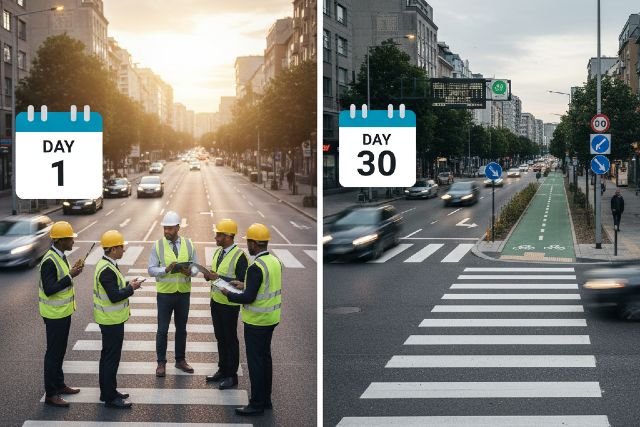
A road safety audit is one of the fastest ways to reduce crash risk on a road, intersection, or corridor without waiting for long capital projects. A well-run road safety audit turns everyday observations into a structured safety plan: you identify where people are most likely to get hurt, you recommend practical changes, and you create a clear path to implementation. That matters because road traffic injuries remain a major global public health challenge, with about 1.19 million deaths each year, and they are a leading cause of death for people aged 5–29.
This article walks you through an actionable, 30-day approach that teams can realistically complete. You will learn what a road safety audit is, how it differs from routine design checks, how to organize the work week by week, and how to produce an audit report that decision-makers can act on. Along the way, you will see real-world scenarios and quick-build examples that often fit within maintenance budgets and short timelines. The goal is simple: improve safety for drivers, pedestrians, cyclists, motorcyclists, and public transport users using a repeatable audit process.
What a road safety audit is and why it works
A Road Safety Audit, often shortened to RSA, is widely described as a formal safety performance examination of an existing or future road or intersection carried out by an independent, multidisciplinary team. The team’s job is to identify potential safety issues and opportunities for improvement for all road users. The “independent and multidisciplinary” part is not a formality. Independence reduces blind spots and confirmation bias, and a multidisciplinary lens ensures the road is examined not only for drivers, but also for pedestrians, cyclists, people with disabilities, and public transport users.
A road safety audit is also different from a standards or compliance review. A compliance review asks whether something meets a rule. An audit asks what could go wrong in the real world when humans behave imperfectly. Major guidance emphasizes that RSAs are about safety performance and practical recommendations, and that the process includes documentation and a response so improvements can be tracked.
If you want the shortest explanation of why RSAs work, it is this: the audit forces a team to see the road as users experience it. People make mistakes, misjudge speed, get distracted, or cross where it’s convenient rather than where a line was painted. A road safety audit makes these realities visible and converts them into design and operational changes. This aligns closely with Safe System thinking, which aims to prevent deaths and serious injuries by designing roads that anticipate human error and reduce the severity of crashes when they occur.
Road safety audit benefits you can achieve in 30 days
Thirty days is long enough to deliver meaningful improvements if you scope correctly. Within a month, you can build an evidence pack, run day and night field reviews, produce a prioritized risk register, and implement a first wave of quick wins. You can also deliver a formal road safety audit report that includes location-specific findings and recommended countermeasures, and you can secure a documented response from the road owner or project sponsor, which is a critical step in many RSA processes.
It helps to define success early. In a 30-day window, success usually looks like a reduction in obvious conflict points, improved visibility and guidance, safer pedestrian movements, reduced ambiguity at intersections, and a clear action plan for medium and long-term fixes. When leaders see quick wins implemented immediately, they are far more likely to fund the remaining recommendations.
How to run a road safety audit in 30 days
Week 1: Set the scope, build the team, and collect minimum viable data
The first week decides whether your audit becomes actionable or turns into an oversized report that no one implements. Start by selecting a site where change is feasible and urgent. Good candidates include intersections with recurring crashes, corridors with heavy pedestrian activity near schools or markets, locations with frequent near-misses, areas with confusing lane geometry or priority, and corridors affected by detours or roadworks.
Next, define boundaries tightly. For a 30-day audit, focus on one to three intersections or a short corridor segment where you can realistically measure, recommend, and implement improvements. Include enough upstream and downstream distance to capture decision-making zones such as merges, driveways, bus stops, and informal crossing points.
Then, build your audit team. Guidance commonly highlights independence and multidisciplinary representation. Your team should include an audit lead with road safety or traffic engineering experience, an operations or maintenance representative who knows what can be installed quickly, and perspectives that reflect vulnerable road users. If you have access to enforcement or public transport operators, their insights on behavior and stop operations can be surprisingly valuable.
Finally, compile a “minimum viable evidence pack.” Perfection is not required. Collect whatever crash data exists, even if incomplete, and summarize patterns such as crash type, severity, and time of day. Gather speed observations or credible samples, traffic volumes or turning counts if available, and land-use context that shapes exposure, such as schools, clinics, transit stops, freight routes, and nighttime activity. This information frames the field review and helps prioritize risks later.
Internal link ideas for your site can be embedded naturally here, such as a page explaining your Safe System approach, a service page for traffic engineering and signal timing, and a resource page on school zone safety improvements.
Week 2: Conduct day and night field reviews and document hazards precisely
Week two is where the road safety audit becomes real. The most common reason audits miss key risks is that teams “look” without truly “moving through” the site the way users do. During the field review, simulate each movement. Walk pedestrian desire lines rather than only marked crosswalks. Trace cyclist paths, including where cyclists may merge or ride on the shoulder. Drive each approach as a driver would, at realistic speeds, and note where the environment encourages speeding or late decision-making.
A night audit is essential for many sites. Nighttime conditions reveal lighting gaps, sign retroreflectivity issues, glare, and visibility problems that are not obvious in daylight. Major RSA guidance emphasizes considering all users and real-world conditions, and that includes observing different lighting and operating environments.
As you observe, document each hazard with a precise location reference, photos, and a short explanation of who is at risk and why. Focus your notes on safety mechanisms, not aesthetics. For example, instead of writing “intersection looks messy,” write “lane guidance unclear on approach; drivers drift between lanes; observed late lane changes near crosswalk.” That type of wording naturally supports later recommendations.
Common issues you will often uncover include excessive approach speeds driven by long straight alignments, limited sight distance from curves or roadside objects, confusing intersection priority, skewed intersection angles that reduce visibility, overly long pedestrian crossing distances, poor placement of crossings relative to desire lines, discontinuities for cyclists that force sudden merges, and roadside hazards such as rigid objects near the travel way. You will also frequently find basic maintenance issues like missing signs, faded markings, blocked sight triangles due to vegetation, and broken streetlights. These are ideal “quick wins” for a 30-day program because they are often inexpensive and high impact.
Week 3: Analyze findings, rank risks, and design quick-build recommendations
In week three, your job is to convert raw observations into a prioritized list that decision-makers can act on. Use a simple risk ranking method that combines likelihood, severity, and exposure. Likelihood reflects how often a risky conflict could occur based on traffic movement and observed behavior. Severity reflects the probable injury outcome, which tends to be higher for pedestrians and cyclists in high-speed environments. Exposure reflects how many users are affected, including vulnerable users.
Once you rank the findings, match each high or medium risk issue to a recommendation that is specific enough to implement. A strong road safety audit recommendation describes the change, where it should be applied, and why it reduces risk. It also helps to include an approximate cost band, such as maintenance-level, minor civil works, or capital project, because that supports realistic scheduling.
This is the week where quick wins should be identified clearly. Quick wins often include replacing missing or incorrect signs, adding advance warnings on high-speed approaches, refreshing stop bars and lane arrows, improving delineation on curves, trimming vegetation that blocks visibility, adjusting parking near corners to improve sight triangles, and fixing lighting failures. Operational changes can also be quick, such as signal timing adjustments, improved pedestrian phases, or changes to lane-use control signs. Where your agency or site context supports it, you can propose quick-build pedestrian safety improvements such as improved markings, temporary delineation, or painted curb extensions, as long as the recommendations are consistent with local standards and engineering judgment.
The logic behind these quick actions fits Safe System thinking: reduce speeds where conflicts exist, reduce conflict points, improve visibility and predictability, and create a more forgiving roadside.
Week 4: Write the report, secure a formal response, and launch the first implementation wave
Week four is about turning analysis into action. A typical audit report that drives implementation begins with an executive summary that lists the highest-risk issues and the top recommended actions. Then it documents the scope and context, describes the team and methodology, and presents findings with photos and clear location references. Recommendations should be grouped into near-term quick wins and longer-term engineering projects so the reader can immediately see what can happen now versus later.
A critical step that teams often skip is the formal response. Many RSA processes call for the road owner or sponsor to document whether each recommendation is accepted, accepted with modification, or rejected, with reasons. This response is valuable because it creates accountability and a record of decisions. It also prevents the audit from becoming a static document that never leads to change.
If you want momentum, pair the report delivery with an implementation kickoff. The kickoff can be short, but it should result in a defined list of tasks, responsible owners, and target dates. Even if only a handful of quick wins are installed immediately, the visible improvements build trust and make it easier to fund bigger upgrades.
Real-world scenarios that show what “30 days” looks like
Imagine a school-area corridor where parents and students cross informally because the marked crosswalk is not where people want to go. In daylight, the crossing looks fine, but you observe drivers approaching quickly and parking near the corner that blocks sightlines. During the audit, your team documents the crossing desire line, notes the sight triangle obstruction, and observes that drivers often brake late. In a 30-day window, you can refresh markings, improve advance warning, daylight the corner by restricting parking near the crossing, and implement temporary curb extensions or delineation where feasible. The safety mechanism is straightforward: pedestrians become more visible, crossing distance is reduced, and drivers receive clearer cues earlier.
Now consider a rural curve with run-off-road risk. The site has poor delineation, narrow shoulders, and fixed objects near the travel way. You may not rebuild the curve in 30 days, but you can improve guidance with chevrons and enhanced edge lines, clear vegetation to improve sight distance, add delineators, and plan for longer-term barrier or shoulder improvements. The short-term changes reduce surprise and improve lane tracking, while the long-term plan addresses roadside severity.
These scenarios illustrate an important truth: a road safety audit is not only about finding problems; it is about sequencing solutions so that immediate risk reduction happens now while larger investments are justified and scheduled.
FAQ style answers for featured snippets
What is a road safety audit?
A road safety audit is a formal safety performance examination of a road or intersection by an independent, multidisciplinary team that identifies safety risks and recommends improvements for all road users.
How long does a road safety audit take?
A tightly scoped audit of one to three intersections or a short corridor segment can often be completed in about 30 days, including scoping, day and night field reviews, risk ranking, reporting, and an implementation-ready action list, especially when quick wins are prioritized.
Who should be included on an audit team?
Audit teams typically include a road safety or traffic engineer, people independent of the original design or operations decisions, maintenance representatives, and perspectives that reflect pedestrian, cyclist, accessibility, and public transport needs. Major guidance emphasizes independence and multidisciplinary review.
Are road safety audits only for new road projects?
No. Road safety audits can be applied to existing roads and intersections as well as projects at different stages, depending on the agency’s program and needs.
Conclusion
A road safety audit is one of the most effective ways to identify and reduce crash risk quickly because it turns real-world observation into implementable changes. In 30 days, you can scope a manageable site, assemble an independent team, conduct day and night field reviews, rank risks, and deliver recommendations that crews can build. The biggest difference between an audit that helps and an audit that gathers dust is follow-through, which is why a formal report and a documented response matter so much in established RSA processes.
If you want, tell me the setting you’re writing for, such as an urban intersection, school zone, rural highway curve, or work zone detour, and I’ll rewrite this into a version tailored to that specific context while keeping it fully SEO-optimized around “road safety audit.”