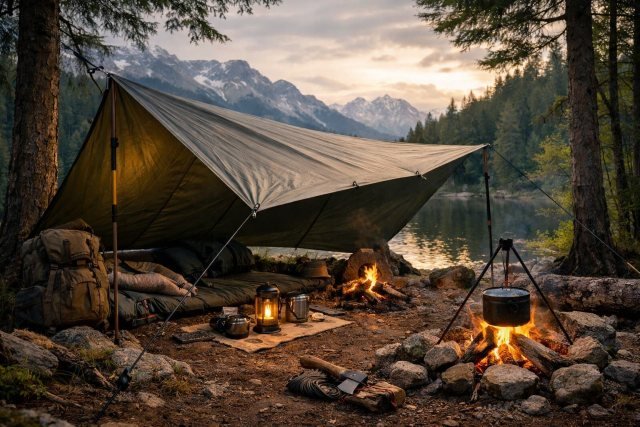
If you spend time outdoors, a Tarnplanen can be one of the most useful, low-profile pieces of kit you own. In plain terms, Tarnplanen are camouflage tarps (the word is commonly used as a German-style term for camo “tarpaulins”) that help you create shelter, stay dry, block wind, protect gear, and blend into your surroundings when needed. Whether you’re camping in the rain, practicing bushcraft, setting up a hunting blind, or building an emergency survival setup, a well-chosen Tarnplanen can replace multiple single-purpose items.
- What is a Tarnplanen?
- Why use a Tarnplanen for camping and survival?
- Tarnplanen materials: what matters (and what’s marketing)
- Choosing the right Tarnplanen: size, tie-outs, and camouflage pattern
- Tarnplanen setup basics (that stop 90% of failures)
- 5 proven Tarnplanen shelter configurations
- Waterproofing, condensation, and the “my tarp is leaking” myth
- Care and maintenance: make your Tarnplanen last
- Real-world scenarios: when Tarnplanen shines
- FAQs
- Conclusion: choosing the right Tarnplanen
How Tarnplanen work, how to pick the right material and size, practical pitching methods, and what experienced outdoors people do to avoid the common “tarp fails” (sagging fabric, water pooling, ripped tie-outs, and condensation).
What is a Tarnplanen?
A Tarnplanen is a camouflage-pattern tarp designed for outdoor use — typically as a rain fly, lean-to, groundsheet, gear cover, concealment screen, or improvised shelter. The “tarn” part refers to camouflage/concealment, while “planen” is associated with tarp/sheet/cover in German-style usage.
In practice, Tarnplanen overlap with categories like:
- Camping tarps / backpacking tarps
- Bushcraft tarps
- Tactical tarps
- Military ponchos used as shelters (many have grommets/snaps specifically to convert into a shelter)
The big difference is intent: Tarnplanen often prioritize low visibility and multi-use field practicality (quiet fabric, subdued colors, lots of tie points, repairability) instead of bright “camp comfort” aesthetics.
Why use a Tarnplanen for camping and survival?
A tarp seems simple until weather turns. Wind plus rain can pull warmth from your body fast, especially if you’re underdressed or your insulation gets wet. Public safety guidance on cold exposure emphasizes that hypothermia is dangerous and can occur in cold, wet, and windy conditions — sometimes in temperatures people underestimate.
A Tarnplanen helps you manage the three problems that make bad nights (and bad outcomes):
1) Rain management (staying dry)
A tarp roof keeps precipitation off your body and gear, and it also helps keep your insulation dry so it can actually insulate.
2) Wind management (reducing heat loss)
Wind increases heat loss from your body; the National Weather Service explains wind chill as the rate of heat loss in cold, windy weather.
A properly pitched tarp becomes a windbreak — often more important than “thicker” sleeping gear if your shelter is exposed.
3) Versatility (one item, many roles)
A quality Tarnplanen can serve as:
- Roof (A-frame, lean-to, plow-point)
- Groundsheet
- Gear cover / pack cover
- Privacy screen
- Water collection surface (in a pinch)
- Concealment for observation or hunting setups
Some military-style ponchos are explicitly designed for multiple shelter uses and include grommets/snaps for modular setup.
Tarnplanen materials: what matters (and what’s marketing)
Material choice determines durability, weight, noise, waterproofing, and how annoying it is to pitch in real weather.
Ripstop nylon (often PU-coated)
This is common in “tactical” and “poncho tarp” style gear: light, packable, and reasonably tough for its weight. Many military-style ponchos are polyurethane-coated ripstop nylon and include features intended for shelter conversion.
Best for: backpacking, fast shelters, emergency kits
Watch-outs: can be slippery; cheaper coatings can delaminate over time
Polyester (often PU-coated)
Polyester generally stretches less than nylon when wet, so it can hold a tighter pitch with less sagging in rain.
Best for: set-and-forget camps, wet climates, longer stays
Watch-outs: can be bulkier at the same strength
Polyethylene (classic “blue tarp” style, sometimes camo)
Usually inexpensive and very waterproof, but bulkier and louder. Grommets can tear out unless reinforced.
Best for: budget vehicle kit, car camping, base camp
Watch-outs: noisy in wind; lower longevity under UV
Canvas / polycotton tarps (less common but loved in bushcraft)
Quieter and often more abrasion resistant; can be more comfortable in condensation-prone conditions — but heavier.
Best for: bushcraft, woodland camps, longer-term shelters
Watch-outs: weight and drying time
Choosing the right Tarnplanen: size, tie-outs, and camouflage pattern
Size: pick based on coverage, not labels
A tarp that’s “almost big enough” is the one that fails when weather turns sideways.
A practical way to choose:
- Solo + minimal gear: ~2.5×3 m (or similar)
- Solo + gear + bad-weather margin: ~3×3 m
- 2 people: ~3×4 m (or larger)
- Group / basecamp: go bigger, or use two tarps modularly
If your Tarnplanen is also a poncho tarp, note that common poncho dimensions are often optimized for wearable coverage first, shelter second. Many products list an “as tarp” dimension (for example, some ponchos expand to larger coverage when laid flat).
Tie-out points: more is usually better
Look for:
- Reinforced corners
- Multiple edge tie-outs (not just 4 corners)
- Strong stitching or bonded reinforcement patches
- Quality grommets and/or sewn webbing loops
The difference between a beginner tarp and a “trust it in a storm” tarp is often the reinforcement around tie-outs.
Camouflage pattern: match the terrain (and be ethical)
Common patterns include woodland, multicam-style, snow/winter, and desert. Pick what fits your environment and consider where you camp.
Also: in many places, “camouflage” in public land contexts can cause misunderstandings. Use common sense, be visible where safety requires it (near roads, during hunting seasons, crowded trails), and follow local regulations.
Tarnplanen setup basics (that stop 90% of failures)
A tarp is only as good as its pitch. Here are the principles that matter most.
Site selection and environmental impact
Before you even tie a knot, think about where you’re pitching. Leave No Trace guidance (also echoed by the U.S. National Park Service) emphasizes planning ahead, using durable surfaces, and minimizing impacts.
Practical takeaway: choose a durable, already-impacted site when possible, and avoid trampling fragile vegetation just to get the “perfect” tarp angle.
Tarp angle: steep beats wide in real rain
If you pitch a Tarnplanen too flat, water pools and wind drives rain underneath. A steeper angle sheds water better and reduces sag.
Tension: expect stretch, then re-tension
Many fabrics relax after a few minutes, especially in damp conditions. Pitch it, wait 10–15 minutes, then tighten lines again.
Drip lines: the tiny trick that keeps you dry
If rain is running down your ridgeline into your shelter, tie a small piece of cord (or even a strip of cloth) onto the line just before it reaches the tarp edge. Water runs down the line, hits the drip line, and falls off — away from your sleeping area.
5 proven Tarnplanen shelter configurations
Below are field-proven pitches you’ll actually reuse.
1) A-frame (ridgeline tarp)
The classic: strong in rain, good coverage, easy to vent.
Best for: general camping, wet conditions
Common mistake: pitching too high so wind blows rain in
2) Lean-to (fast windbreak)
Open front, protected back. Great when you want a fire in front (where permitted) and quick setup.
Best for: mild weather, quick stops
Common mistake: facing the opening into the wind
3) Plow point (storm mode)
One corner high, opposite corner staked low — excellent for wind and driving rain.
Best for: bad weather, exposed areas
Common mistake: forgetting ventilation and waking up to condensation
4) Diamond fly (minimalist)
Great coverage for weight if you’re using a square tarp.
Best for: ultralight setups
Common mistake: underestimating sideways rain
5) Groundsheet + rain fly combo (two-layer thinking)
If you have a second small sheet (or poncho tarp), a ground layer protects from abrasion and moisture while the main Tarnplanen is your roof.
Best for: long trips, rough ground
Common mistake: making the groundsheet bigger than the roof edge so it catches runoff
Waterproofing, condensation, and the “my tarp is leaking” myth
Many “leaks” aren’t fabric failure — they’re physics.
Condensation vs leaks
Warm, moist air from breathing hits a cooler tarp surface and condenses into droplets. You wake up, touch the tarp, and it “rains” inside.
Fix: increase airflow, pitch higher on one side, or add a small vent gap.
Wind-driven rain
If the wind is pushing rain under your tarp edge, you’ll feel like it’s leaking.
Fix: lower the windward edge, rotate the pitch, use a plow-point, or add a side wall with a second line.
Seam and tie-out issues
If water is wicking through stitching, seam sealing can help (on gear that isn’t factory seam-taped).
Care and maintenance: make your Tarnplanen last
A Tarnplanen is simple gear, but small habits extend its life a lot:
- Dry it fully before long storage (prevents mildew and odor).
- Avoid UV baking for days at a time; sun is a slow tarp killer.
- Clean gently with water and mild soap; harsh chemicals can damage coatings.
- Repair early: tiny punctures become long tears in wind.
Carry a small repair kit: tape appropriate to your fabric, a needle/thread, and a spare guyline.
Real-world scenarios: when Tarnplanen shines
Scenario 1: Surprise cold rain at 3 PM
You’re hiking, temps drop, and you’re wet. Public health guidance warns hypothermia is dangerous and prevention matters — staying dry and reducing exposure are key themes.
A quick plow-point pitch with a Tarnplanen can create immediate shelter to change layers, eat, and regain warmth.
Scenario 2: Long camp in windy terrain
You can have a warm sleeping bag and still freeze if wind strips heat away. The wind chill concept is specifically about how wind increases heat loss.
A low, tight A-frame with the windward side close to the ground is the “cheap upgrade” many people skip.
Scenario 3: Low-profile wildlife observation or hunting
A camo tarp used as a screen (not fully enclosed) can break up your outline. Done responsibly and legally, it’s a practical use case for Tarnplanen beyond pure camping.
FAQs
What does “Tarnplanen” mean?
“Tarnplanen” commonly refers to camouflage tarps used for concealment and protection outdoors. They’re popular for camping, survival, bushcraft, and tactical-style use.
Is a Tarnplanen better than a tent?
It depends. A Tarnplanen is lighter, more versatile, and faster to deploy, but it offers less bug protection and privacy than most tents. Many campers use a tarp + bug net as a modular alternative.
How do I stop water pooling on my Tarnplanen?
Pitch it with a steeper angle, increase tension, add more tie-out points if available, and avoid flat roof sections. Re-tension after fabric relaxes in humidity.
Can a Tarnplanen help prevent hypothermia?
A tarp can reduce exposure to rain and wind — two factors that increase heat loss — so it can be an important part of staying safe in cold/wet conditions. Always pair shelter with dry layers, food, and smart decision-making.
What size Tarnplanen should I buy for one person?
For most solo campers, a 3×3 m class tarp is a comfortable all-around choice because it gives storm margin. Smaller can work, but errors in pitch and shifting wind become less forgiving.
Conclusion: choosing the right Tarnplanen
A Tarnplanen isn’t just “a camo tarp” — it’s a flexible shelter system that rewards good technique. Choose the right material for your style, prioritize reinforced tie-outs, size up for bad weather, and practice a couple of storm-ready pitches before you need them. Combine that with responsible campsite choices aligned with Leave No Trace principles, and you’ll have a setup that’s lighter, simpler, and more adaptable than many traditional shelter options.