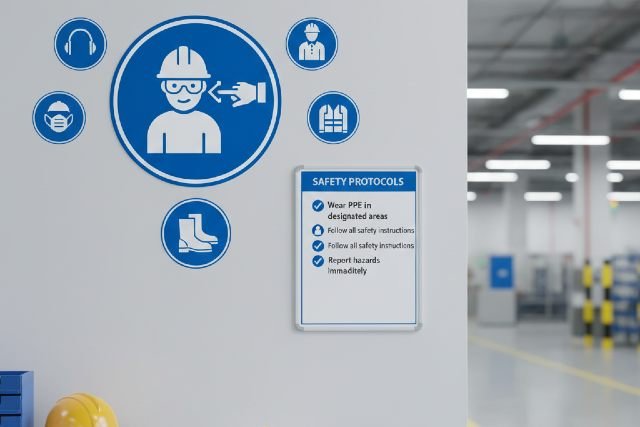
A mandatory sign is a safety sign that clearly tells people what they must do to stay safe and comply with workplace rules. You will commonly see a mandatory sign in industrial workplaces, construction areas, laboratories, warehouses, and public environments where protective actions are required. These signs matter because they reduce injuries, improve safety behavior, and support compliance audits. Internationally, mandatory signs often follow ISO 7010 conventions, which typically use a blue circular sign with a white pictogram to represent required actions.
- What Does a Mandatory Sign Mean?
- Mandatory Sign vs Warning Sign vs Prohibition Sign
- Why Mandatory Signs Matter
- Mandatory Sign Standards You Should Know
- Where Mandatory Signs Are Used
- Mandatory Sign Requirements: What Makes a Sign Compliant?
- Mandatory Sign Placement: How to Get It Right
- How Many Mandatory Signs Should You Use?
- Choosing the Right Material for Mandatory Signs
- Mandatory Sign and PPE Compliance: A Practical Safety System
- Case Scenario: How Mandatory Signs Prevent Incidents
- Common Mistakes to Avoid with Mandatory Signs
- Mandatory Sign Inspection Checklist
- FAQ: Mandatory Sign Questions
- Conclusion: Mandatory Signs Improve Safety and Strengthen Compliance
What Does a Mandatory Sign Mean?
A mandatory sign means a specific action is required and not optional. It communicates a direct instruction that must be followed to reduce risk. In practice, mandatory signs commonly require people to wear protective equipment, use safety features, follow hygiene procedures, or perform a particular operational step. ISO 7010 defines multiple mandatory action symbols so that these instructions remain consistent across languages and industries.
Mandatory Sign vs Warning Sign vs Prohibition Sign
Mandatory signs are often confused with other safety signage categories, and that confusion can weaken safety communication. A mandatory sign tells people what they must do, usually presented as a blue circle with a white pictogram under ISO conventions. A warning sign alerts people that a hazard is present and is often a yellow triangle. A prohibition sign tells people what they must not do and is commonly a red circle with a diagonal slash. ISO 7010 reinforces these differences through consistent shape and color rules so people recognize meaning instantly.
Why Mandatory Signs Matter
Mandatory signs are not decorative compliance items; they are practical safety controls that reinforce required actions in the exact location where risk exists. When employees and visitors follow these instructions, incidents can be reduced and safety culture improves. This matters because workplace injuries and fatalities have serious personal consequences and large economic costs. The National Safety Council estimates that the total economic cost of work-related injuries and deaths in the United States reached $176.5 billion in 2023, including productivity losses, medical expenses, and other impacts.
Mandatory signs also help organizations meet safety requirements and demonstrate due diligence. In the United States, OSHA provides specifications and guidance for accident prevention signs and tags under 29 CFR 1910.145, and workplaces are expected to communicate hazards effectively.
Mandatory Sign Standards You Should Know
Mandatory sign compliance depends on the rules and standards applied in your country and industry. ISO 7010 is one of the most widely recognized international standards for safety symbols. It aims to create universally understood safety messages by using standardized pictograms, shape rules, and consistent colors. Under ISO 7010, mandatory signs typically appear as blue circles with white pictograms that communicate required behavior.
In the U.S., OSHA 29 CFR 1910.145 outlines the specifications and guidance around accident prevention signs and tags. While OSHA signage conventions differ from ISO design formats, OSHA focuses heavily on whether signage effectively communicates hazards and necessary actions.
ANSI Z535 standards are commonly used in North America and provide guidelines for sign layouts, color use, safety headers, and message clarity. Many multinational workplaces adopt ANSI Z535 as a best-practice framework even when ISO pictograms are used. The National Electrical Manufacturers Association provides a helpful overview of the ANSI Z535 series, which includes multiple standards covering signs, labels, and safety communication principles.
Where Mandatory Signs Are Used
A mandatory sign is used anywhere a specific behavior must be followed to protect people, equipment, or hygiene conditions. Common areas include PPE stations, machine operation zones, laboratory entrances, construction site access points, chemical storage rooms, electrical control panels, warehouses, and loading bays. In food production, mandatory signs often appear near handwashing sinks and protective clothing stations. In laboratories, mandatory signs commonly require gloves, lab coats, and face shields. In construction, mandatory signs frequently instruct workers to wear helmets, harnesses, and high-visibility clothing.
Mandatory Sign Requirements: What Makes a Sign Compliant?
A mandatory sign is compliant when it communicates a required action clearly, remains visible, and meets design conventions for recognition and readability. Under ISO conventions, compliance is strongly tied to using the correct blue circular format and recognized pictograms. A sign should be high contrast, durable enough for the environment, and sized properly for the viewing distance. Text can be used, but it should support the symbol rather than replace it, especially because pictograms improve comprehension across multilingual workplaces.
Mandatory Sign Placement: How to Get It Right
Placement is one of the most overlooked factors in mandatory sign effectiveness. The best rule is that signage should appear where decisions happen. A mandatory sign should be installed at the entrance of a controlled area and again at the point where the action is required. It should be positioned at eye level where possible, remain unobstructed, and be visible in typical lighting conditions. Mandatory PPE signs, for example, should appear at facility entrances, work zone entry points, and next to the actual equipment that creates the risk. When signs are placed too far away, hidden behind doors, or blended into cluttered sign walls, workers stop noticing them.
How Many Mandatory Signs Should You Use?
Mandatory signs work best when signage is meaningful and not excessive. One of the biggest hazards in safety communication is sign overload. When walls contain too many instructions, people become desensitized and ignore everything. A better strategy is to prioritize one clear mandatory sign at entry points, add secondary signs only where requirements change, and avoid repeating the same sign every few meters unless the environment is large or complex. This keeps attention focused and improves compliance behavior.
Choosing the Right Material for Mandatory Signs
Material selection influences durability and legibility. Indoor offices and clean environments can use PVC or vinyl signage with good print quality. Industrial and outdoor environments typically require aluminum or rigid plastic, along with UV-resistant inks to prevent fading. High-moisture environments such as washdown food processing facilities require chemical-resistant materials and strong adhesives. In areas with low lighting or emergency relevance, photoluminescent signs improve visibility. If vehicles or outdoor work zones are involved, reflective signs are often preferred.
Mandatory Sign and PPE Compliance: A Practical Safety System
Mandatory signs are most powerful when they are part of a complete compliance system. First, the organization performs a risk assessment to define which PPE or safety actions are required. Next, mandatory signs are installed at entry points and at the point of use. Then, PPE must be available nearby so the sign instruction is easy to follow. Finally, training and routine audits ensure that signs remain meaningful and behavior stays consistent. This system prevents the common failure where signs exist but PPE is missing, or where workers don’t understand the meaning behind the symbols.
Case Scenario: How Mandatory Signs Prevent Incidents
Consider a warehouse where staff regularly handle pallets and heavy items. The facility has a safety footwear policy, but injuries still happen because visitors and new staff do not follow the rule. After reviewing incident data, management installs mandatory “Wear safety footwear” signs at every entry point, adds short supporting text for clarity, and includes sign meaning in onboarding training. They also ensure spare safety footwear is available for contractors. Compliance increases and incidents decrease because the instruction is visible, reinforced, and practical.
Common Mistakes to Avoid with Mandatory Signs
A common mistake is using the wrong sign type, such as a warning sign instead of a mandatory sign. Another frequent issue is poor placement, where the sign is hidden or posted too late after the hazard begins. Many facilities also use long text-heavy signs that people don’t read, or low-quality printing that fades and becomes illegible. Perhaps the most damaging mistake is installing signs without training support, which leads to workers viewing signage as background noise rather than essential safety guidance.
Mandatory Sign Inspection Checklist
A strong compliance program includes routine sign inspections. A sign review should confirm the sign is visible, correct for the hazard, undamaged, and clearly readable from the correct distance. Workers should be able to understand the meaning, and required PPE or safety resources should be available nearby. Signs must also be updated when layouts, processes, or hazards change. This prevents outdated instructions that could mislead workers and create compliance gaps.
FAQ: Mandatory Sign Questions
What is a mandatory sign?
A mandatory sign is a safety sign that tells people what action must be taken, such as wearing PPE or following a required procedure.
What color is a mandatory sign?
Under ISO safety sign conventions, a mandatory sign is usually a blue circular sign with a white pictogram that indicates a required action.
Where should mandatory signs be placed?
Mandatory signs should be placed at entry points to controlled zones, at the point where action is required, and before the risk begins. They should remain visible, well-lit, and unobstructed.
Are mandatory signs required by OSHA?
OSHA expects workplaces to communicate hazards effectively and provides specifications and guidance for accident prevention signs and tags under 29 CFR 1910.145. The key requirement is that signs must effectively communicate necessary actions and hazards.
What is ISO 7010 and why does it matter?
ISO 7010 is an international standard that defines safety symbols intended to be universally understood, helping workplaces communicate safety requirements consistently across languages.
Conclusion: Mandatory Signs Improve Safety and Strengthen Compliance
A mandatory sign is one of the most effective tools for improving safety, supporting compliance, and preventing workplace injuries. When designed according to recognized standards such as ISO 7010 and aligned with regional guidance such as OSHA and ANSI frameworks, these signs provide clear instruction that reduces confusion and reinforces safety behavior. The most successful safety programs use mandatory signage as part of a system that includes training, PPE availability, audits, and continuous improvement. With workplace injury costs reaching $176.5 billion in 2023, improving compliance through clear mandatory signs is not only a regulatory responsibility but also a smart operational investment.