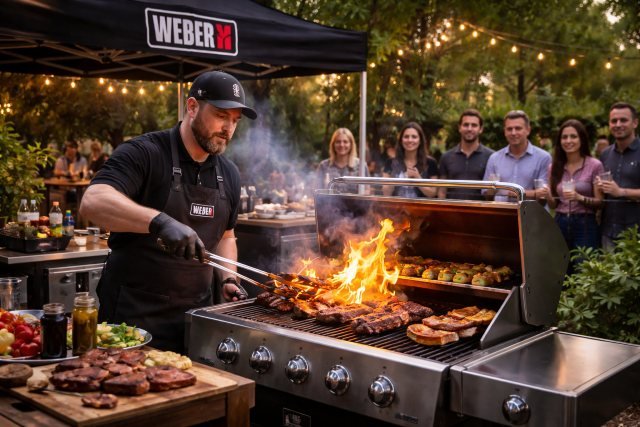
A Weber Grillvorführung is more than a simple grill demo. It’s a live masterclass in heat control, timing, and flavor development. Whether you’re using a Weber charcoal kettle, gas grill, or electric model, watching professional techniques in action can instantly elevate your barbecue results.
- What Is a Weber Grillvorführung?
- Why a Weber Grillvorführung Instantly Improves Your BBQ Skills
- 1. Mastering Two-Zone Heat Control
- 2. Lid Management: Turning Your Grill into a Convection Oven
- 3. Understanding the Maillard Reaction
- 4. Cooking by Internal Temperature, Not Guesswork
- 5. Clean Setup and Controlled Workflow
- Gas Grill Two-Zone Setup
- Charcoal Grill Two-Zone Setup
- Reverse Sear Method
- Wood Smoke Enhancement
- Airflow Management
The secret isn’t expensive equipment or complicated recipes. It’s understanding heat zones, lid management, the Maillard reaction, proper internal temperatures, and workflow discipline. In this detailed guide, you’ll learn how to apply the same techniques showcased in a Weber Grillvorführung to dramatically improve your BBQ at home.
What Is a Weber Grillvorführung?
A Weber Grillvorführung is a professional grilling demonstration — often hosted in stores, events, or training workshops — where experts showcase advanced Weber grilling techniques. These sessions focus on practical skills rather than theory, helping grillers understand:
- Direct vs. indirect heat
- Two-zone grilling setups
- Lid control for convection cooking
- Searing and flavor development
- Internal temperature accuracy
- Food safety best practices
According to Weber’s official grilling guides, mastering direct and indirect heat zones is foundational for consistent results.
The goal isn’t just to cook — it’s to cook with control.
Why a Weber Grillvorführung Instantly Improves Your BBQ Skills
Most backyard grillers rely on instinct. Professionals rely on process.
When you watch a Weber Grillvorführung, you see:
- Structured grill setup before food hits the grate
- Controlled heat adjustments
- Strategic lid usage
- Thermometer-based cooking
- Clean workflow and timing discipline
These small adjustments compound into dramatically better flavor, texture, and consistency.
The 5 Pro Techniques from a Weber Grillvorführung
1. Mastering Two-Zone Heat Control
The single biggest upgrade you can make is using two heat zones.
In a Weber Grillvorführung, professionals almost always set up:
- A direct heat zone (high heat for searing)
- An indirect heat zone (moderate heat for finishing)
Weber emphasizes this method as a core grilling principle.
Why This Works
Direct heat builds crust and flavor through the Maillard reaction.
Indirect heat gently brings the internal temperature up without burning the exterior.
Example: Steak Workflow
- Sear 60–90 seconds per side over direct heat.
- Move to indirect heat.
- Close the lid.
- Cook to target internal temperature.
Result: Even doneness with a perfect crust.
2. Lid Management: Turning Your Grill into a Convection Oven
During a Weber Grillvorführung, you’ll notice the lid stays closed more often than expected.
Why?
Because closing the lid creates convection heat, circulating hot air evenly around the food. This is especially critical for:
- Thick steaks
- Whole chicken
- Ribs
- Large roasts
According to Weber’s official grilling technique documentation, lid control improves heat consistency and cooking efficiency.
Pro Tip
If your food is browning too fast but undercooked inside:
Move it to indirect heat and close the lid.
This prevents surface burning while finishing internally.
3. Understanding the Maillard Reaction
One of the most valuable lessons in a Weber Grillvorführung is how to intentionally create better browning.
The Maillard reaction is the chemical process that creates deep brown crusts and complex flavors when proteins and sugars react under heat. Food science sources explain that this reaction intensifies above roughly 300°F (150°C).
How Pros Trigger It
- Pat meat dry before grilling
- Preheat grill thoroughly
- Avoid flipping too early
- Do not press burgers down
Moisture prevents browning because water must evaporate before searing can begin.
Case Study: Burger Upgrade
Amateur mistake: Pressing burgers for faster browning.
Pro method: High heat, short sear, then indirect finish.
Result: Better crust, juicier interior.
4. Cooking by Internal Temperature, Not Guesswork
In every Weber Grillvorführung, a thermometer is used consistently.
Why? Because visual cues are unreliable.
The USDA recommends using a food thermometer to ensure safe internal temperatures rather than judging by color.
Recommended Minimum Internal Temperatures
According to FoodSafety.gov:
- Poultry: 165°F (74°C)
- Ground beef: 160°F (71°C)
- Beef steaks: 145°F (63°C) + rest time
- Fish: 145°F (63°C)
Using a thermometer improves both food safety and texture control.
5. Clean Setup and Controlled Workflow
Professional grillers prepare before cooking begins.
The CDC outlines food safety fundamentals as “Clean, Separate, Cook, Chill” (CDC Food Safety:
In a Weber Grillvorführung, you’ll notice:
- Clean grates
- Organized prep areas
- Separate tools for raw and cooked foods
- Controlled timing
A clean grill also improves searing performance by ensuring better surface contact.
Recreating a Weber Grillvorführung at Home
Gas Grill Two-Zone Setup
- Preheat grill for 10–15 minutes.
- Turn off center burners.
- Leave outer burners on medium.
- Place food in center for indirect cooking.
This mirrors the professional Weber setup described in their grill method documentation (Weber.com).
Charcoal Grill Two-Zone Setup
- Arrange charcoal on one side.
- Leave opposite side empty.
- Adjust vents for airflow control.
- Close lid during indirect cooking.
This simple configuration gives you professional-level control.
Common Mistakes Professionals Avoid
Not Preheating Long Enough
A hot grill prevents sticking and enhances browning.
Using Only Direct Heat
Everything doesn’t need maximum flame.
Adding Sauce Too Early
Sugar burns quickly. Apply BBQ sauce near the end.
Skipping Rest Time
Allow meat to rest so juices redistribute.
Advanced Pro Techniques You’ll See in a Weber Grillvorführung
Reverse Sear Method
- Cook indirectly first.
- Finish with high-heat sear.
- Achieve edge-to-edge doneness.
Wood Smoke Enhancement
Adding wood chunks to charcoal builds subtle smoke flavor without overpowering the protein.
Airflow Management
On charcoal grills, vent adjustments regulate temperature more precisely than adding more fuel mid-cook.
FAQs – Weber Grillvorführung
What does “direct vs indirect grilling” mean?
Direct grilling places food over the heat source for quick searing. Indirect grilling places food beside the heat source for slower, even cooking.
Why do professionals keep the lid closed?
Closing the lid creates convection heat, improving temperature stability and even cooking.
Do I really need a grill thermometer?
Yes. Food safety authorities recommend cooking by internal temperature rather than appearance (USDA).
How do I get steakhouse-quality crust?
Dry the surface, preheat thoroughly, and use high direct heat before finishing indirectly.
Conclusion: Why a Weber Grillvorführung Changes the Way You Grill
A Weber Grillvorführung isn’t about flashy tricks. It’s about mastering heat control, workflow discipline, lid management, and temperature accuracy.
When you shift from guesswork to structured technique, your BBQ improves immediately. Steaks become juicier. Chicken cooks evenly. Burgers develop deeper crust. Results become consistent.
The real takeaway from any Weber Grillvorführung is this:
Professional grilling is not about intensity — it’s about control.
And once you understand that, your backyard BBQ will never be the same.