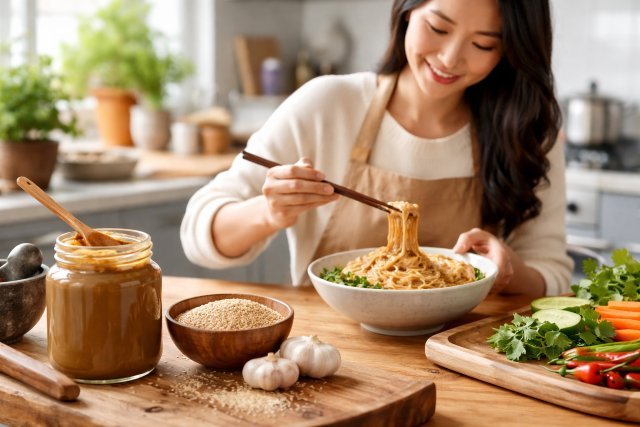
Chinese Sesame Paste is one of those ingredients that instantly changes a dish. It is deep, nutty, roasted, slightly bitter, creamy, and intensely aromatic. In Chinese cooking, it has long been valued for the richness it brings to noodle sauces, dipping sauces, dressings, and even sweets. Unlike many trendy pantry ingredients that come and go, this paste has real culinary history and remarkable versatility. Traditional cooks use it for flavor and body, while modern home cooks are finding new ways to work it into quick meals, fusion recipes, and healthier homemade sauces.
- What Is Chinese Sesame Paste?
- Chinese Sesame Paste vs. Tahini
- Why Chinese Sesame Paste Matters in Traditional Cooking
- Chinese Sesame Paste Nutrition and Health Perspective
- How Chinese Sesame Paste Is Used Traditionally
- Modern Uses for Chinese Sesame Paste
- How to Buy Good Chinese Sesame Paste
- Storage Tips and Homemade Option
- Common Questions About Chinese Sesame Paste
- Final Thoughts on Chinese Sesame Paste
At its core, Chinese Sesame Paste is made from toasted white sesame seeds ground into a thick paste. That detail matters, because the toasting creates a darker color, stronger aroma, and more robust flavor than raw sesame pastes. This is why Chinese Sesame Paste tastes quite different from standard tahini, even though both come from sesame seeds. Chinese sesame paste is usually denser, more savory, and more assertively roasted, which makes it especially well suited to bold dishes like sesame noodles, hot pot sauces, and cold dressed dishes.
What Is Chinese Sesame Paste?
Chinese Sesame Paste, often called zhi ma jiang, is a traditional condiment made by grinding toasted sesame seeds until their natural oils release and form a thick, smooth paste. Sources focused on Chinese cooking describe it as richly flavored, dark, nutty, and thicker than many Western sesame spreads. It is not typically eaten plain like a sandwich spread. Instead, it is usually loosened with warm water, soy sauce, vinegar, garlic, chili oil, or other seasonings to build layered sauces and dressings.
This ingredient is especially important in dishes where texture matters as much as taste. A spoonful can turn a thin sauce into something silky and full-bodied. It also helps create that restaurant-style cling on noodles and vegetables that many home cooks struggle to replicate. In authentic Chinese and Taiwanese cooking, it appears in dishes such as cold sesame noodles, dan dan noodles, and hot pot dipping sauces, where its roasted character stands out instead of fading into the background.
Chinese Sesame Paste vs. Tahini
A lot of people assume Chinese Sesame Paste and tahini are interchangeable, but the flavor difference is real. Tahini is generally made from raw or lightly processed hulled sesame seeds, while Chinese Sesame Paste is made from toasted seeds. That toast level changes everything. Chinese Sesame Paste is darker, more aromatic, more intense, and often slightly thicker. Tahini, by comparison, usually tastes milder and lighter.
That does not mean tahini cannot work in an emergency. Several cooking sources note that tahini can be used as a substitute in a pinch, but the result will be milder and less authentic. Peanut butter is also sometimes used as a backup in home kitchens, though it shifts the flavor in a different direction. If the goal is true Chinese-style sesame noodles or a classic hot pot dip, Chinese Sesame Paste is the better option because its toasted depth is part of the identity of the dish itself.
Why Chinese Sesame Paste Matters in Traditional Cooking
Traditional ingredients survive because they solve real cooking problems. Chinese Sesame Paste brings concentrated flavor, richness, and emulsifying power in one spoonful. In dishes with vinegar, garlic, soy sauce, or chili oil, it softens sharp edges and creates balance. In noodle dishes, it gives body and a luxurious mouthfeel. In cold dishes, it adds warmth and roasted complexity without needing dairy or heavy cream.
Its importance also reflects a broader truth about Chinese cuisine: condiments are often foundational, not optional. Chinese Sesame Paste is not only about sesame flavor. It is about depth, texture, aroma, and the ability to carry other seasonings. That is one reason it has remained relevant in both traditional and modern kitchens. Even when recipes evolve, the ingredient still performs the same essential job remarkably well.
Chinese Sesame Paste Nutrition and Health Perspective
Chinese Sesame Paste is rich, so it should be viewed as a nutrient-dense ingredient rather than a low-calorie one. USDA-linked nutrition data for sesame butter paste show that one tablespoon provides roughly 94 to 95 calories, about 8 grams of fat, nearly 3 grams of protein, and notable amounts of calcium and iron. A tablespoon can provide around 154 mg of calcium and about 3.1 mg of iron, which is meaningful for such a small serving.
From a nutrition standpoint, sesame-based foods also contain unsaturated fats, and Mayo Clinic notes that replacing saturated fats with plant-derived unsaturated fats can support healthier cholesterol patterns and heart health. That does not make Chinese Sesame Paste a miracle food, but it does mean it can fit sensibly into a balanced diet when used in moderate portions. Sesame seeds are also widely recognized in the research literature as nutrient-dense and naturally rich in compounds such as lignans and minerals.
The most practical takeaway is simple. Chinese Sesame Paste is best treated like olive oil, nut butter, or cheese: flavorful, concentrated, and valuable in the right amount. A small quantity can make a meal more satisfying, especially when paired with vegetables, noodles, tofu, lean protein, or whole grains. In real-world cooking, that makes it easier to build dishes that feel indulgent without relying on ultra-processed bottled sauces.
How Chinese Sesame Paste Is Used Traditionally
Traditional uses are where Chinese Sesame Paste truly shines. One classic method is mixing it with warm water until it turns lighter, creamier, and easier to pour. Then cooks add soy sauce, vinegar, garlic, and sometimes chili oil to create a smooth sesame sauce for cold noodles or dressed vegetables. This simple technique transforms a dense paste into a silky condiment with impressive depth.
It is also common in hot pot culture, where it becomes part of a customized dipping sauce. The paste adds richness that balances spicy broth, sliced meats, mushrooms, greens, and tofu. In dishes like dan dan noodles and Taiwanese cold noodles, it acts almost like the backbone of the sauce, binding savory, spicy, and acidic elements together. These are not random uses. They show how traditional cuisine relies on Chinese Sesame Paste as both flavoring and structure.
Desserts and sweets offer another angle. While savory applications are better known internationally, sesame-based pastes are also used across Chinese food traditions in sweet contexts, especially where roasted nutty flavor is welcome. That ability to cross from savory to sweet is part of what makes this ingredient so useful today.
Modern Uses for Chinese Sesame Paste
Modern cooking has expanded the role of Chinese Sesame Paste far beyond traditional noodle bowls. It works beautifully in salad dressings when blended with citrus, rice vinegar, honey, or chili crisp. It can be stirred into broth for a creamier texture, swirled into grain bowls, spread thinly on toast with a savory topping, or whisked into marinades for tofu and chicken. Because it is concentrated, even one spoonful can give a recipe a more developed flavor.
It also suits fusion cooking exceptionally well. A cook who already uses tahini in roasted vegetable bowls, wraps, or sauces can swap in Chinese Sesame Paste for a toastier and more complex result. In a practical sense, it is a shortcut to restaurant-style flavor. Busy home cooks often want sauces that taste layered without requiring ten separate steps. This paste helps deliver that effect quickly.
One especially useful modern application is the “quick sauce formula.” Mix Chinese Sesame Paste with warm water, soy sauce, black vinegar or rice vinegar, grated garlic, and a touch of chili oil. Toss that with noodles, cucumbers, shredded chicken, or steamed greens, and you have a meal that feels thoughtful rather than rushed. This is exactly where traditional ingredients prove their modern value: they make simple food taste complete.
How to Buy Good Chinese Sesame Paste
When shopping, the best jars are usually the simplest ones. Cooking sources recommend products made primarily from sesame seeds, without extra sugar or unnecessary fillers. Some commercial versions may include peanuts, so anyone with peanut allergies needs to check labels carefully. Ingredient purity affects both flavor and flexibility, especially if you want to use the paste in a range of savory and sweet dishes.
Texture can be misleading at first. Like natural peanut butter, sesame paste often separates, with oil rising to the top and denser solids settling below. That is normal. Stirring thoroughly before use is part of working with the ingredient. If the texture looks thick and stubborn, that usually means it is real sesame paste, not a watered-down sauce.
Storage Tips and Homemade Option
Because Chinese Sesame Paste contains a high amount of oil, it should be stored carefully. Reputable cooking sources advise refrigerating it after opening to reduce the risk of rancidity. Before refrigeration, it helps to stir the jar well so the oil is evenly distributed. Once chilled, the paste may harden, but that is normal and can be managed by letting it sit briefly at room temperature before use.
Making it at home is also very realistic. The standard method is straightforward: toast sesame seeds until fragrant and lightly golden, cool them slightly, then blend with sesame oil until smooth. Homemade versions can be especially appealing for people who want fresher flavor, better ingredient control, or easier access when specialty stores are not nearby. For some cooks, the homemade route is the easiest way to understand just how powerful the toasted sesame aroma can be.
Common Questions About Chinese Sesame Paste
A common question is whether Chinese Sesame Paste is healthy. The most honest answer is that it can be part of a healthy diet, especially because sesame-based paste provides unsaturated fats, minerals, and some protein, but portion size still matters because it is calorie-dense. Used thoughtfully in balanced meals, it adds both flavor and nutritional value.
Another common question is whether it tastes like peanut butter. The texture may remind people of peanut butter, but the flavor is different. Chinese Sesame Paste tastes roastier, more aromatic, and more savory, with a deeper sesame note that is hard to imitate. That is why substitution works only partially.
People also ask whether it can be used in non-Chinese recipes. Absolutely. It works in dressings, dips, soups, roasted vegetables, noodle bowls, and even creative dessert applications. The best way to think about it is not as a niche specialty, but as a high-impact pantry ingredient with cultural depth and modern flexibility.
Final Thoughts on Chinese Sesame Paste
Chinese Sesame Paste deserves more attention than it usually gets. It is traditional, practical, deeply flavorful, and surprisingly adaptable. It brings authenticity to classic Chinese dishes, but it also fits naturally into modern home cooking, where bold flavor and quick preparation matter more than ever. Its toasted sesame character, dense texture, and ability to transform simple ingredients make it one of the most useful specialty staples a cook can keep on hand.
For anyone curious about building richer sauces, better noodle bowls, more satisfying dressings, or more interesting fusion meals, Chinese Sesame Paste is worth trying. Start with a small jar, stir it well, use it in a classic noodle sauce, and then branch out into your own variations. That is often how traditional ingredients find new life: not by losing their identity, but by proving how relevant they still are. Chinese Sesame Paste does exactly that.