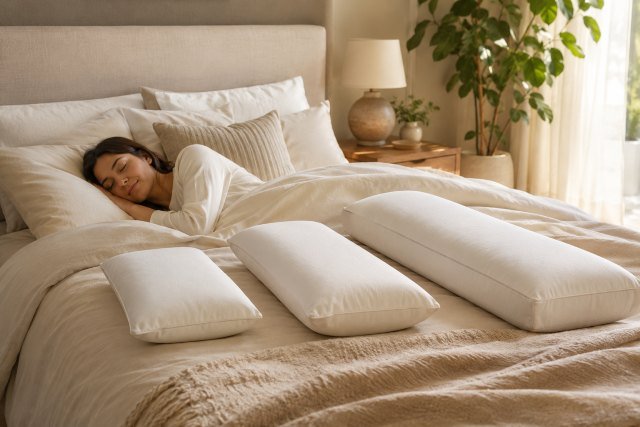
Choosing the right Pillow Lengths may seem like a small bedding decision, but it can make a real difference in how supported, relaxed, and comfortable you feel at night. A pillow that is too short may not give enough room for movement, while one that is too long can feel bulky or awkward on a smaller bed. Standard pillow sizing usually includes standard, queen, king, and body pillows, each designed for different beds, sleepers, and comfort needs.
- What Are Pillow Lengths?
- Common Pillow Lengths and Sizes
- Why Pillow Lengths Matter for Sleep Quality
- Pillow Lengths and Neck Support
- Best Pillow Lengths for Side Sleepers
- Best Pillow Lengths for Back Sleepers
- Best Pillow Lengths for Stomach Sleepers
- Choosing Pillow Lengths by Bed Size
- Pillow Lengths for People Who Move a Lot
- Pillowcase Fit and Pillow Lengths
- Pillow Lengths and Bedroom Style
- Signs Your Pillow Length Is Wrong
- Real-World Example: Choosing the Right Pillow Length
- How to Choose the Right Pillow Length
- Common Mistakes When Buying Pillow Lengths
- Are Longer Pillows Always Better?
- FAQs About Pillow Lengths
- Conclusion
The best pillow is not only about softness. It should also support your head and neck in a healthy position. Cleveland Clinic notes that a good pillow should help keep the neck parallel to the mattress instead of bent upward, downward, or sideways.
In this guide, we will look at common pillow lengths, how they fit different beds, and how to choose the right size based on your sleeping style, body type, and comfort needs.
What Are Pillow Lengths?
Pillow lengths refer to the horizontal measurement of a pillow from one end to the other. In simple terms, it tells you how long the pillow is across the bed.
Most sleeping pillows have a similar width, often around 20 inches, but their length changes depending on the size. For example, a standard pillow is commonly around 20 by 26 inches, a queen pillow around 20 by 30 inches, and a king pillow around 20 by 36 inches. Body pillows are usually much longer and may measure around 20 by 54 inches.
This length matters because it affects how much space your head has, how the pillow looks on your bed, and how comfortably you can move during sleep.
Common Pillow Lengths and Sizes
The most common pillow size is the standard pillow. It usually measures about 20 by 26 inches and works well for twin, full, and sometimes queen beds. It is a practical choice for people who do not move much during sleep and want a simple, easy-to-fit pillow.
A queen pillow is slightly longer, usually around 20 by 30 inches. This extra length can help people who turn from side to side during the night. Sleep Foundation notes that queen pillows fit well across a queen bed, and their additional length can benefit sleepers who change positions.
A king pillow is longer again, commonly around 20 by 36 inches. It is often used on king and California king beds, but some people also like it for extra support while reading or sitting up in bed.
A body pillow is much longer than a regular pillow. It is often used by side sleepers, pregnant sleepers, or anyone who wants full-body support. The longer shape can help support the knees, hips, and upper body when used correctly.
Why Pillow Lengths Matter for Sleep Quality
Pillow length matters because sleep is not completely still. Many people turn, shift, roll, or adjust their head position during the night. A pillow with enough length gives your head more room to stay supported even when you move.
Sleep quality is also linked to body alignment. The American Academy of Sleep Medicine recommends that adults get 7 or more hours of sleep per night on a regular basis for optimal health. If your pillow causes discomfort, neck strain, or repeated waking, it may make it harder to stay asleep long enough.
The wrong pillow length can also create practical problems. A short pillow may leave your head near the edge if you move a lot. A very long pillow may crowd a smaller bed or push against a sleeping partner. The right length creates a balance between comfort, support, and bed space.
Pillow Lengths and Neck Support
Pillow length and pillow height are different, but both affect comfort. Length gives you room to move across the pillow, while height, also called loft, affects how your neck lines up with your spine.
Mayo Clinic advises that your pillow should support your neck in alignment with your chest and back. Cleveland Clinic gives similar guidance, explaining that a pillow should keep the neck parallel to the mattress instead of forcing it into an awkward angle.
This means the longest pillow is not always the best pillow. A king pillow may look luxurious, but if it is too high, too firm, or too flat for your sleep position, it may still cause discomfort. The goal is to choose a pillow length that gives enough space while also choosing a loft and firmness that support your neck naturally.
Best Pillow Lengths for Side Sleepers
Side sleepers often need more support because there is a larger gap between the head and the mattress. The shoulder creates space that the pillow must fill so the neck does not bend downward.
For many side sleepers, a queen pillow is a comfortable middle option. It offers more length than a standard pillow, giving extra room for movement. A king pillow can also work well for side sleepers who shift often or like a larger sleeping surface.
Some side sleepers may also benefit from a body pillow. A body pillow can be placed between the knees and hugged with the arms, helping reduce twisting through the hips and shoulders. While pillow length helps with movement, the pillow’s thickness and firmness still matter most for keeping the head and neck aligned.
Best Pillow Lengths for Back Sleepers
Back sleepers usually do not need as much side-to-side pillow length as restless side sleepers, but they still need steady support under the neck and head. A standard pillow can work well for many back sleepers, especially if they sleep mostly in one place.
A queen pillow may be better if the sleeper moves slightly or prefers a wider surface. A king pillow can be useful for people who like a more spacious feel, but it should not push the head forward.
Mayo Clinic also suggests that back sleepers may place a pillow under the knees to help relax the back muscles and maintain the lower back’s natural curve. This shows that pillow choice is not only about the head pillow. Sometimes better sleep comfort comes from using the right pillow in the right place.
Best Pillow Lengths for Stomach Sleepers
Stomach sleeping can place more strain on the neck because the head is turned to one side for long periods. For this reason, stomach sleepers often need a thinner, softer pillow rather than a large or high pillow.
A standard pillow is usually enough for stomach sleepers because they often do not need extra length or extra loft. A queen pillow can work if it is thin and soft, but a thick king pillow may be too much for many stomach sleepers.
The main goal is to avoid pushing the neck backward or sideways at a harsh angle. A longer pillow may feel comfortable at first, but if it lifts the head too much, it can create stiffness by morning.
Choosing Pillow Lengths by Bed Size
Your bed size should also guide your pillow length. A twin bed usually looks and feels best with one standard pillow. A full bed can use one or two standard pillows depending on the sleeper’s preference.
A queen bed often pairs well with two queen pillows because the length fills the bed more evenly. Sleep Foundation notes that two queen pillows fit well across a queen bed. Standard pillows can also be used on queen beds if you prefer a simpler look or want more open space.
A king bed usually works best with two king pillows or three standard pillows. King pillows create a fuller, hotel-style appearance and provide plenty of surface area for movement. However, if you sleep with a partner and both of you prefer smaller pillows, standard or queen pillows may still be more comfortable.
Pillow Lengths for People Who Move a Lot
If you toss and turn during sleep, pillow length becomes more important. A standard pillow may work if you stay centered, but it may feel limited if you roll from one side to the other.
A queen pillow gives extra length without becoming as large as a king pillow. This makes it a good option for combination sleepers who move between back and side positions.
A king pillow may be helpful if you move a lot and have a larger bed. It gives the most space among regular sleeping pillows. However, it can feel oversized on a smaller mattress and may not fit well in standard pillowcases.
Pillowcase Fit and Pillow Lengths
Pillowcase size is easy to overlook, but it affects how the pillow feels. If the pillowcase is too small, it can compress the pillow and make it feel firmer or higher. If it is too large, the extra fabric may bunch up and feel uncomfortable.
Standard pillowcases usually fit standard pillows and may sometimes fit queen pillows, depending on the brand and fabric. Sleep Foundation notes that standard pillowcases can sometimes be used with queen pillows, especially when a slightly firmer or higher feel is desired.
King pillows usually need king pillowcases. A king pillow forced into a smaller case can lose its natural shape, which may affect comfort and support.
Pillow Lengths and Bedroom Style
Pillow length also affects how your bed looks. Standard pillows create a neat and simple appearance. Queen pillows look fuller on queen beds and can make the bed feel more balanced.
King pillows create a luxury look, especially on larger beds. They can also work as backrests while reading, watching TV, or relaxing. However, style should not be the only reason to choose a pillow. A beautiful pillow that causes neck discomfort is not the right choice for nightly sleep.
For decorative layering, many people use sleeping pillows in the back and smaller accent pillows in front. This works well visually, but your main sleeping pillow should still be chosen for comfort first.
Signs Your Pillow Length Is Wrong
Your pillow length may be wrong if your head often slips off the edge during the night. This is common for people who move a lot but use a small pillow.
Another sign is feeling crowded in bed. A king pillow on a small mattress may take up too much space, especially if two people are sharing the bed. You may also notice that your pillow does not fit properly in its case or looks squeezed.
Morning discomfort can also be a clue, although this is often related to loft and firmness rather than length alone. If you wake up with neck stiffness, Cleveland Clinic’s guidance suggests checking whether your pillow is keeping your neck parallel to the mattress.
Real-World Example: Choosing the Right Pillow Length
Imagine someone who sleeps on a queen bed and often changes from back sleeping to side sleeping. A standard pillow may feel fine at first, but during the night their head may move close to the edge. In this case, a queen pillow could be a better fit because it adds a few inches of length without overwhelming the bed.
Now imagine a stomach sleeper on a full bed. A large king pillow may look attractive, but it could be too bulky and may lift the head too much. A thinner standard pillow would likely be more practical.
For someone who sleeps on a king bed and reads before sleeping, a king pillow may be useful. It provides a wide surface for sleep and better back support while sitting up. The right choice depends on how the pillow is used, not just how it looks.
How to Choose the Right Pillow Length
Start with your bed size. A standard pillow is a safe choice for twin and full beds. A queen pillow is often ideal for queen beds and combination sleepers. A king pillow usually works best on king beds or for people who want extra space.
Next, consider your sleep position. Side sleepers and combination sleepers may appreciate extra length. Back sleepers may be comfortable with standard or queen sizes. Stomach sleepers usually need a thinner pillow and may not need extra length.
Finally, think about your body size and movement. A broad-shouldered side sleeper may need more support and surface area than a smaller back sleeper. A restless sleeper may need a longer pillow than someone who stays still all night.
Common Mistakes When Buying Pillow Lengths
One common mistake is buying pillows only to match the bed size. A king bed can look great with king pillows, but that does not mean every sleeper will find them comfortable.
Another mistake is ignoring pillow height. A pillow can be the perfect length but still uncomfortable if it is too thick or too flat. Neck alignment matters more than size alone.
People also forget about pillowcases. The right pillowcase helps the pillow keep its intended shape. A poor fit can change how the pillow feels and performs.
Are Longer Pillows Always Better?
Longer pillows are not always better. They give more space, but they can also take up more room and feel bulky. A longer pillow may be useful for active sleepers, larger beds, and people who like a spacious feel.
However, a shorter pillow can be better for small beds, minimal bedding setups, and sleepers who do not move much. Comfort depends on the full combination of pillow length, height, firmness, material, and sleeping position.
The best pillow length is the one that supports your natural sleep habits without forcing your body into an uncomfortable position.
FAQs About Pillow Lengths
What is the most common pillow length?
The most common pillow length is around 26 inches, which is the typical length of a standard pillow. Standard pillows are widely used because they fit many beds and pillowcases.
Is a queen pillow better than a standard pillow?
A queen pillow may be better if you move around during sleep or want extra space for your head. A standard pillow may be better if you prefer a smaller pillow or sleep on a smaller bed.
What pillow length is best for a king bed?
King pillows, commonly around 36 inches long, are designed to fit king beds well. However, some people prefer using queen or standard pillows depending on comfort and sleeping style.
Can pillow length help with neck pain?
Pillow length can help by giving your head enough room to stay supported, but neck pain is more directly affected by pillow height, firmness, and alignment. Mayo Clinic and Cleveland Clinic both emphasize keeping the neck aligned with the rest of the body during sleep.
What is the best pillow length for side sleepers?
Many side sleepers prefer queen or king pillows because they offer more room for movement. A body pillow may also help side sleepers support the knees and upper body.
Conclusion
Choosing the right Pillow Lengths is about more than matching your bedding. The right pillow length gives your head enough space, supports your sleeping habits, fits your bed properly, and helps create a more comfortable sleep environment.
Standard pillows are practical and versatile. Queen pillows offer extra space without feeling too large. King pillows work well on bigger beds and for sleepers who want more room. Body pillows are useful for full-body support, especially for side sleepers.
For better sleep, focus on the full picture: pillow length, height, firmness, material, bed size, and sleep position. When your pillow supports your neck naturally and gives you enough room to rest comfortably, sleep can feel easier, deeper, and more refreshing.