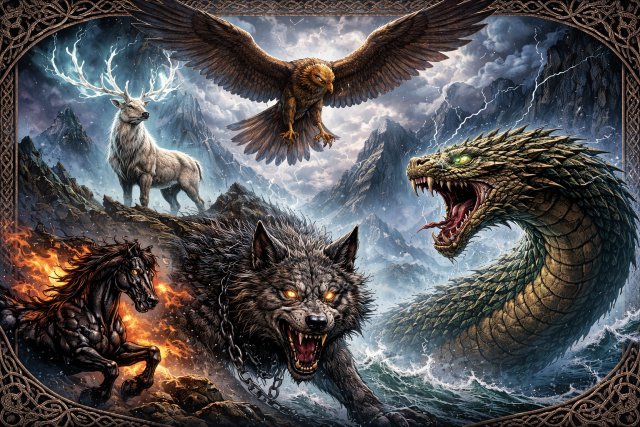
Viking Mythical Animals are among the most fascinating elements of Norse mythology, representing power, chaos, wisdom, and the mysteries of the natural world. These creatures were not merely fictional beasts; they played essential roles in Viking cosmology, storytelling, and belief systems.
- The Role of Animals in Norse Mythology
- Fenrir: The Wolf of Doom
- Jörmungandr: The World Serpent
- Sleipnir: Odin’s Eight-Legged Horse
- Huginn and Muninn: The Ravens of Thought and Memory
- Níðhöggr: The Dragon Beneath the World Tree
- Ratatoskr: The Mischievous Messenger
- Garmr: The Guardian of Hel
- Hræsvelgr: The Giant Eagle of the Skies
- Symbolism Behind Viking Mythical Animals
- Why Viking Mythical Animals Still Matter Today
- Common Questions About Viking Mythical Animals
- Conclusion: The Legacy of Viking Mythical Animals
Within the Norse worldview, animals were often seen as extensions of gods, embodiments of natural forces, or omens of fate. From colossal wolves destined to destroy the gods to serpents that encircle the world, Viking mythical animals continue to captivate historians, fantasy enthusiasts, and cultural researchers alike.
The Role of Animals in Norse Mythology
Animals in Norse mythology were deeply symbolic and often intertwined with divine narratives. Unlike many mythologies where animals are secondary, in Viking culture they were central figures shaping the fate of gods and humans.
The Norse cosmos consisted of interconnected realms such as Midgard (Earth), Asgard (realm of gods), and Jotunheim (land of giants). Mythical animals moved freely between these worlds, acting as messengers, protectors, or destroyers.
Scholars studying texts like the Poetic Edda and Prose Edda (compiled in the 13th century by Snorri Sturluson) note that animals often represent natural forces such as storms, the sea, or the passage of time.
Fenrir: The Wolf of Doom
Fenrir is perhaps the most feared among all Viking mythical animals. This gigantic wolf, son of Loki, was prophesied to bring destruction during Ragnarok — the end of the world in Norse mythology.
The gods, aware of his fate, attempted to bind him. However, Fenrir broke every chain until the dwarves created a magical binding called Gleipnir. Even then, Fenrir bit off the hand of the god Tyr as a sign of defiance.
Fenrir symbolizes uncontrollable chaos and the inevitability of destiny. His story reflects a recurring Norse theme: fate cannot be avoided, only delayed.
Jörmungandr: The World Serpent
Jörmungandr, also known as the Midgard Serpent, is one of the most iconic Viking mythical animals. This enormous sea serpent is so vast that it encircles the entire world, biting its own tail.
As the eternal rival of Thor, Jörmungandr represents the destructive power of the ocean. According to myth, when it releases its tail, Ragnarok will begin.
The serpent embodies cycles, infinity, and hidden danger beneath calm surfaces. Modern interpretations often connect Jörmungandr with environmental symbolism, especially the unpredictability of oceans.
Sleipnir: Odin’s Eight-Legged Horse
Sleipnir stands out as one of the most unique creatures in Viking mythology. This eight-legged horse belongs to Odin, the Allfather, and is considered the fastest and most powerful steed in existence.
Born from Loki (who shapeshifted into a mare), Sleipnir can travel between worlds, including the realm of the dead. This ability makes it a symbol of transcendence and spiritual journey.
In Viking culture, horses were sacred animals associated with travel, war, and communication with the divine. Sleipnir amplifies these traits to a supernatural level.
Huginn and Muninn: The Ravens of Thought and Memory
Odin’s two ravens, Huginn (thought) and Muninn (memory), are vital Viking mythical animals representing intelligence and awareness.
Each day, they fly across the world gathering information and return to Odin to whisper everything they have seen and heard. This reflects the Viking emphasis on knowledge, observation, and strategy.
Ravens were commonly associated with battlefields, often seen feeding on the fallen. As such, they also symbolized death and the presence of Odin himself.
Níðhöggr: The Dragon Beneath the World Tree
Níðhöggr is a fearsome dragon that gnaws at the roots of Yggdrasil, the world tree connecting all realms. This creature represents decay, corruption, and the destructive forces constantly threatening the balance of the universe.
Unlike dragons in later European folklore, Níðhöggr is not a treasure hoarder but a symbol of entropy. Its actions signify that even the strongest structures — like Yggdrasil — are vulnerable to decay.
This concept aligns with Norse beliefs about impermanence and the cyclical nature of existence.
Ratatoskr: The Mischievous Messenger
Ratatoskr is a lesser-known but intriguing figure among Viking mythical animals. This squirrel runs up and down Yggdrasil, carrying messages between the eagle at the top and Níðhöggr at the roots.
However, Ratatoskr does not promote harmony. Instead, it spreads insults and misinformation, fueling conflict.
This creature represents gossip, communication, and the power of words — concepts still highly relevant in today’s digital age.
Garmr: The Guardian of Hel
Garmr is a monstrous dog associated with Hel, the Norse underworld. Often compared to Cerberus from Greek mythology, Garmr guards the gates of the dead.
During Ragnarok, Garmr will break free and engage in a deadly battle with the god Tyr.
This creature symbolizes death, guardianship, and the thin boundary between life and the afterlife.
Hræsvelgr: The Giant Eagle of the Skies
Hræsvelgr is a giant eagle perched at the edge of the world. According to Norse texts, the beating of its wings creates the winds.
This Viking mythical animal embodies natural forces, particularly weather patterns. For seafaring Vikings, understanding and respecting the wind was crucial for survival.
Hræsvelgr demonstrates how mythology served as a way to explain natural phenomena before scientific understanding.
Symbolism Behind Viking Mythical Animals
Viking mythical animals were not random creations. Each carried layered meanings tied to the Viking worldview.
They often represented:
Power and strength, as seen in Fenrir and Jörmungandr.
Wisdom and knowledge, embodied by Odin’s ravens.
Chaos and destruction, symbolized by creatures like Níðhöggr.
Cycles of life and fate, reflected in the interconnected roles of these beings.
Modern scholars from institutions such as the University of Oslo have highlighted how these symbols influenced Viking art, runestones, and storytelling traditions.
Why Viking Mythical Animals Still Matter Today
The influence of Viking mythical animals extends far beyond ancient Scandinavia. Today, they appear in literature, movies, video games, and modern mythology-inspired works.
Franchises like Marvel’s Thor and games like God of War have reintroduced these creatures to global audiences. However, their original meanings are often deeper than their modern portrayals.
These animals resonate because they address universal themes: fate, power, knowledge, and survival.
Common Questions About Viking Mythical Animals
What are Viking mythical animals?
Viking mythical animals are legendary creatures from Norse mythology that symbolize natural forces, divine power, and cosmic balance.
Which is the most powerful Viking creature?
Fenrir is often considered the most powerful due to his role in Ragnarok and his ability to defeat Odin.
Are Viking mythical animals based on real animals?
Many are inspired by real animals like wolves, ravens, and serpents but exaggerated to reflect mythological significance.
Where can I learn more about Norse mythology?
You can explore primary sources like the Poetic Edda and Prose Edda, as well as academic resources from institutions such as Britannica and university research publications.
Conclusion: The Legacy of Viking Mythical Animals
Viking Mythical Animals remain a powerful gateway into understanding Norse culture, beliefs, and storytelling traditions. These creatures were more than myths — they were symbolic tools used to interpret the world, explain natural phenomena, and explore existential themes.
From the destructive force of Fenrir to the wisdom of Odin’s ravens, each creature contributes to a rich tapestry of mythology that continues to inspire modern audiences.
As interest in Norse mythology grows, these ancient beings remind us that stories — no matter how old — still hold relevance in shaping how we understand power, nature, and destiny.