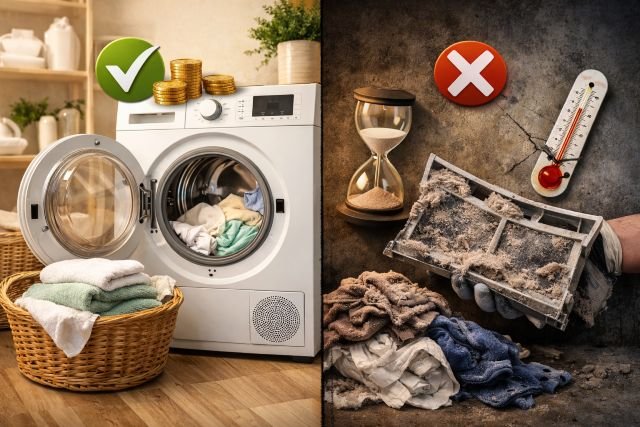
A heat pump tumble dryer is often marketed as the “future of laundry,” promising lower energy bills, gentler fabric care, and eco-friendly performance. And to be fair, those claims are mostly true. But what many brands don’t emphasize is that the same technology that saves energy can also introduce trade-offs, including longer cycle times, more maintenance points, and performance differences depending on humidity, load type, and installation conditions.
- What Is a Heat Pump Tumble Dryer?
- Why Heat Pump Tumble Dryers Are Becoming the Default in Many Markets
- The Big Advantages: Heat Pump Tumble Dryer Pros You’ll Actually Notice
- The Trade-Offs: Heat Pump Tumble Dryer Cons Brands Downplay
- The “Hidden Truth” Brands Don’t Emphasize: Efficiency Depends on Your Laundry Habits
- Real-World Scenarios: When a Heat Pump Tumble Dryer Makes Sense
- When You Should Avoid a Heat Pump Tumble Dryer
- How to Choose the Best Heat Pump Tumble Dryer
- Are Heat Pump Tumble Dryers Worth It? A Practical Cost Perspective
- Featured Snippet FAQs: Heat Pump Tumble Dryer Questions People Ask Most
- Conclusion: Heat Pump Tumble Dryer Pros and Cons, Honestly
If you’re considering a heat pump tumble dryer, this guide will walk you through the honest pros and cons, including the real-world issues owners experience, what the energy savings look like, and the hidden factors that determine whether it’s worth the higher upfront cost. You’ll also get practical buying tips, common mistakes to avoid, and clear answers to the questions people search for most.
What Is a Heat Pump Tumble Dryer?
A heat pump tumble dryer is a type of dryer that reuses warm air in a closed-loop system instead of constantly heating fresh air and venting it out. Traditional vented and condenser dryers generate heat using electric resistance (or gas in some regions) and then expel moisture-filled air or condense it to water. Heat pump dryers, on the other hand, recycle the same air repeatedly, extracting moisture and reheating air more efficiently.
This is why heat pump models use lower temperatures and significantly less electricity, and why they are considered one of the most energy-efficient drying options available. Retail and manufacturer guides consistently highlight lower drying temperatures (around 50°C versus 70–75°C in conventional dryers), which is also linked to gentler fabric care.
Why Heat Pump Tumble Dryers Are Becoming the Default in Many Markets
One major reason heat pump tumble dryers are rising fast is regulation. The European Union updated energy labelling and ecodesign measures for tumble dryers, with new measures applying from 1 July 2025. Industry groups and EU communications indicate the shift strongly favors heat pump technology as the standard going forward. Energy+1
That doesn’t automatically mean they’re perfect for every household, but it does signal a clear direction: governments want dryers to use less energy, and heat pump dryers are currently the leading solution.
The Big Advantages: Heat Pump Tumble Dryer Pros You’ll Actually Notice
1) Much Lower Energy Use (The #1 Reason People Switch)
The strongest argument for buying a heat pump tumble dryer is energy efficiency. ENERGY STAR specifically positions heat pump dryers as a high-efficiency option and emphasizes best practices such as using sensor dry settings and cleaning filters to maintain performance.
Independent and retailer resources often claim heat pump dryers can use dramatically less energy than conventional condenser dryers, sometimes “up to 60% less,” depending on model and usage patterns.
What matters more than percentages is what that means in real life. If your household runs several dryer cycles per week, energy savings can become noticeable within a year or two. For occasional users, savings still exist, but the payback period can be longer because the purchase price is higher.
A helpful benchmark for how meaningful dryer energy use can be comes from a field study published by ACEEE, which reported average measured electric resistance dryer energy use around 814 kWh per year in monitored homes. That number can vary widely by household behavior, but it shows drying is not a trivial energy load.
The practical takeaway is simple: if drying is a frequent task in your home, heat pump technology can reduce a meaningful chunk of electricity use over time.
2) Gentler on Clothes and Better for Fabrics
A heat pump tumble dryer uses lower temperatures, and that alone changes the fabric-care story. Lower heat reduces stress on elastics, shrink-prone cotton blends, and delicate fibers. Many consumer-oriented guides emphasize that the lower-temperature approach is gentler on clothing and helps fabrics last longer.
This matters more than people expect. If you regularly dry sportswear, school uniforms, baby clothes, or anything with stretch, the dryer becomes part of the “longevity equation.” Heat pump drying is still drying, but it’s usually less harsh than high-heat traditional cycles.
3) Ventless Installation and Flexible Placement
Most heat pump tumble dryers are ventless. That means you don’t need a wall vent, and you can often place the dryer in apartments, closets, utility rooms, or interior laundry spaces where vented dryers are difficult or impossible.
For urban living, rented homes, or compact laundry spaces, this flexibility is a major win. It’s one reason heat pump dryers are heavily promoted in markets where venting isn’t standard or where retrofitting ducts is expensive.
4) Lower Risk of Overdrying with Sensor Drying
Many heat pump models pair well with modern sensor technology, which can stop the cycle when clothes are dry rather than running on a fixed time. ENERGY STAR encourages using sensor settings to avoid unnecessary energy use and protect clothing.
This is a subtle “quality-of-life” benefit. Instead of guessing drying time, you get more consistent results and less risk of baking fabrics longer than needed.
The Trade-Offs: Heat Pump Tumble Dryer Cons Brands Downplay
Now let’s talk about what the marketing often glosses over. Heat pump technology is excellent, but it is not “free efficiency.” The energy savings come with practical compromises.
1) Longer Drying Times Are Real
This is the most common frustration for new heat pump dryer owners. Because heat pump dryers operate at lower temperatures, they often take longer to dry. Some sources estimate about 20–30 minutes longer per cycle compared to condenser dryers, depending on load type and settings.
This isn’t a flaw in the machine. It’s a direct result of using lower heat and recycling air.
If you’re the kind of person who does laundry in short bursts or needs quick turnarounds, this can feel annoying at first. For families doing multiple loads back-to-back, longer cycles can change the rhythm of laundry day.
The key is managing expectations. Heat pump drying is more like “low and slow.” For many households, the energy savings outweigh the extra time, but it’s not ideal for everyone.
2) Higher Upfront Cost (Sometimes a Lot Higher)
Heat pump tumble dryers usually cost more than vented or standard condenser dryers. That’s because the system is more complex, involving a compressor and heat exchanger components.
Brands often emphasize “long-term savings,” which is true, but the upfront price can still be a deal-breaker. The real question is not whether it saves energy, but whether your household will dry enough loads to recover the price difference before you replace the appliance.
If you dry frequently, you are more likely to see a good return. If you dry only once or twice a week, the payback period can stretch longer, and the purchase becomes more about fabric care, convenience, and environmental priorities.
3) Maintenance Is Not Optional (And Neglect Can Hurt Performance)
With many conventional dryers, people treat filter cleaning like a suggestion. With a heat pump tumble dryer, maintenance is more crucial.
Most heat pump dryers have multiple filters and heat-exchanger areas that need cleaning. If these get clogged, airflow decreases and drying times become even longer. ENERGY STAR explicitly notes that regular maintenance, including cleaning filters, improves efficiency and lifespan.
This is one of the biggest “brands don’t tell you” realities. Heat pump drying is efficient, but it relies on good airflow and clean surfaces to work well.
If you’re buying one, accept upfront that maintenance is part of ownership. It’s not hard, but it’s not something you can ignore.
4) They Can Be Less Forgiving in Humid or Poorly Ventilated Rooms
Heat pump dryers are ventless, but they still interact with your indoor environment. They condense moisture into a tank or drain, but the process still produces some heat and may affect the surrounding air. In poorly ventilated laundry rooms, some owners notice increased warmth or dampness, especially if the dryer is overworked or filters aren’t clean.
This isn’t universal, and many modern models manage it well, but it’s worth considering if your laundry space is small, enclosed, or already humid.
The practical fix is ensuring adequate ventilation and not stuffing the dryer into a sealed closet without airflow unless the manufacturer specifically allows it.
5) Repairs Can Be More Expensive
Heat pump dryers have more specialized components than resistance dryers. The compressor and heat exchanger add efficiency, but they also introduce potential repair costs if something goes wrong.
This doesn’t mean they are unreliable, but repairs can be pricier than the simplest vented models. If you live in an area with limited appliance service options, parts and expertise availability should be part of your decision-making.
The “Hidden Truth” Brands Don’t Emphasize: Efficiency Depends on Your Laundry Habits
The biggest misconception in heat pump dryer marketing is the idea that buying one automatically guarantees huge savings. The truth is that your results depend heavily on how you use it.
If you frequently overload your dryer, use timed drying instead of sensors, or don’t spin clothes well in the washer, your energy use and drying time will increase. ENERGY STAR recommends pairing efficient drying with a high-spin front-load washer, because removing more water in the final spin reduces dryer energy consumption.
This is an important point: a heat pump tumble dryer is an efficiency tool, but your laundry process determines how much benefit you extract from it.
Real-World Scenarios: When a Heat Pump Tumble Dryer Makes Sense
Scenario 1: A Family Running Multiple Loads per Week
If you have children, sports uniforms, school clothes, and multiple weekly laundry cycles, a heat pump dryer often delivers strong value. The extra cycle time matters less because you’re likely doing laundry continuously anyway, and the energy savings add up faster over the year.
Families also benefit from gentler drying. Clothes are replaced less frequently when they aren’t baked at high temperatures.
Scenario 2: Apartment Living or Homes Without Venting
In many apartments, venting isn’t allowed or isn’t feasible. A heat pump tumble dryer becomes one of the best solutions because it does not require external venting.
This is why heat pump technology is often promoted for compact homes and urban settings, where flexibility beats raw drying speed.
Scenario 3: Sustainability-Focused Households
If your household is reducing electricity use for environmental reasons, heat pump drying is one of the clearest appliance upgrades you can make. The EU’s strong push toward heat pump dryers reflects the broader policy emphasis on reducing energy consumption at scale.
When You Should Avoid a Heat Pump Tumble Dryer
Heat pump dryers may not be ideal if you need extremely fast drying, such as in busy hospitality settings, commercial laundry, or households where multiple people need laundry done immediately.
They also may not be the best choice if you know you will not keep up with maintenance. A neglected heat pump dryer can turn into a “slow dryer,” and many complaints about poor performance are actually maintenance-related.
If budget is tight and you simply need a basic dryer for occasional loads, a conventional dryer can still be the better value.
How to Choose the Best Heat Pump Tumble Dryer
The key is to choose a model that matches your household and usage patterns.
Start by checking the energy label or ENERGY STAR certification and focus on models with strong efficiency ratings. ENERGY STAR provides usage and maintenance guidance and highlights that heat pump dryers already use relatively low heat, making them efficient by design.
Then look at capacity. A model that is too small for your household will force you to do more cycles, reducing the convenience advantage.
Also pay attention to drainage options. Some models allow direct drain connections instead of requiring you to empty a water tank. This matters more than you think, especially for frequent users.
Finally, read reviews that specifically mention drying time, noise, and filter cleaning ease. Many issues people report are not about the technology itself, but about daily ownership friction.
Are Heat Pump Tumble Dryers Worth It? A Practical Cost Perspective
The “worth it” question depends on the difference in purchase price and your annual usage.
To think about this realistically, estimate how many loads you dry per week and multiply by your typical electricity cost. If you dry often, the savings can justify the higher upfront cost. If you dry rarely, you’re paying more primarily for fabric care, installation flexibility, and environmental benefits.
The ACEEE paper noting average electric resistance dryer energy use around 814 kWh/year gives context for how much energy drying can consume in some households, but your mileage will vary.
The most reliable way to decide is to compare the estimated annual energy use on the label for the exact model you’re considering versus a comparable conventional model. That gives a real savings estimate rather than vague percentage claims.
Featured Snippet FAQs: Heat Pump Tumble Dryer Questions People Ask Most
What is a heat pump tumble dryer?
A heat pump tumble dryer is a ventless dryer that recycles warm air using heat pump technology, drying clothes at lower temperatures and using less electricity than traditional dryers.
Do heat pump tumble dryers take longer to dry clothes?
Yes, they typically take longer because they operate at lower temperatures. Many comparisons estimate around 20–30 minutes longer per cycle depending on the load and settings.
Are heat pump tumble dryers cheaper to run?
Yes, they generally use significantly less electricity than condenser or vented dryers, which reduces running costs over time, especially for frequent users.
Do heat pump tumble dryers need a vent?
No, most heat pump tumble dryers are ventless. Moisture is condensed into a water tank or drained away, which allows flexible installation in many homes.
Do heat pump tumble dryers shrink clothes less?
They are less likely to shrink clothes because they dry using lower temperatures and gentler heat compared to conventional dryers.
What maintenance does a heat pump tumble dryer require?
You typically need to clean lint filters regularly and keep the heat exchanger or condenser area clean. ENERGY STAR notes that maintenance helps efficiency and lifespan.
Conclusion: Heat Pump Tumble Dryer Pros and Cons, Honestly
A heat pump tumble dryer is one of the smartest appliance upgrades for energy efficiency, especially in households that dry frequently or want ventless installation flexibility. The pros are substantial: lower electricity use, gentler fabric care, and long-term savings potential.
But brands don’t always highlight the trade-offs. Drying takes longer, the upfront cost is higher, and maintenance matters more than with basic dryers. If you understand these realities and choose the right model for your space and habits, a heat pump tumble dryer can be a high-value investment that pays off in comfort, fabric longevity, and lower energy use over time.