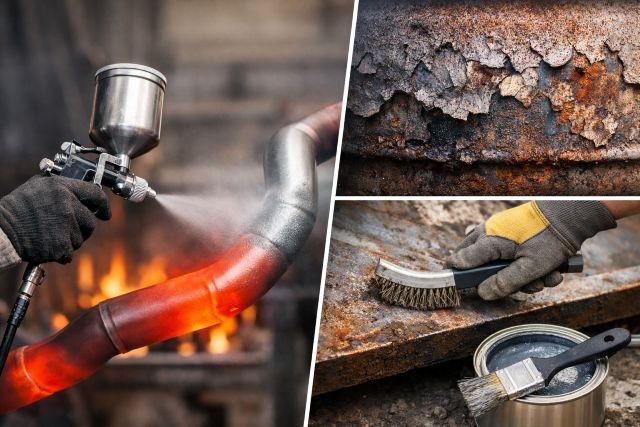
If you’re using heat resistant paint on a grill, fireplace, stove, exhaust pipe, or industrial surface, you’re probably asking the most important question: how long will it actually last? The honest answer is that heat resistant paint can last anywhere from a few months to many years, depending on how well the surface is prepared, what temperature it faces, and whether the coating is properly cured. In other words, the paint’s lifespan has less to do with luck and more to do with process.
- What Is Heat Resistant Paint?
- How Long Does Heat Resistant Paint Last?
- Why Heat Resistant Paint Fails Earlier Than Expected
- Manufacturer Curing Instructions Matter More Than People Think
- Heat Resistant Paint Temperature Ratings: What They Really Mean
- The Real Lifespan by Application
- How to Make Heat Resistant Paint Last Longer
- Heat Resistant Paint vs. High Temperature Coatings: Are They the Same?
- What About Safety and VOCs in Heat Resistant Paint?
- Common Mistakes That Shorten Heat Resistant Paint Life
- Real-World Scenario: Why One Grill Paint Job Lasts 6 Months and Another Lasts 3 Years
- FAQ: Featured Snippet Answers About Heat Resistant Paint
- Conclusion: Heat Resistant Paint Can Last for Years — If You Apply It Right
In this guide, you’ll learn what affects the durability of heat resistant paint, the realistic lifespan for different applications, and the best ways to make it last longer — even in harsh, high-temperature environments. You’ll also get clear expert answers to common questions, practical examples, and actionable techniques you can apply immediately.
What Is Heat Resistant Paint?
Heat resistant paint is a specialized coating formulated to withstand elevated temperatures without breaking down, discoloring, blistering, or peeling. Unlike standard enamel or wall paint, high-heat coatings use resins and pigments engineered to remain stable under heat exposure. Many products are designed for temperatures ranging from 400°F up to 1000°F (and sometimes higher depending on the coating system).
Heat resistant paint is commonly used on grills, wood stoves, radiators, fire pits, fireplace screens, and automotive parts because ordinary paint tends to crack, burn, or flake under repeated heat cycles.
How Long Does Heat Resistant Paint Last?
The lifespan of heat resistant paint depends on four core factors: temperature exposure, surface prep, coating thickness, and how the painted surface is used. A properly applied and cured high-heat coating can often last several years, but frequent extreme temperatures, abrasion, grease buildup, and moisture can shorten that lifespan significantly.
In real-world conditions, you can think of lifespan like this:
When applied on surfaces exposed to moderate heat levels, such as radiators or heat-adjacent panels, heat resistant paint may last many years with minimal fading.
When applied on surfaces exposed to intense direct heat and greasy residue, such as grill lids and fire pits, the same coating may need touch-ups within one to three years depending on usage.
When applied to exhaust systems or engine components that experience constant heat cycling, road salt, and vibration, durability depends heavily on prep and curing, and shorter lifespans are common if those steps are rushed.
In short, heat resistant paint lasts longest when temperatures remain within the coating’s rated limits and the coating is properly heat-cured.
Why Heat Resistant Paint Fails Earlier Than Expected
Many people assume that once they buy “high heat paint,” it should simply hold up forever. But the biggest reason heat resistant paint fails early is that heat alone is rarely the only challenge. Most high-temperature surfaces are also exposed to corrosion, oils, grease, soot, and repeated expansion and contraction.
Heat Cycling Is the Silent Paint Killer
Even if your surface does not exceed the paint’s rated temperature, repeated heating and cooling can cause microscopic movement in the metal or substrate. Over time, this movement stresses the coating, leading to cracking, peeling, and flaking.
Heat resistant paint must resist not just heat, but constant thermal expansion. That’s why high-heat coatings often perform best when they’re applied correctly and cured according to manufacturer instructions.
Manufacturer Curing Instructions Matter More Than People Think
One of the most overlooked factors in heat resistant paint durability is curing. Some products require a specific heat-curing process to achieve full performance. For example, certain high-heat coatings state that after drying, full cure requires heating the coated surface to around 450°F for one hour, and they may emit smoke and odor during that curing stage.
This is critical because heat resistant paint can feel “dry” to the touch but still lack full chemical resistance until properly cured. If the coating is placed into service too early, it’s much more likely to blister or peel.
Heat Resistant Paint Temperature Ratings: What They Really Mean
A paint labeled “up to 1000°F” does not mean it performs perfectly at that temperature forever. It usually means the coating can tolerate that temperature without immediate failure under controlled conditions. In real life, durability depends on whether the surface repeatedly hits that maximum temperature or only occasionally approaches it.
Many high heat paints are marketed as being rated to extreme temperatures and used on grills, stoves, and automotive parts.
If your grill lid frequently spikes near the maximum rating, paint breakdown can happen faster than on a surface that stays in the mid-range.
The Real Lifespan by Application
Instead of thinking in exact years, it’s better to think in realistic ranges based on typical usage.
A radiator or heat-adjacent appliance surface tends to deliver longer paint life because it rarely gets hot enough to push the coating to its limits, and it experiences less grease and combustion residue.
A grill, smoker, fireplace insert, and stove exterior tends to have medium-to-high heat exposure, plus grease or soot buildup. These surfaces often need periodic maintenance and occasional touch-ups.
A fire pit or outdoor stove faces high heat plus weather, moisture, and oxidation. Outdoor exposure accelerates corrosion, which can lift paint even if the coating is technically heat-stable.
Automotive components face heat, vibration, moisture, and salt. These are among the most punishing environments for any coating system, and performance depends heavily on prep and coating type.
How to Make Heat Resistant Paint Last Longer
Heat resistant paint durability is mostly determined before the first coat is applied. If you want the coating to survive multiple seasons, you need to treat the process like a coating project, not like a quick spray job.
Start With Proper Surface Preparation
Paint does not bond well to rust, grease, or soot. If you skip prep, you’re essentially painting over a failure layer.
The best approach is to remove loose rust and scale, sand the surface to create a clean profile, and use a degreaser that removes oils completely. Any contamination trapped under the paint becomes a weak point that can cause blistering during heat cycles.
Use the Correct Film Thickness
With heat resistant paint, more is not always better. Applying a heavy coat can trap solvents, which later expand under heat and cause bubbling. Many manufacturers emphasize applying thin, even coats and avoiding unnecessary recoats in some formulations.
Thin coats dry and cure more consistently. This increases adhesion and reduces the risk of heat-caused blistering.
Follow the Cure Schedule Exactly
If the manufacturer requires a heat cure, treat that as mandatory. If you paint a grill and immediately fire it up to maximum temperature, the paint can fail because the solvent and resin system hasn’t stabilized.
Some high-heat paints recommend letting the coating dry for a set time before heating, then curing under controlled temperature conditions, such as a one-hour cure at 450°F for full performance.
A safer approach is to gradually increase temperature in stages. This reduces thermal shock and allows the resin system to crosslink properly.
Reduce Grease and Soot Buildup
One of the fastest ways to shorten paint life is to allow grease and soot to bake onto painted surfaces. Over time, these residues become acidic and corrosive, and they can also trap moisture.
For grills, a regular wipe-down after cooling and occasional deep cleaning can extend paint life significantly. This isn’t just about aesthetics — it’s about reducing corrosion and preventing chemical breakdown of the coating.
Avoid Exceeding the Paint’s Maximum Rating
Even the best heat resistant paint has limits. If your surface routinely exceeds the maximum temperature rating, you should consider a different coating system, such as industrial-grade high-temperature coatings or ceramic coatings designed for sustained extreme temperatures.
Heat Resistant Paint vs. High Temperature Coatings: Are They the Same?
People often use “heat resistant paint” and “high temperature coating” interchangeably, but the performance expectations can differ depending on the product category and test standards.
For instance, ASTM publishes test methods for evaluating coatings designed to protect steel surfaces exposed to elevated temperatures during their service life, reflecting how performance is measured under heat conditions.
This matters because some consumer products are intended for intermittent heat exposure, while industrial coatings may be designed for continuous high-temperature service.
If your application involves constant high temperatures in industrial settings, it’s worth choosing products that reference performance testing or industrial standards rather than relying only on retail labeling.
What About Safety and VOCs in Heat Resistant Paint?
Like many coatings, heat resistant paint can contain solvents and chemicals that off-gas during drying and curing. This is particularly noticeable during heat curing, where manufacturers often warn of smoke or odors.
For readers concerned about VOC exposure, the U.S. Environmental Protection Agency provides regulatory details and limits for VOC content in architectural coatings, including categories that cover high temperature coatings and related product groups.
That doesn’t mean every high-heat paint is unsafe, but it does mean ventilation matters. Always cure high-heat coatings outdoors or in a well-ventilated space where fumes can dissipate safely.
Common Mistakes That Shorten Heat Resistant Paint Life
Even premium high-heat paint fails quickly when applied incorrectly.
The most common mistake is painting over rust or grease, which prevents adhesion.
The second biggest issue is applying the paint too thick, which traps solvents and causes bubbling during heat.
Another major mistake is skipping the curing schedule. If the product requires heat curing but is never cured properly, it may remain soft, break down faster, and fail under heat cycling.
Finally, many people exceed the paint’s rated temperature without realizing it. Certain grills and fire pits can reach temperatures that surpass consumer paint ratings, particularly during high-fire cooking or when airflow is unrestricted.
Real-World Scenario: Why One Grill Paint Job Lasts 6 Months and Another Lasts 3 Years
Two homeowners paint identical grills with heat resistant paint. One lasts through multiple seasons. The other peels in a few months.
The difference is rarely the paint brand. It’s usually the process.
The long-lasting job comes from someone who wire-brushed rust, degreased thoroughly, applied thin coats, allowed proper dry time, then gradually cured the coating through heat cycles.
The short-lasting job comes from painting over grease residue, applying thick coats, and firing the grill to maximum heat immediately.
Heat resistant paint can be incredibly durable, but only if the coating has a clean surface to bond to and time to cure correctly.
FAQ: Featured Snippet Answers About Heat Resistant Paint
How long does heat resistant paint last?
Heat resistant paint can last from a few months to several years depending on temperature exposure, surface preparation, and curing. With proper prep and correct application, high-quality coatings often last several years.
Does heat resistant paint need to be cured?
Many heat resistant paints require heat curing to reach full performance. Some products specify curing at around 450°F for one hour after drying to achieve full cure.
Why does heat resistant paint peel or blister?
Peeling and blistering usually occur due to poor surface prep, grease or rust contamination, applying coats too thick, skipping curing steps, or exposing the paint to temperatures beyond its rating.
Can you use heat resistant paint indoors?
Some high-heat paints can be used indoors on appropriate surfaces such as stove exteriors, but ventilation is critical because curing can release odors and fumes. Always follow manufacturer safety directions and cure in a ventilated environment.
Does heat resistant paint prevent rust?
Many products include rust-preventive formulations designed for metal surfaces exposed to heat, but rust prevention depends on prep quality and whether moisture is present.
Conclusion: Heat Resistant Paint Can Last for Years — If You Apply It Right
Heat resistant paint is one of the best solutions for protecting surfaces exposed to elevated temperatures, but its lifespan depends on preparation, application technique, and curing discipline. When applied correctly and cured as instructed, heat resistant paint can last for years on many surfaces. But when applied over grease, rust, or without proper curing, it can fail quickly—sometimes in months.
If you want your coating to last longer, focus on three essentials: thorough surface cleaning, thin even coats, and manufacturer-recommended curing. Combine those steps with routine maintenance and temperature management, and you’ll dramatically extend the life of your heat resistant paint while keeping your equipment and surfaces looking cleaner and performing better over time.