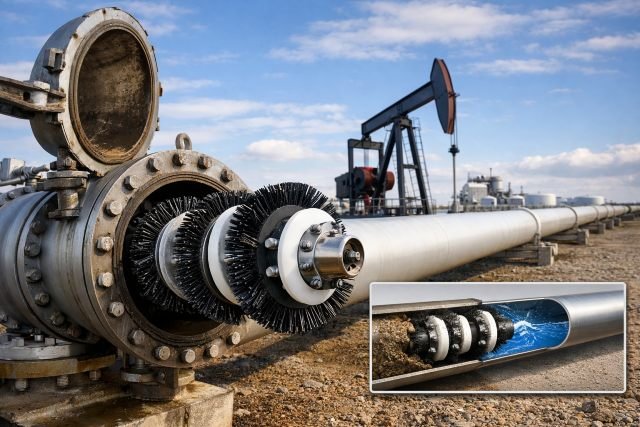
Pipeline cleaners play a major role in maintaining flow efficiency throughout oil and gas infrastructure. Even the most advanced pipeline system loses performance over time if deposits such as wax, scale, sand, sludge, and corrosion products are allowed to accumulate. These deposits reduce internal diameter and increase friction, causing higher pressure drop and forcing pumps and compressors to work harder just to maintain production targets.
- What Are Pipeline Cleaners?
- How Pipeline Cleaners Improve Flow Efficiency (Simple Definition)
- Why Deposits Reduce Pipeline Performance
- Pipeline Cleaners Used in Oil & Gas Systems
- How Pipeline Cleaners Reduce Pressure Drop
- How Pipeline Cleaners Increase Throughput
- How Pipeline Cleaners Stabilize Flow and Reduce Slugging
- Pipeline Cleaners and Corrosion Risk Reduction
- Pipeline Cleaners in Gas Systems: Managing Liquid Accumulation
- Pipeline Cleaners in Crude Oil Systems: Wax and Paraffin Control
- Best Practices for Pigging and Pipeline Cleaner Programs
- How Often Should Pipeline Cleaners Be Used?
- Measuring Flow Efficiency Improvements After Cleaning
- FAQ
- Conclusion: Why Pipeline Cleaners Are Essential for Efficient Oil & Gas Operations
In oil and gas, cleaning is most commonly achieved through pigging operations. The Society of Petroleum Engineers explains that pigging is routinely performed to remove wax, scale, debris, and other restrictions that reduce flow efficiency and contribute to corrosion risk. The U.S. Environmental Protection Agency also describes pigging as a process that inserts a device into the pipeline and forces it through using pressure or compressed gas until it is trapped at the receiver.
This guide explains exactly how pipeline cleaners work, how they improve flow efficiency, and how oil and gas operators can create cleaning programs that reduce operational loss while improving long-term system reliability.
What Are Pipeline Cleaners?
Pipeline cleaners are tools and methods used to remove unwanted material from the inside of pipelines so that hydrocarbons can flow with less restriction. In most oil and gas operations, pipeline cleaners refer to mechanical pigs, chemical cleaning processes, gel pigs, or combinations of these approaches depending on the type of deposit present.
Their purpose is not just cleanliness for appearance. Pipeline cleaners serve an operational goal: improving throughput, minimizing energy consumption, and supporting corrosion control. When deposits are removed, the pipeline returns closer to its designed internal diameter and flow becomes more stable, efficient, and predictable.
How Pipeline Cleaners Improve Flow Efficiency (Simple Definition)
Pipeline cleaners improve flow efficiency by reducing the frictional resistance inside the pipe and restoring cross-sectional area. When deposits shrink the pipe’s internal space, the same amount of product must travel through a smaller path, increasing velocity effects, pressure loss, and turbulence. Cleaning the pipeline reduces these losses, allowing the system to transport more product with less energy.
This is one of the main reasons pipeline cleaning is closely tied to flow assurance programs. Flow assurance focuses on preventing wax buildup, hydrate formation, solids accumulation, corrosion, slugging, and other factors that disrupt flow and reduce production reliability.
Why Deposits Reduce Pipeline Performance
Pipeline performance decreases when wax, scale, solids, or corrosion products begin to accumulate because the flow path becomes narrower and rougher. This is important because pipelines are designed with specific internal dimensions to balance pressure, velocity, temperature, and production targets. When internal diameter decreases even slightly, the change can create a surprisingly large impact on hydraulic efficiency.
Deposits cause pressure drop to increase, and pressure drop directly translates to higher operating cost. Operators must increase pumping power or compression just to overcome the additional resistance. Over time, this higher load increases equipment wear and makes the pipeline more vulnerable to operational instability. In gas systems, liquid accumulation worsens the issue by creating slugging conditions and unstable pressure fluctuations.
SPE highlights that pigging is often used not only for cleaning but also for keeping pipelines free of liquids and solids that reduce flow and promote corrosion.
Pipeline Cleaners Used in Oil & Gas Systems
Pipeline cleaners exist in several forms, and they are chosen based on deposit type, pipeline condition, and operational requirements. Foam pigs are often used for light debris removal and sweeping. Brush pigs provide stronger contact with the wall and can remove loose rust, scale, and moderate wax. Scraper pigs or mandrel pigs are designed for tougher deposits and deliver aggressive cleaning.
In some cases, gel pigging or chemical cleaning is required when deposits are too complex to remove mechanically. Intelligent pigs are not cleaners by default, but the pipeline often needs thorough cleaning before an inspection run because deposits can reduce measurement accuracy.
The key is that pipeline cleaning is not a one-size-fits-all process. Oil and gas systems often require a combination of cleaning tools and a structured pigging sequence to achieve the best results.
How Pipeline Cleaners Reduce Pressure Drop
Pressure drop is one of the most direct ways pipeline cleaners improve flow efficiency. When the inside of a pipeline becomes rougher and narrower due to deposits, flow friction increases, and pressure drop rises. A cleaned pipeline reduces wall roughness and restores the internal diameter, which helps stabilize the flow profile.
This matters because pressure drop affects energy consumption and maximum throughput. If pressure drop becomes too high, operators may be forced to lower production rates, increase pumping costs, or limit system capacity. Removing deposits can restore operating performance and improve the pipeline’s ability to handle production targets without overloading equipment.
How Pipeline Cleaners Increase Throughput
Throughput is a simple concept: how much hydrocarbon product can be moved through the pipeline per unit time. When a line is restricted by wax, scale, sand, or corrosion debris, throughput is reduced. Cleaning removes restrictions and improves the ability to move more product at a given operating pressure.
Many operators justify pigging programs specifically because cleaning can delay expensive upgrades. If cleaning restores pipeline capacity, there may be no need to increase compression, expand infrastructure, or build new lines. Pigging can effectively recover lost capacity, which is one of the strongest economic benefits of pipeline cleaners.
How Pipeline Cleaners Stabilize Flow and Reduce Slugging
Flow instability is a major concern in gas pipelines and multiphase systems. Liquids can accumulate in low points and form slugs, which then travel downstream and disrupt separators, compressors, and processing equipment. Pigging removes those liquids and keeps the system more stable.
Recent flow assurance research also highlights advanced pigging strategies such as bypass pigging, which helps control pig velocity and reduce pigging-related slug volumes. These techniques support both flow efficiency and operational safety.
Pipeline Cleaners and Corrosion Risk Reduction
Pipeline cleaners help reduce corrosion risk because deposits create under-deposit corrosion conditions. Wax, solids, and corrosion products trap water and chemicals against the pipeline wall. This creates localized conditions that accelerate corrosion, including microbial activity in some systems. Cleaning removes these trapped environments and helps reduce corrosion progression.
Pipeline integrity guidance consistently identifies internal corrosion as one of the largest threats to pipeline safety and long-term performance. Cleaning supports integrity management by reducing the conditions that accelerate internal corrosion.
Pipeline Cleaners in Gas Systems: Managing Liquid Accumulation
Gas pipelines often require pigging because liquids collect and reduce flow efficiency. Even small amounts of water or condensate can cause increased pressure drop and flow restrictions. Over time, this liquid holdup leads to slugging, unstable pressures, and increased risk of hydrate formation in cold systems.
SPE notes that pigging is commonly used in gas pipelines specifically to remove accumulated liquids and maintain operational efficiency. This makes pipeline cleaners essential not only for performance but also for preventing production disruption.
Pipeline Cleaners in Crude Oil Systems: Wax and Paraffin Control
Wax deposition is one of the most common flow assurance challenges in crude oil pipelines. Wax forms when crude temperature drops below the wax appearance temperature and begins depositing along the pipeline wall. Over time, it thickens and reduces internal diameter, leading to increasing pressure drop and lower throughput.
Pigging is one of the most effective physical solutions for wax removal. Operators often combine pigging with chemical inhibitors and adjust cleaning frequency based on seasonal temperature profiles, crude characteristics, and pressure trends. This is why pipeline cleaning programs are often designed dynamically rather than being fixed schedules.
Best Practices for Pigging and Pipeline Cleaner Programs
The most efficient pipeline cleaning programs are planned, staged, and data-driven. Cleaning is most effective when pipelines are assessed for piggability, proper pig selection is made, and runs are executed with monitoring in place. Operators should track differential pressure, pig travel time, recovered debris volume, and post-cleaning throughput performance.
Pigging also involves safety and environmental considerations. The EPA notes that pig launcher and receiver operations can involve venting gas when barrels are depressurized, which may result in methane emissions if not controlled. For this reason, best practice includes using emission control systems, safe venting procedures, and operational planning to minimize release.
How Often Should Pipeline Cleaners Be Used?
There is no single frequency that applies to all pipelines. Cleaning frequency depends on temperature, deposit formation rate, solids content, fluid type, corrosion risk, and operational sensitivity. Operators typically decide schedules based on performance data such as pressure drop trend analysis, flow stability, and inspection results.
A good approach is to treat cleaning as predictive maintenance. When pressure drop begins increasing consistently, or when solids recovery rises, cleaning frequency may need to increase. When the system remains stable and debris recovery decreases, the schedule may be optimized for lower cost.
Measuring Flow Efficiency Improvements After Cleaning
To prove the impact of pipeline cleaners, operators should compare pre- and post-cleaning performance. The most common metric is pressure drop at a consistent flow rate. If the same flow rate requires lower pressure after cleaning, that indicates restored efficiency. Another important metric is throughput at a fixed pumping or compression level.
Energy usage, pump load, compressor performance, and stability in downstream processing are also useful indicators. Long-term measurements should include corrosion trend data, inspection results, and unplanned downtime statistics.
FAQ
What are pipeline cleaners?
Pipeline cleaners are tools and methods used to remove wax, scale, liquids, corrosion debris, and solids from pipelines to improve flow efficiency, maintain throughput, and support pipeline integrity.
How do pipeline cleaners improve flow efficiency?
Pipeline cleaners reduce internal restrictions and friction by removing deposits. This reduces pressure drop and allows pipelines to transport more product at lower energy cost.
Are pipeline cleaners the same as pipeline pigs?
In most cases, yes. Pipeline cleaners commonly refer to pigging tools, although chemical cleaning and gel pigging are also used for certain deposit types.
Do pipeline cleaners help prevent corrosion?
Yes. Cleaning reduces under-deposit corrosion by removing trapped water and corrosive environments along the pipeline wall.
Does pigging cause methane emissions?
Pigging can result in methane emissions when launcher and receiver barrels are depressurized and gas is vented, as noted by the EPA. Emission control strategies help reduce these releases.
Conclusion: Why Pipeline Cleaners Are Essential for Efficient Oil & Gas Operations
Pipeline cleaners are critical for protecting flow efficiency and operational stability in oil and gas systems. By removing wax, scale, solids, corrosion debris, and liquids, they reduce pressure drop, increase throughput, stabilize flow, and support long-term integrity. Operators who invest in structured cleaning programs often achieve lower operating costs, fewer disruptions, and better compliance with integrity and environmental goals.
Industry guidance and research consistently connect pigging and pipeline cleaning with improved throughput, stronger flow assurance, reduced corrosion conditions, and better system reliability.