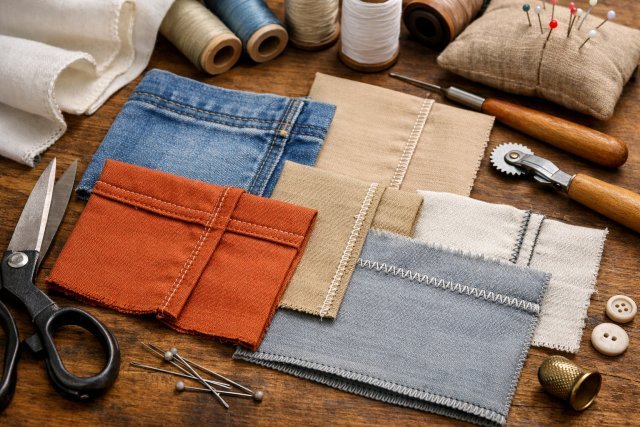
Nahttypen — also known as seam types — are the structural foundation of every sewn product. Whether you’re constructing garments, upholstery, sportswear, or technical textiles, understanding different Nahttypen determines durability, comfort, flexibility, and overall quality. The right seam can make a garment last years longer, while the wrong one may fail after only a few wears.
- What Are Nahttypen?
- Why Choosing the Right Nahttypen Matters
- 1. Superimposed Seam (SS) – The Basic Seam
- 2. Lapped Seam (LS) – Strong & Reinforced
- 3. Bound Seam (BS) – Clean & Decorative
- 4. Flat Seam (FS) – Stretch-Friendly Construction
- 5. Edge-Finished Seam (EF) – Clean Internal Finish
- 6. French Seam – Enclosed & Elegant
- 7. Taped Seam – Waterproof Applications
- Stitch Classes vs. Nahttypen
You’ll learn what Nahttypen are, how they’re classified, where each seam type is used, and how professionals choose the right seam for strength and performance. We’ll also explore stitch classes, durability standards, and practical tips that elevate your sewing from basic to professional level.
What Are Nahttypen?
Nahttypen refer to the structural methods used to join two or more pieces of fabric together. They differ in how fabric edges are aligned, enclosed, reinforced, or finished.
In industrial standards, seam types are often categorized under the ISO 4916 seam classification system, which defines seam constructions used in apparel and technical textiles. The system classifies seams into eight main categories based on construction method.
According to the International Organization for Standardization (ISO 4916), seam classification provides consistency in garment manufacturing and textile engineering. You can review the official ISO classification system here:
Understanding these classifications helps designers, tailors, and manufacturers ensure structural integrity and performance compliance.
Why Choosing the Right Nahttypen Matters
Selecting the correct seam type impacts:
- Durability and tensile strength
- Comfort and flexibility
- Waterproofing or windproofing
- Appearance and finish quality
- Production efficiency
Research from textile engineering studies shows that seam efficiency (the ratio between seam strength and fabric strength) directly affects product longevity. A seam with 70–80% efficiency is considered strong for most apparel applications (Source: Textile Research Journal).
For example, sportswear requires stretch-compatible seams, while denim jeans require reinforced seams capable of withstanding repeated stress.
Main Seam Classifications (ISO 4916)
Below are the primary seam categories under ISO standards. Each represents a fundamental Nahttypen structure used in apparel and industrial textiles.
1. Superimposed Seam (SS) – The Basic Seam
This is the most common seam type. Two fabric layers are placed on top of each other and stitched together.
Typical Uses:
- T-shirts
- Dresses
- Simple blouses
- Basic woven garments
It’s easy to construct and efficient for production. However, it may require finishing (like overlocking or zigzag stitching) to prevent fraying.
Professional Tip:
For woven fabrics, finish raw edges with a serger or bound seam to improve longevity.
2. Lapped Seam (LS) – Strong & Reinforced
In this seam, one fabric edge overlaps another. It is often used in heavy-duty garments.
Common Applications:
- Denim jeans (flat-felled seam)
- Workwear
- Outdoor gear
The flat-felled seam is one of the most durable Nahttypen in apparel manufacturing. It encloses raw edges and provides high strength.
Case Study Example:
Most premium denim brands use flat-felled seams in inseams because they withstand high abrasion and stress during movement.
3. Bound Seam (BS) – Clean & Decorative
A bound seam encloses the raw edge with binding fabric.
Used In:
- Unlined jackets
- High-end tailoring
- Decorative finishes
This seam enhances aesthetics while preventing fraying. It’s common in couture garments.
4. Flat Seam (FS) – Stretch-Friendly Construction
Flat seams are designed to reduce bulk and friction. Often used in activewear and compression garments.
Why It Matters:
Athletic clothing requires seams that stretch and sit flat against the skin to prevent chafing.
Brands like Nike and Adidas frequently use flatlock seams in performance wear for this reason.
5. Edge-Finished Seam (EF) – Clean Internal Finish
This seam type refers to superimposed seams where edges are finished separately (e.g., overlocked).
Ideal For:
- Mid-range ready-to-wear garments
- Production environments prioritizing speed
6. French Seam – Enclosed & Elegant
The French seam encloses raw edges completely inside the seam.
Perfect For:
- Sheer fabrics
- Silk blouses
- Lingerie
It prevents fraying and offers a clean interior finish without visible overlocking.
7. Taped Seam – Waterproof Applications
Taped seams are sealed with adhesive seam tape to prevent water penetration.
Used In:
- Rain jackets
- Technical outerwear
- Tents
According to outdoor textile testing standards, seam sealing is critical to achieving waterproof ratings above 5,000 mm hydrostatic head (Source: Outdoor Industry Association).
Stitch Classes vs. Nahttypen
It’s important not to confuse seam types with stitch classes.
Seam type (Nahttypen) refers to fabric construction.
Stitch class refers to the stitch formation used.
ISO 4915 classifies stitches into six main types:
- 100: Chain stitches
- 200: Hand stitches
- 300: Lockstitches
- 400: Multi-thread chain stitches
- 500: Overedge stitches
- 600: Covering chain stitches
For example, a flat-felled seam (lapped seam) may use a 300-class lockstitch or a 400-class chain stitch depending on manufacturing requirements.
How to Choose the Right Nahttypen
Choosing the right seam depends on five core factors.
1. Fabric Type
Lightweight fabrics benefit from French seams.
Heavy fabrics need reinforced seams like flat-felled.
2. Garment Function
Sportswear requires stretch seams.
Formalwear prioritizes clean interior finishing.
3. Durability Requirements
Workwear demands seams with high tensile strength and abrasion resistance.
4. Aesthetic Goals
Decorative seams can become design features.
5. Production Scale
Industrial sewing prioritizes speed and repeatability.
Seam Strength & Durability Insights
Seam failure accounts for a significant portion of garment returns in the apparel industry. According to quality control studies in textile manufacturing, seam slippage and thread breakage are among the top causes of product failure.
To maximize seam strength:
- Match thread type to fabric weight
- Use proper stitch density
- Avoid excessive tension
- Test seam efficiency before production
Professional manufacturers conduct seam strength testing using tensile machines to ensure compliance with ASTM D1683 standards.
Common Mistakes When Using Nahttypen
Using the wrong seam type can lead to:
- Fabric puckering
- Seam slippage
- Thread breakage
- Poor fit
- Visible bulk
Example Scenario:
A beginner uses a basic superimposed seam on heavy denim without reinforcement. After several washes, the inseam splits due to stress concentration. A flat-felled seam would have prevented this failure.
Frequently Asked Questions
What are the main types of Nahttypen?
The main Nahttypen include superimposed seams, lapped seams, bound seams, flat seams, French seams, and taped seams, each serving different structural and aesthetic purposes.
Which seam type is strongest?
Flat-felled (lapped) seams are among the strongest seam types due to double stitching and enclosed raw edges.
What seam is best for stretch fabrics?
Flatlock seams or stretch-compatible overlock seams are ideal for elastic fabrics.
Are Nahttypen and stitch types the same?
No. Nahttypen describe fabric construction methods, while stitch types describe how thread forms loops or locks to secure the fabric.
Expert Tips for Professional Results
Professional garment engineers follow three golden rules:
First, always test on scrap fabric before committing.
Second, evaluate seam bulk when layering fabrics.
Third, balance strength with flexibility rather than maximizing one.
Industrial manufacturers also perform wash testing and wear simulation to evaluate seam longevity before launching products.
Conclusion: Mastering Nahttypen for Better Sewing
Understanding Nahttypen transforms how you approach sewing. Instead of simply joining fabric pieces, you make strategic structural decisions that impact durability, comfort, and quality.
Whether you’re sewing a delicate silk blouse, constructing durable denim, or engineering waterproof outerwear, the correct seam type ensures professional-grade results.
Master the structure. Match the seam to the purpose. Test for durability.
That’s how professionals build garments that last.