The dual fuel cooker is becoming the go-to upgrade for people who cook often and want better results without changing their habits. It’s a simple idea with a big payoff: a gas hob for fast, responsive heat and an electric oven for steady, even baking and roasting. If you’ve ever wished your pasta water boiled faster, your sauces simmered more predictably, and your cakes baked more evenly, the dual-fuel setup is designed to deliver exactly that.
- What is a dual fuel cooker?
- Dual fuel cooker benefits that matter in everyday cooking
- Why so many kitchens are switching now
- Dual fuel cooker drawbacks you should know before buying
- Dual fuel cooker vs gas cooker vs electric cooker
- What to look for when buying a dual fuel cooker
- Real-world scenarios where dual fuel cookers shine
- FAQs about dual fuel cookers
- Conclusion: why a dual fuel cooker is winning over so many home cooks
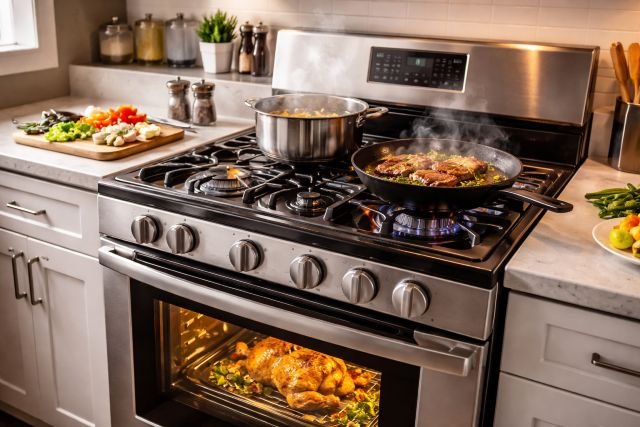
A dual fuel cooker combines a gas cooktop with an electric oven in a single appliance, so you can get the flame control many cooks love on top while relying on the temperature stability electric ovens are known for. Manufacturers describe dual fuel ranges in these terms: gas on the hob and electricity in the oven to take advantage of both fuel types.
This article breaks down the real-world benefits, what to look for when buying, what installation usually involves, and how to decide if switching makes sense for your kitchen and cooking style.
What is a dual fuel cooker?
A dual fuel cooker is a cooker (also called a range in many markets) that uses two energy sources. The hob burners are powered by gas, and the oven is powered by electricity. The goal is to give you the best of both worlds: quick, visible heat control on the hob and consistent heat performance in the oven.
People sometimes assume it means the cooker can switch between gas and electric for the same function. In most home models, it does not. It’s usually gas only on top and electric only in the oven.
Dual fuel cooker benefits that matter in everyday cooking
Gas hob control that feels immediate and intuitive
Most people who “switch” are chasing control. Gas hobs respond quickly because the heat changes as soon as you adjust the flame. That responsiveness makes it easier to go from a rolling boil to a gentle simmer without waiting for a heating element to catch up or cool down.
In a typical week, this helps with sauces that need steady reduction, pan-frying where you want fast recovery after adding cold ingredients, and any dish where you keep adjusting heat to avoid overcooking. It’s also psychologically easier for many cooks because the flame gives a visible cue, which reduces guesswork.
Electric oven consistency for baking and roasting
The other half of the dual fuel cooker appeal is the oven. Many brands and service guides explain dual fuel ranges as pairing a responsive gas cooktop with an electric oven designed for precision and more even performance.
In real kitchens, “consistent heat” is what makes baking less stressful. Cakes rise more evenly, cookies brown more predictably, and roasts cook more uniformly without forcing you to rotate trays and shift pans as often. Even if you’re not a dedicated baker, electric oven stability tends to show up in everyday food too, especially when you batch roast vegetables, reheat casseroles, or cook multiple dishes at once.
Convection cooking that can speed up meals and improve browning
A large number of electric ovens in dual fuel cookers come with convection modes. Convection uses a fan to circulate hot air, which can reduce hot spots and speed up cooking. If you regularly cook sheet-pan meals, roast chicken, or bake multiple trays, convection can make your timing more forgiving and your results more even.
The advantage becomes obvious when you’re feeding a family or hosting guests. Faster, more even cooking means less kitchen congestion, fewer “one tray at a time” compromises, and less last-minute panic that something will be underdone or overbrowned.
Better performance for multi-dish cooking and entertaining
A dual fuel cooker often shines when you cook several components at once. You can keep sauces and sides going on the gas hob while the electric oven handles the main dish more predictably. The practical benefit is not just quality, but flow. The cooking process feels smoother, because the appliance supports two different types of control in two different zones.
If your current setup forces you to micromanage oven heat or babysit tray placement, dual fuel can feel like you’ve gained “mental space” during cooking. That’s one of the most underrated benefits: fewer adjustments, fewer surprises.
A premium-feel upgrade without learning a new cooking system
Many people consider induction but hesitate because it feels like a bigger change. Dual fuel tends to feel familiar right away. You still cook on flame, you still use your current cookware (in most cases), and the oven becomes the area where you notice the performance jump.
That makes dual fuel a popular “safe upgrade” for households where different people cook and everyone wants it to be intuitive from day one.
Why so many kitchens are switching now
Renovation decisions are becoming more performance-driven
Kitchen upgrades aren’t just about looks anymore. People want appliances that make everyday cooking easier and more reliable. Dual fuel fits that shift because it offers a tangible difference in control and consistency without requiring a complete rethink of how you cook.
It’s also a common choice when someone wants to step up from entry-level appliances to something that feels more professional at home.
Efficiency standards are pushing design improvements across cookers
Cooking appliances are also influenced by energy policy and efficiency standards. In the U.S., the Department of Energy finalized updated efficiency standards for residential cooking products in early 2024, framing them as cost-saving and manufacturer-backed.
Even if you’re not shopping in the U.S., the broader pattern is similar in many markets: newer models are often better insulated, better controlled, and built with improved performance baselines. Dual fuel cookers benefit from that trend, especially in the oven category where insulation, control, and airflow design matter a lot.
Dual fuel cooker drawbacks you should know before buying
Installation usually requires both gas and higher-voltage electric
This is the biggest “surprise” for many buyers. A dual fuel cooker typically needs a gas hookup for the hob and a higher-voltage electrical supply for the oven. Wolf’s guidance for dual fuel range electrical requirements states the unit requires a 240/208V power supply and won’t work on a standard 120V supply.
That means switching may involve an electrician if your kitchen doesn’t already have the appropriate circuit. The cost and complexity vary by home, but it’s important to plan for it early so you don’t buy the cooker and then discover your wiring setup can’t support it.
You still have gas combustion on the hob, so ventilation remains important
Dual fuel is not the same as going fully electric. If your priority is reducing indoor combustion, dual fuel doesn’t eliminate that because the hob is still gas. For many households, the practical takeaway is to treat ventilation as part of the purchase decision, not an afterthought.
A good extractor hood, ideally ducted outside, can make a noticeable difference in comfort and indoor air quality during cooking.
Upfront cost is often higher than single-fuel cookers
Dual fuel cookers frequently sit in a higher tier of product lines. You may pay more upfront compared to an all-gas or all-electric cooker of similar size. The value equation improves if you bake often, cook large meals, or keep appliances for many years, because you benefit from performance every week.
Dual fuel cooker vs gas cooker vs electric cooker
Dual fuel cooker: best for cooks who want control and consistency
A dual fuel cooker is a strong fit if you love gas cooking on the hob and also care about oven results. It’s especially compelling if you bake, roast, or cook multiple dishes often.
Gas cooker: best for simplicity and lower installation hassle
A full gas cooker can be simpler to install in homes already set up for gas, and it can be a good option for people who cook mostly on the hob and don’t mind oven variability. It can also appeal to those who prefer a consistent fuel type across the whole appliance.
Electric cooker or induction: best for electrification-first households
If your main goal is reducing combustion indoors or you don’t have gas service, going all-electric or induction may fit better. Induction, in particular, can offer fast, precise control, though it’s a different cooking feel than flame.
If you’re building internal content, a useful internal link here would be something like: /dual-fuel-vs-gas-vs-electric-cooker.
What to look for when buying a dual fuel cooker
Focus on the oven first, because that’s where dual fuel earns its keep
Most buyers already understand why gas feels good on the hob. The smarter shopping move is to compare ovens. Look closely at oven capacity, temperature controls, convection options, rack positions, and whether the oven is designed to hold stable temperatures for longer bakes.
A cooker that looks similar on the outside can perform very differently in the oven.
Burner spacing and low-simmer control matter more than maximum power
High heat is nice, but everyday cooking is often about control at the low end. If you cook sauces, rice, or delicate foods, low-simmer performance matters. Also consider whether the burners are spaced well enough to use two large pans comfortably, because cramped layouts can be frustrating long-term.
Check the electrical requirements before you commit
Because dual fuel cookers commonly require a 240/208V supply, verifying your kitchen’s electrical readiness is a must. Wolf’s official support guidance is explicit about this requirement.
If you want to support a claim on your site with a source link, that Wolf requirement page is one of the cleanest authoritative references.
A strong internal link opportunity here is a practical installation guide like: /dual-fuel-cooker-installation-requirements.
Measure carefully and plan ventilation early
Cooker width and depth are only part of the story. You’ll also need to think about how the cooker fits with cabinetry, how the power and gas connections sit behind it, and what extractor solution you’ll use. In many kitchens, upgrading the cooker is the moment people finally upgrade ventilation too, because they’re already moving things around.
Real-world scenarios where dual fuel cookers shine
The weekday cook who bakes on weekends
If you cook fast meals Monday to Friday and bake on weekends, dual fuel can feel perfect. The hob stays responsive for quick dinners, while the oven becomes more reliable for breads, cakes, tray bakes, and pizzas. The biggest quality-of-life improvement is predictability. You stop “learning a new oven” every time you bake because results become more repeatable.
The entertainer who cooks multiple dishes at once
If you host, you’re often juggling timing: mains, sides, and something finishing in the oven while you keep sauces and sautéed sides moving on the hob. A dual fuel cooker supports that workflow naturally. You’re less likely to get delayed by an oven that browns unevenly or takes longer than expected to stabilize.
FAQs about dual fuel cookers
Is a dual fuel cooker worth it?
A dual fuel cooker is worth it if you want gas control on the hob and you care about consistent oven performance for baking and roasting. It’s less worth it if you rarely use the oven or if your kitchen would require major electrical work to support the required power supply. Wolf notes dual fuel ranges require a 240/208V supply and won’t run on standard 120V power.
Do dual fuel cookers need special wiring?
Most do, because the electric oven often requires a higher-voltage supply. Always check the installation requirements for the exact model you’re considering. Wolf’s dual fuel electrical requirements state the need for a 240/208V supply.
What are the biggest benefits of a dual fuel cooker?
The most meaningful benefits are responsive gas cooking on the hob and the more stable performance of an electric oven, which supports better baking and roasting. Manufacturers commonly define dual fuel ranges as combining a gas cooktop with an electric oven to take advantage of both fuel types.
Is dual fuel better than induction?
It depends on what you value. Dual fuel keeps flame cooking, which many people love for control and familiarity. Induction can be very fast and precise and removes combustion from the kitchen, but it changes the cooking experience and may require cookware checks. A good internal link here would be: /dual-fuel-vs-induction.
Conclusion: why a dual fuel cooker is winning over so many home cooks
The dual fuel cooker is popular because it solves a real kitchen problem: you shouldn’t have to choose between the control of gas cooking and the consistency of an electric oven. By combining a gas hob with an electric oven, it delivers fast responsiveness on top and steady performance for baking and roasting where it matters most.
If you cook frequently, bake even occasionally, or entertain at home, dual fuel can make your results more predictable and your cooking process smoother. Just plan the switch carefully, especially the electrical supply requirement, because many dual fuel ranges need 240/208V power and won’t work on standard 120V.