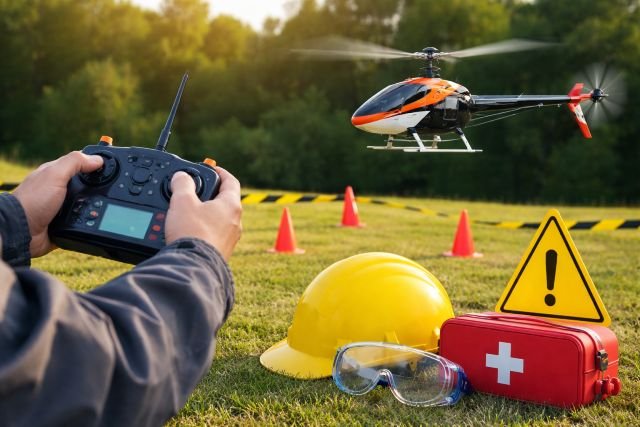
Flying a remote control helicopter is one of those hobbies that looks easy until you try it. The machine feels alive, the controls feel sensitive, and the smallest mistake can turn into a tip-over, a broken blade, or a scary moment near people and property. The good news is that most crashes and injuries are not “bad luck.” They usually come from predictable causes like rushing setup, flying in the wrong place, ignoring wind, or mishandling batteries.
- What remote control helicopter safety really means
- Why most RC helicopter crashes happen before the helicopter even lifts off
- The pre-flight routine that prevents expensive repairs
- Pick a safe place to fly your remote control helicopter
- Wind safety: the most underrated crash trigger
- Battery safety: prevent swelling, overheating, and fires
- Safe handling on the ground: where many injuries actually happen
- Training the safe way: how to learn without crash cycles
- The most common beginner mistakes that cause crashes and injuries
- Mechanical setup tips that keep your remote control helicopter predictable
- Safe flight planning: the small choices that prevent big problems
- FAQ: quick answers for safe flying
- Conclusion: remote control helicopter safety is a skill you build
This article walks you through safety in a way that actually reduces crashes, prevents injuries, and saves money on repairs. You’ll learn what to check before takeoff, how to choose a safe flying site, how to handle lithium batteries responsibly, and how to train your skills without pushing into panic territory. If you’re new, this will help you build confidence without sacrificing safety. If you’ve flown before, it’ll refresh the habits that separate “smooth pilot” from “constant rebuilds.”
What remote control helicopter safety really means
Remote control helicopter safety is not a single trick. It’s a system made up of planning, mechanical checks, smart flying decisions, and disciplined battery care. When people say they want to “avoid crashes,” they’re usually describing three goals at the same time: keeping people safe, keeping property safe, and keeping the helicopter safe.
People safety matters because spinning rotors can cut skin, and a fast-moving heli can injure someone even without blade contact. Property safety matters because windows, cars, and nearby homes are unforgiving targets. Equipment safety matters because a crash often damages parts you can’t see right away, leading to vibration, instability, and more crashes later.
Once you think of safety as a system, you stop relying on luck. You start relying on routines.
Why most RC helicopter crashes happen before the helicopter even lifts off
A large percentage of “mystery crashes” are not caused by flying skill. They come from skipped steps. When a remote control helicopter flips instantly on takeoff, drifts uncontrollably, or suddenly yaws hard, it’s often a setup issue such as incorrect gyro compensation, reversed controls, loose blade grips, or binding linkages.
The fix is simple, but it has to be consistent. You need a quick pre-flight routine that is short enough to actually do every time, but thorough enough to catch the common failure points.
The pre-flight routine that prevents expensive repairs
Before each flight, you want to confirm that nothing is loose, cracked, reversed, or binding. Blades should be secure and free of cracks. Linkages should be connected firmly and move smoothly. The main shaft and feathering shaft should be straight enough that there’s no visible wobble. The tail system should be secure, with correct belt tension or gear mesh depending on your design. Servos should move freely without grinding sounds, and the helicopter should respond correctly to your inputs.
The most important “safety check” for many modern helicopters is gyro direction. If the gyro or flight controller is compensating in the wrong direction, the helicopter will amplify movement instead of stabilizing it. A quick test on the ground, where you gently tilt the heli and verify the system pushes back the correct way, can prevent a dramatic first-second crash.
If you just repaired something, treat the next flight like a test flight. Start with a gentle spool-up and a low hover. You’re not trying to prove anything. You’re confirming that the helicopter is healthy.
Pick a safe place to fly your remote control helicopter
Where you fly often matters more than what you fly. Even a stable helicopter becomes unsafe when flown near people, vehicles, power lines, or tight backyards. The safest sites are open and predictable, with clear space in every direction and minimal foot traffic.
A dedicated RC club field is usually the best option because it has clear flight rules, a defined pilot line, and a culture of safety. A large open field can also work well when it’s not crowded and when you can maintain distance from others. What you want to avoid are busy parks, playgrounds, sidewalks, parking lots, and any location where someone can wander into your flight path unexpectedly.
Distance is your friend. A practical safety mindset is to treat the area around the helicopter as an “injury zone” and keep people and pets outside it. The exact distance depends on helicopter size, speed, and your experience, but the principle stays the same. If losing control for two seconds could put the helicopter near a person, you’re too close.
Wind safety: the most underrated crash trigger
Wind doesn’t just push the helicopter. It can turn smooth air into turbulence, especially near trees, fences, and buildings. Turbulence is what creates those sudden drops or sideways surges that feel like the helicopter “got slapped” mid-hover. Beginners often underestimate how quickly wind can overwhelm their correction speed and orientation skills.
A good beginner rule is simple. If you can’t hold a hover without constant aggressive corrections, the conditions are beyond your current comfort level. Calm air helps you learn. Windy air punishes mistakes and teaches panic reactions. Early morning and late afternoon often offer smoother conditions than the middle of the day, depending on your local weather patterns.
When you do fly in wind, give yourself more space than usual. Wind increases drift, and drift turns into collisions when you’re near obstacles.
Battery safety: prevent swelling, overheating, and fires
Many remote control helicopters use lithium-based batteries because they offer high power for their weight. The tradeoff is that lithium batteries demand respect. Batteries can overheat or become dangerous when charged incorrectly, damaged in crashes, stored improperly, or used beyond their limits.
Your safest routine starts with charging. Charge batteries on a non-flammable surface in a clear area, away from papers, fabrics, and clutter. Use a quality charger and confirm the correct battery type and settings before starting. Never charge a battery that is physically damaged, swollen, leaking, unusually hot, or smells strange. If a battery was involved in a crash, inspect it closely before charging or using it again. A pack that “looks fine” can still have internal damage.
Storage also affects safety and lifespan. Storing packs fully charged for long periods can accelerate wear and swelling. Storing packs completely empty can also cause problems. If you won’t fly for a while, storing at a moderate charge level is generally healthier. Keep packs in a cool, dry place, away from direct sunlight and heat sources.
Battery discipline does more than prevent worst-case scenarios. It reduces voltage sag, improves performance, and makes the helicopter feel more predictable in the air, which itself prevents crashes.
Safe handling on the ground: where many injuries actually happen
Some of the scariest moments happen when the helicopter is not “flying” in your mind, such as arming, spooling up, and walking toward the model after landing. A spinning rotor is still a spinning rotor, even if you’re proud of that perfect touchdown.
A safe habit is to treat the helicopter as dangerous any time the battery is connected and the motor could spool. Keep your hands and face away from the rotor disk. Avoid leaning over the model to “fix something quickly” while it’s armed. After landing, lower the throttle fully and wait until the blades stop before approaching. If something feels wrong during spool-up, such as vibration, unusual noise, or yaw twitching, disarm and investigate before trying again.
If you fly with spectators, especially kids, set the rule early: people stay behind you and do not approach until you say it’s safe. This single boundary prevents an enormous number of near-misses.
Training the safe way: how to learn without crash cycles
The safest pilots usually follow a boring training path. It’s boring because it works.
Start with tail-in hovering, where the helicopter’s tail faces you and left/right controls match your perspective. Practice holding position and height smoothly. Keep the hover low enough that a mistake won’t become a high-energy crash, but high enough that the helicopter isn’t constantly getting disturbed by ground turbulence. Knee-to-waist height is a common range for early practice depending on conditions and model size.
Once tail-in hover feels calm, move to side-in hover. Side-in is where many people start to feel disoriented, so the goal is to hold a stable position without “stirring the sticks.” Then practice the other side-in orientation. Only after both sides are comfortable should you move to nose-in hover, which is the biggest mental flip for most beginners.
After hovering, start gentle circuits. The key word is gentle. Smooth turns and consistent speed teach control. Fast, jerky moves teach adrenaline.
If your helicopter has a stabilization or training mode, use it intentionally. It’s not cheating. It’s a tool that helps you build orientation and muscle memory with fewer high-impact consequences. The goal is not to rely on stabilization forever. The goal is to reduce early crashes so you stay motivated and safe.
The most common beginner mistakes that cause crashes and injuries
One common mistake is overcorrecting. Beginners tend to input too much stick, then too much the other way, creating a wobble that grows. The better approach is small corrections and a short pause to let the helicopter respond. Helicopters don’t behave like video games. They need time to settle.
Another mistake is flying too close because it feels easier to see. In reality, flying close reduces reaction time and increases risk. If you want better visibility, consider a larger helicopter, a brighter canopy, high-contrast blades, or better lighting conditions. Don’t “solve” visibility by sacrificing distance.
A third mistake is trying to save a bad situation with aggressive throttle changes. Sudden collective changes can destabilize the helicopter and increase damage when contact happens. In many situations, a calmer approach is to reduce collective slightly, level the heli, and then climb away smoothly once stable.
Finally, there is the “post-crash rush.” After a tip-over, many pilots reconnect and try again immediately. That’s when unseen damage causes the next crash to be worse. A crash should always be followed by a quick inspection before you fly again.
Mechanical setup tips that keep your remote control helicopter predictable
Predictable helicopters are safer helicopters because predictability reduces panic corrections.
Blade tightness matters. If blades are too loose, they can flap excessively and reduce stability. If they are too tight, they can stress grips and reduce the ability to fold in a strike. You want a firm, consistent feel.
Vibration is another big safety issue because it can confuse sensors and degrade control. Bent shafts, chipped blades, and unbalanced parts can all create vibration. If your helicopter suddenly feels “nervous” after a crash, don’t assume you forgot how to fly. Assume you introduced vibration or mechanical slop and investigate.
Control linkages should be smooth and secure. Any binding can cause servo stress and unpredictable response. Any loose linkage can pop off mid-flight, which often ends in a crash.
If you’re using a programmable radio, set sensible rates and expo. Too aggressive a setup makes the helicopter twitchy and increases the chance of overcorrection. A calmer setup is safer while learning and often still feels better even for experienced pilots when doing precision hovering.
Safe flight planning: the small choices that prevent big problems
Safe flights often come down to simple planning. Fly when you’re not rushed. Fly when you’re alert. Avoid flying when you’re irritated, distracted, or trying to squeeze in “one last pack” in bad conditions. The decision-making quality drops fast when you’re tired.
Also plan the “what if.” Decide where you will steer the helicopter if something goes wrong. Pilots who already have an escape direction in mind react faster and more safely. That direction should always be away from people, property, and obstacles.
If you’re flying somewhere public, keep a mental boundary. If people enter your safe zone, land and wait. It’s not awkward. It’s responsible.
FAQ: quick answers for safe flying
What is the safest way to start flying a remote control helicopter? The safest start is a large open area, calm wind, a stabilization mode if available, and a focus on tail-in hover training at a controlled height. That combination gives you time to react and lowers the consequences of early mistakes.
Why does my remote control helicopter tip over on takeoff? Sudden tip-overs often come from incorrect gyro direction, reversed controls, uneven spool-up technique, a mechanical bind, or vibration from bent shafts or damaged blades. A ground test of gyro compensation and a quick mechanical inspection often reveal the cause.
How can I prevent injuries while flying? Keep people and pets at a safe distance, maintain a clear flight area, keep spectators behind you, and treat the rotor disk as dangerous any time the battery is connected. After landing, wait for blades to stop before approaching.
How do I reduce repair costs over time? Repair costs drop when you prevent the common crash triggers. Fly in safe open areas, avoid wind beyond your skill level, use small control corrections, inspect after crashes, and maintain the helicopter so vibration and loose parts don’t snowball into bigger failures.
Conclusion: remote control helicopter safety is a skill you build
A remote control helicopter rewards patience. The pilots who crash less and spend less on repairs are usually not the most fearless. They’re the most consistent. They do quick checks before every flight, they choose safe flying locations, they respect wind, they handle batteries responsibly, and they train in a progression that builds real control.
If you commit to those habits, you’ll notice something quickly. Your helicopter becomes easier to fly because it stays healthy and predictable. Your confidence grows because you’re not relying on luck. And the hobby becomes what it’s supposed to be: fun, challenging, and safe.