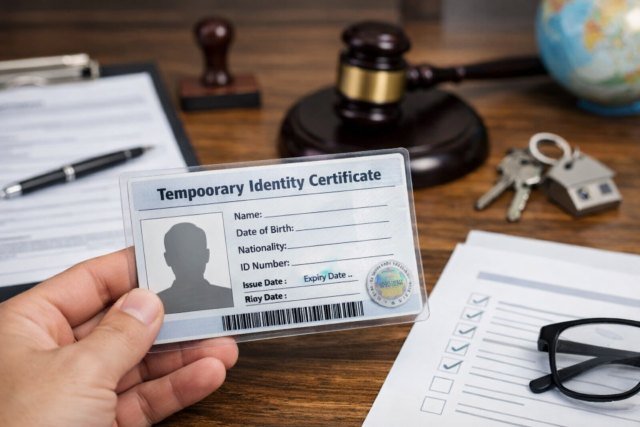
A Temporary Identity Certificate is an essential document issued to individuals who need a provisional form of identification when standard identification is unavailable, lost, or under processing. Whether due to administrative delays, emergencies, or transitional legal status, this certificate plays a critical role in ensuring continuity of access to essential services.
- What Is a Temporary Identity Certificate?
- Why Is a Temporary Identity Certificate Important?
- Requirements for Obtaining a Temporary Identity Certificate
- Eligibility Criteria for a Temporary Identity Certificate
- The Process of Applying for a Temporary Identity Certificate
- Benefits of a Temporary Identity Certificate
- Common Use Cases of a Temporary Identity Certificate
- Legal Validity and Limitations
- Temporary Identity Certificate vs Permanent ID
- How to Avoid Delays in the Application Process
- Digital Transformation of Temporary Identity Certificates
- Frequently Asked Questions (FAQ)
- Conclusion
In today’s increasingly regulated world, identity verification is required for nearly every formal interaction — from banking and healthcare to travel and employment. A Temporary Identity Certificate bridges this gap, offering a legally recognized alternative until a permanent identity document is issued.
What Is a Temporary Identity Certificate?
A Temporary Identity Certificate is an official document issued by a government authority that serves as a short-term proof of identity. It is typically granted when an individual is awaiting the issuance of a permanent ID card, passport, or national identification number.
Unlike permanent identification documents, this certificate has a limited validity period. However, during this time, it holds legal value and can be used for various administrative and personal purposes.
In many countries, temporary identity documentation is part of a broader identity management system designed to ensure no individual is excluded from essential services due to delays or unforeseen circumstances.
Why Is a Temporary Identity Certificate Important?
The importance of a Temporary Identity Certificate lies in its ability to maintain an individual’s functional identity within legal and administrative systems.
Without valid identification, individuals may face challenges such as inability to open bank accounts, access healthcare services, enroll in educational institutions, or even verify employment eligibility.
According to the World Bank’s Identity for Development (ID4D) initiative, over 850 million people globally lack official identification, which limits their access to services and economic opportunities. A Temporary Identity Certificate helps mitigate such gaps by providing interim recognition.
Requirements for Obtaining a Temporary Identity Certificate
The requirements for obtaining a Temporary Identity Certificate may vary depending on the country or issuing authority. However, certain common prerequisites are typically observed across jurisdictions.
Applicants are generally required to provide proof of their identity through alternative means. This may include expired identification documents, birth certificates, or affidavits confirming identity.
Additionally, supporting documents such as proof of residence, recent photographs, and application forms are often mandatory. In some cases, biometric verification, including fingerprints or facial recognition, may also be required.
Applicants may also need to demonstrate the reason for requesting the temporary certificate. This could include loss of original documents, pending issuance of a national ID, or urgent need for identity verification.
It is advisable to check with the relevant government department or authority to confirm specific documentation requirements before applying.
Eligibility Criteria for a Temporary Identity Certificate
Eligibility for a Temporary Identity Certificate is generally determined based on the applicant’s situation and need for temporary identification.
Individuals who have lost their official ID documents are typically eligible, provided they can offer alternative proof of identity. Similarly, applicants awaiting new or renewed identification documents may qualify.
In some cases, refugees, migrants, or individuals undergoing legal status changes may also be issued temporary identity certificates to facilitate access to services.
Government authorities may conduct verification checks before issuing the certificate to prevent misuse or fraudulent claims.
The Process of Applying for a Temporary Identity Certificate
The process of obtaining a Temporary Identity Certificate is usually straightforward but requires careful attention to detail.
Applicants begin by submitting an application form, either online or at a designated government office. This form includes personal details such as name, date of birth, address, and reason for requesting the certificate.
Once the application is submitted, supporting documents are reviewed by the issuing authority. This stage may involve verification of identity through existing records or third-party validation.
After successful verification, the Temporary Identity Certificate is issued. In many cases, it is provided within a few days, although processing times can vary depending on administrative efficiency.
Some governments have digitized this process, allowing applicants to track their application status online and receive digital copies of their certificates.
Benefits of a Temporary Identity Certificate
A Temporary Identity Certificate offers several practical and legal benefits that make it an indispensable document in transitional situations.
One of its primary advantages is uninterrupted access to essential services. Individuals can continue to engage in activities such as banking, healthcare, and education without disruption.
It also ensures compliance with legal requirements. Many jurisdictions mandate identity verification for transactions and services, and this certificate fulfills that requirement.
Another significant benefit is its role in safeguarding individuals from identity-related exclusion. By providing a recognized form of identification, it prevents marginalization and supports social inclusion.
Furthermore, it acts as a bridge between identity loss and restoration, ensuring that individuals remain functional within administrative systems.
Common Use Cases of a Temporary Identity Certificate
A Temporary Identity Certificate is used in various real-world scenarios where immediate identity verification is necessary.
For instance, individuals who have lost their national ID cards may use this certificate to prove their identity while waiting for replacements. Similarly, travelers who misplace their passports can rely on temporary documentation to navigate administrative processes.
Students enrolling in educational institutions may also use temporary identity certificates if their official documents are pending. Likewise, employees may need it for onboarding procedures when their permanent ID is unavailable.
In healthcare settings, patients without valid ID can present a Temporary Identity Certificate to access medical services without delay.
Legal Validity and Limitations
While a Temporary Identity Certificate is legally recognized, it comes with certain limitations that users should be aware of.
Its validity period is typically short, ranging from a few weeks to several months. Once expired, it must either be renewed or replaced with a permanent identity document.
Additionally, some institutions may impose restrictions on its use. For example, it may not be accepted for international travel or high-security transactions.
Users are advised to verify the scope of acceptance with relevant institutions before relying on the certificate for critical purposes.
Temporary Identity Certificate vs Permanent ID
The key difference between a Temporary Identity Certificate and a permanent ID lies in duration and scope.
A permanent ID is issued after comprehensive verification and serves as a long-term identity document. It is widely accepted across all sectors and typically has a longer validity period.
In contrast, a Temporary Identity Certificate is provisional and intended for short-term use. While it offers essential functionality, it does not replace the need for a permanent identity document.
How to Avoid Delays in the Application Process
To ensure a smooth application process for a Temporary Identity Certificate, applicants should take proactive measures.
Providing accurate and complete information is crucial. Errors or inconsistencies can lead to delays or rejection.
Submitting all required documents at the time of application helps streamline verification. Missing documents often result in additional processing time.
Applicants should also keep track of their application status and respond promptly to any requests for additional information.
Digital Transformation of Temporary Identity Certificates
Many governments are adopting digital solutions to improve the issuance and management of Temporary Identity Certificates.
Digital certificates can be accessed via mobile applications or online portals, making them more convenient and secure. These systems often incorporate QR codes or blockchain technology to prevent forgery.
According to a report by McKinsey on digital identity systems, digital IDs can unlock economic value equivalent to 3–13% of GDP in emerging economies.
This shift toward digital identity solutions enhances accessibility and reduces administrative burdens for both applicants and authorities.
Frequently Asked Questions (FAQ)
What is a Temporary Identity Certificate used for?
A Temporary Identity Certificate is used as a short-term proof of identity when permanent identification documents are unavailable or under processing.
How long is a Temporary Identity Certificate valid?
The validity period varies by country but typically ranges from a few weeks to several months.
Can I use a Temporary Identity Certificate for travel?
In most cases, it is not accepted for international travel but may be used for domestic verification.
Is a Temporary Identity Certificate legally valid?
Yes, it is legally recognized for specific purposes within its validity period.
How can I apply for a Temporary Identity Certificate?
You can apply through a government office or online portal by submitting required documents and completing the application form.
Conclusion
The Temporary Identity Certificate is a vital document that ensures individuals remain connected to essential services during periods of identity transition. Whether dealing with lost documents, administrative delays, or legal changes, this certificate provides a reliable and legally recognized solution.
Understanding the requirements, benefits, and process of obtaining a Temporary Identity Certificate empowers individuals to navigate identity challenges efficiently. As governments continue to digitize identity systems, the accessibility and effectiveness of temporary identification solutions are expected to improve further.