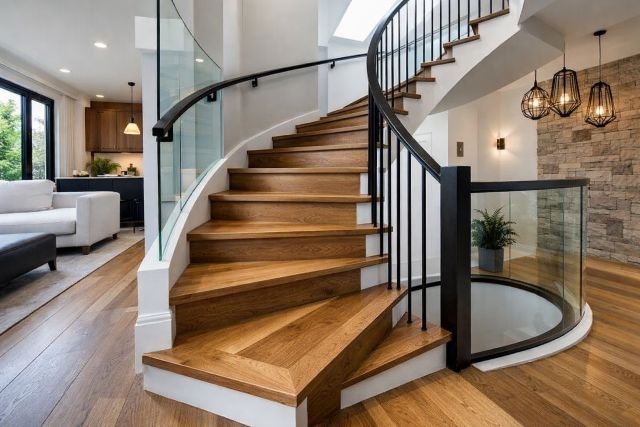
A winder stair is a staircase that changes direction without a flat landing by using wedge-shaped steps. You’ll commonly see winders used to create a quarter turn (about 90 degrees) or a half turn (about 180 degrees), especially in homes where space is limited or where the stair needs to tuck into a corner.
- Why Winders Fit Modern Stair Design So Well
- The Safety Conversation: What Matters Most With Winders
- The Practical Advantages of Winders in Real Homes
- Winders vs. Landings vs. Spiral Stairs
- How to Design Winders the Right Way
- A Real-World Scenario Where Winders Unlock the Layout
- FAQs About Winders
- Conclusion: Why Winders Are the Smart Choice for Modern Stair Designs
The key idea is simple: instead of stepping onto a rectangular platform to turn, you turn while still stepping on treads. That continuity is one reason winders feel visually “modern.” There’s less interruption in the line of the stair, and the geometry can look crisp and architectural when it’s laid out with care.
Why Winders Fit Modern Stair Design So Well
Modern stair design usually aims to do three things at once: protect usable floor area, keep circulation clean, and contribute to the home’s visual identity. Winders can hit all three, which is why they show up so often in contemporary plans.
Winders save space without shrinking the experience
A landing consumes floor area, and in compact homes that space is often the difference between a comfortable living zone and an awkward one. Winders replace that platform with turning treads, often allowing the stair to rotate within a smaller footprint. In real projects, that can free up space for storage, a wider hallway, a better kitchen layout, or simply more breathing room in the main living area.
This is especially valuable in townhouses, ADUs, loft conversions, narrow-plan homes, and remodels where the stair has to live inside a tight structural “box.”
Winders can create a more seamless, high-end look
Modern interiors often treat the staircase as part of the architecture, not just a functional connector between floors. Winders naturally create a sculptural moment because the turn fans out through the space. When the detailing is modern, such as clean balustrade lines, a continuous handrail, and well-chosen finishes, the winder turn reads like an intentional design move rather than a space-saving trick.
The visual benefit is also practical. Because winders can keep the stair compact, they can help you position the stair where it supports the flow of the plan instead of dominating it.
Winders are recognized by code when designed around the walkline
Winders get criticized most often when they’re poorly designed. The issue is rarely the concept; it’s the execution. Good winders feel predictable. Bad winders feel like the steps are “changing under you.”
Codes address that predictability through walkline-based measurements. In the 2021 International Residential Code (IRC), winder treads must be at least 10 inches deep when measured at the walkline, and at least 6 inches deep at any point within the clear width of the stair. This is a big deal because it tells you where the stair must work best: along the path people naturally use when they walk through the turn.
The International Building Code (IBC) also defines the walkline location for winder treads as 12 inches from the side where the treads are narrower. Even if your project is residential, this definition is helpful because it explains the logic: the walkline is a consistent “design path” through the turn, not just a drafting detail.
The Safety Conversation: What Matters Most With Winders
Any staircase can be risky if it’s dim, inconsistent, or lacking a reliable handhold. With winders, the turn adds an extra layer of complexity, so the details matter more. This is not just a design opinion; it’s a real safety issue.
The CDC reports that falls are the leading cause of injury for adults age 65 and older, and that over 14 million older adults, about one in four, report falling each year. While that statistic is broader than stairs alone, it highlights why stair design choices should be deliberate, especially in homes meant to be lived in for decades.
Research also points to the role of the home environment in stair fall risk. A recent PLOS ONE paper discussing stair falls and older adults notes hazards commonly linked to falls such as poor lighting, missing or poorly designed handrails, and challenging stair dimensions. In other words, the “feel” of a stair is not just aesthetics; it’s a usability and safety outcome.
What makes winders feel safe and comfortable?
Safe-feeling winders usually share a few traits. First, the stepping zone feels consistent because the tread depth at the walkline is steady. The IRC’s minimum tread depth requirement at the walkline exists for exactly this reason. Second, the handrail is continuous through the turn, so the user can keep a stable grip while rotating their body. Third, the turn is well-lit, reducing shadow confusion and misreads of the tread edge. Finally, the geometry avoids extreme “knife-edge” corners that create awkward foot placements near the inside of the turn.
When those elements are in place, winders can feel as normal as many landing turns, and in some modern homes they feel more natural than a tight spiral.
The Practical Advantages of Winders in Real Homes
Winders are excellent for tight footprints and corner stairs
A major reason designers choose winders is that they allow a direction change without reserving floor area for a landing. In narrow footprints, this can be the difference between a stair that fits gracefully and one that forces compromises across the entire floor plan.
If your stair needs to rotate around a tight core, or if the plan has a corner location that would otherwise become dead space, winders can be a clean solution. That’s why they’re common in compact multi-story homes and space-conscious remodels.
Winders support open-plan circulation
Open-plan interiors typically avoid chopped-up hallways and bulky circulation zones. A landing can feel like an interruption in the room, especially if the stair is near living or dining areas. Winders let you maintain a more continuous stair line, which often reads “lighter” visually and can help the room feel bigger.
In modern design, where the stair is often visible from multiple angles, this continuity can be a major aesthetic win.
Winders can reduce disruptive remodeling moves
In renovations, adding or enlarging a landing might require reframing, relocating doorways, or shrinking adjacent rooms. A well-designed winder turn can sometimes fit into an existing stair envelope more easily than a landing turn, especially when structural constraints limit how much you can expand the opening.
This doesn’t mean winders are always easier to build. It means they can sometimes be easier to fit into an existing plan without triggering a chain reaction of changes elsewhere.
Winders vs. Landings vs. Spiral Stairs
Winders usually enter the conversation when a stair must turn but space is limited, or when the homeowner wants a more modern, continuous look.
A landing-based turn often feels more forgiving, especially in high-traffic homes, because the landing provides a rest point and a clear pivot. If the household includes people with mobility challenges, or if you anticipate frequent two-way traffic on the stairs, landings can be the more comfortable choice.
Spiral stairs can be extremely compact, but they often feel steeper and more restrictive when carrying items. The walk path can be tighter, and the turning motion is constant rather than transitional. Winders often feel more “like a normal stair” than a tight spiral because the stepping path can be designed around a practical walkline.
How to Design Winders the Right Way
Design for the walkline first
If you want winders that feel effortless, start with the walkline. The IRC’s language is explicit about measuring minimum tread depth at the walkline, and it sets a minimum depth anywhere in the clear width as well. That structure tells you what matters: the stair must work where people actually step, not only where it looks most symmetrical.
The IBC’s definition of walkline placement, 12 inches from the narrow side, helps clarify where that stepping path typically sits in a turning stair.
Keep the “walking zone” consistent
People rarely step at the tightest inner corner of a winder. They naturally drift toward the walkline, where the tread is more usable. If the tread depth in that zone changes abruptly from one step to the next, the body’s rhythm breaks, and that’s when missteps happen.
In practice, the best winders feel like a smooth sequence, not like three unrelated wedges.
Prioritize a continuous handrail through the turn
The turn is where users most rely on a stable handhold because their body orientation changes mid-flight. If the handrail breaks, shifts awkwardly, or forces a re-grip at the exact moment of turning, the stair feels less secure.
This aligns with what researchers and safety-focused reviews emphasize: handrail use and environmental improvements like lighting can reduce fall risk on stairs.
Light the turn like it’s the focal point
Modern stairs often include intentional lighting anyway, and winders benefit especially from it. Even, glare-free light around the turning area helps users read tread edges and understand the geometry. If the stair is near a window that creates strong shadows, lighting becomes even more important at dusk and nighttime.
Choose materials that support traction and durability
A modern stair can look sleek without becoming slippery. High-gloss finishes can be risky in sock traffic, and a turning stair amplifies that risk. The goal is a finish that looks refined but behaves predictably underfoot.
If the stair sits near an entry or kitchen, consider how moisture, dust, and daily wear affect the surface. A finish that looks perfect in a showroom but becomes slick in real life can undermine the usability of the whole design.
A Real-World Scenario Where Winders Unlock the Layout
Picture a narrow townhouse where a straight stair steals too much depth from the living room. The homeowner wants a larger seating area and a more open feel, but there’s no room to add a landing-based turn without pushing into the kitchen and triggering major cabinet changes.
A compact winder turn can rotate the stair within roughly the same structural zone, effectively giving back floor area to the living room. The stair still turns, circulation still works, but the plan feels less cramped. In many remodels, that kind of win is what makes winders feel “smart”: they solve planning constraints without making the home feel like it’s been compromised.
FAQs About Winders
Are winders safe?
Winders can be safe and comfortable when they’re designed around code intent and human walking behavior. The IRC requires minimum tread depth at the walkline and sets a minimum anywhere in the clear stair width, which helps ensure there’s usable footing through the turn. Good safety outcomes also depend on continuous handrails and strong lighting, which are repeatedly highlighted in stair safety research and fall-prevention discussions.
What is the definition of a winder stair?
A winder stair changes direction using wedge-shaped treads instead of a flat landing. The treads are narrower on the inside of the turn and wider on the outside, creating a smooth rotation in a compact footprint.
Do winders save space compared to a landing?
In most layouts, yes. A landing requires a rectangular platform area, while winders can achieve the same direction change within a smaller envelope by using turning treads. The exact savings depend on the stair width, the turning angle, and how the stair is integrated into the plan.
Where is the walkline on winders?
Codes define the walkline as a consistent path through the turn. The IBC describes it as located 12 inches from the side where the winder treads are narrower. The IRC then uses that concept to define where tread depth must meet the minimum requirement on winders.
Are winders a good choice for aging in place?
They can be, but the details matter. Falls are a major concern for older adults, and the CDC notes both the scale and frequency of falls among people 65 and older. Research on stair falls highlights hazards such as lighting problems, handrail issues, and challenging dimensions. If aging in place is a priority, focus on generous and consistent walkline tread depths, continuous handrails, bright and even lighting, and clear tread-edge visibility.
Conclusion: Why Winders Are the Smart Choice for Modern Stair Designs
For modern homes that demand smarter space planning and cleaner architectural lines, winders are often the most strategic way to make a staircase turn. They can reduce the footprint compared to a landing, preserve the visual flow of open-plan interiors, and create a stair that feels like a designed feature rather than a forced necessity. The real secret is disciplined execution: design around the walkline, keep the walking zone consistent, maintain a continuous handrail through the turn, and light the geometry so it’s easy to read. When those pieces come together, winders deliver the modern trifecta of space efficiency, aesthetic impact, and everyday usability — while aligning with code-based requirements for tread depth and safe walking paths.