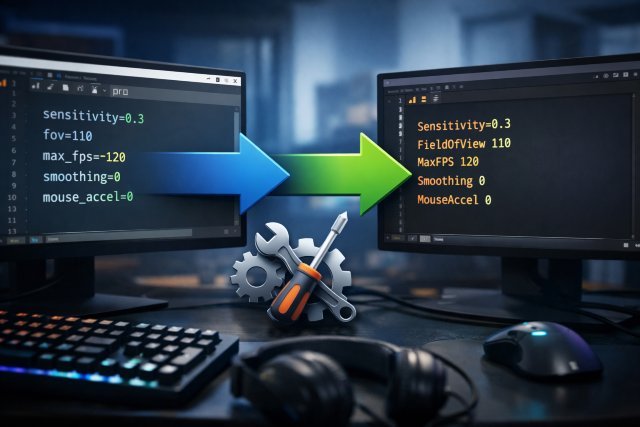
If you’ve ever opened a config file, changed one “tiny” value, and suddenly everything breaks, you’re not alone. That’s exactly why the 120fpsconfigfile.pro Code Converter Tool exists: it helps you turn messy, hard-to-read .PRO configs into clean, structured formats (like JSON or YAML) in seconds — without installing anything.
- What Is the 120fpsconfigfile.pro Code Converter Tool?
- Why Convert .PRO Configs to JSON or YAML?
- Key Features of the 120fpsconfigfile.pro Code Converter Tool
- How to Use the 120fpsconfigfile.pro Code Converter Tool (Step-by-Step)
- Who Should Use This Tool?
- Real-World Scenarios and Mini Case Studies
- Why “120 FPS” Matters (Without the Hype)
- Is It Safe to Upload Config Files?
- Frequently Asked Questions
- Actionable Tips for Better Conversion Results
- Conclusion
You’ll learn what the 120fpsconfigfile.pro Code Converter Tool does, who it’s for, how it works, and how to use it safely — plus real-world scenarios, tips, and FAQs that make conversions smoother (and less stressful).
What Is the 120fpsconfigfile.pro Code Converter Tool?
The 120fpsconfigfile.pro Code Converter Tool is a browser-based converter that takes a .PRO config file and outputs a structured version in JSON or YAML, typically used for easier editing, sharing, validation, and automation. The tool (hosted on 120fpsconfigfiles.pro) is designed to be lightweight and quick: upload → pick output format → convert → download.
While the name sounds gaming-focused — and it can absolutely help gamers organize FPS-related settings — its core strength is code conversion: transforming .PRO configs into formats that developers and power users can work with more confidently.
Why Convert .PRO Configs to JSON or YAML?
A .PRO config might be fine until you need to:
- compare versions side-by-side
- track changes in Git
- share settings with a friend or teammate
- validate structure and prevent typos
- integrate config values into tools or pipelines
That’s where JSON and YAML shine.
JSON: best for apps, APIs, and structured tooling
JSON is a lightweight, language-independent data format used widely in software development and data interchange.
YAML: best for human readability and config workflows
YAML is a human-friendly serialization language often used for configuration files (and especially popular in DevOps).
And if you’ve worked with Kubernetes, you’ll recognize YAML instantly — Kubernetes manifests are commonly written in YAML (JSON is also supported).
Key Features of the 120fpsconfigfile.pro Code Converter Tool
Based on the tool’s own documentation and interface, here’s what it provides:
- Converts
.PRO→ JSON or YAML - Lets you set an FPS value (default shown as 120)
- Runs in the browser (no software install, no account required)
- Designed to be fast (“within seconds”)
- Claims conversions happen locally in-browser and files aren’t stored
That last point matters, so we’ll cover safety best practices in a dedicated section.
How to Use the 120fpsconfigfile.pro Code Converter Tool (Step-by-Step)
If you want the simplest workflow, this is it:
- Upload your
.PROfile
On the homepage you’ll see an upload field labeled for.proconfig files. - Choose output format
Select JSON or YAML depending on what you want to do next. - Set FPS (if applicable)
The tool includes an FPS input (default 120). If your use-case depends on FPS-related values, choose the number that matches your target profile. - Convert and download
Click Convert, then download the converted output.
Pro tip: validate immediately
After downloading, open the JSON/YAML in a validator or editor (VS Code, online validators, CI linting). You’ll catch formatting issues early, before you paste it into anything important.
Who Should Use This Tool?
Gamers who tweak FPS configs
If you’re experimenting with FPS-related settings (frame caps, performance tuning configs, device profiles), converting to JSON/YAML makes settings easier to read, audit, and share. Even if you don’t change anything, structured formats make it clearer what’s happening.
Developers and IT professionals
The tool explicitly targets developers, programmers, gamers, and IT professionals and highlights JSON/YAML as supported outputs.
If your .PRO config is part of an app/tool workflow, converting to JSON can help integrate it with scripts and services.
DevOps and cloud engineers
YAML becomes extremely useful when you want configs that “look like infrastructure code.” Kubernetes commonly uses YAML manifests by convention.
Even if your .PRO file isn’t a Kubernetes manifest, YAML can still be the format you standardize on internally.
Real-World Scenarios and Mini Case Studies
Scenario 1: A mobile gamer builds two FPS profiles
Let’s say you maintain two .PRO configs:
- one for competitive play (max smoothness)
- one for streaming (balanced visuals)
You convert both to JSON, then compare them side-by-side using a diff tool. The structure helps you spot what changed (and prevents “mystery settings” you forgot you edited).
Actionable tip: once your JSON is clean, store it in a folder like:/configs/deviceA/competitive.json and /configs/deviceA/stream.json
Now you have repeatability.
Scenario 2: A developer needs structured config to automate edits
A common developer workflow is:
convert → programmatically edit → export
JSON is especially friendly here because almost every language parses JSON easily, and JSON has clear formatting rules.
Once you convert your .PRO to JSON, you can write a small script to update keys (like toggles, thresholds, or tuning parameters) without manual editing.
Scenario 3: A DevOps team standardizes config documentation in YAML
Teams love YAML when configs need to be readable in PR reviews. YAML is explicitly positioned as a human-friendly serialization format.
After conversion, they add comments, document fields, and keep a consistent structure across projects.
Why “120 FPS” Matters (Without the Hype)
Even if your end goal is performance tuning, it’s worth understanding what FPS changes physically.
At a basic level, higher FPS lowers the time budget per frame:
- 60 FPS ≈ 16.67 ms per frame
- 120 FPS ≈ 8.33 ms per frame
This relationship (FPS ↔ frame time) is a useful mental model when you’re aiming for smoother motion and potentially lower latency.
Research in FPS gaming also suggests performance benefits rise sharply from low frame rates and can level off beyond a point (with perception continuing to improve). A WPI study of 44 participants found performance improvements that “level out after about 90 f/s,” while perceived smoothness kept improving at higher rates.
So the practical takeaway isn’t “always chase higher numbers” — it’s:
- stabilize your frame pacing
- remove config mistakes
- and make changes safely and repeatably
Structured conversion helps with all three.
Is It Safe to Upload Config Files?
The tool states that conversions happen in the browser and that files aren’t stored, shared, or tracked.
That’s a strong claim, but smart users still follow best practices:
Safety checklist (recommended)
- Don’t upload configs that contain passwords, tokens, private URLs, or device identifiers.
- If unsure, open the file and quickly scan for secrets before uploading.
- Keep a local backup of the original
.PRO. - After converting, review the output for unexpected fields or values.
If you’re working in a corporate environment, follow your org’s security policy. Even “in-browser” tools may be restricted for certain files.
Frequently Asked Questions
What does the 120fpsconfigfile.pro Code Converter Tool do?
It converts .PRO configuration files into structured JSON or YAML formats so they’re easier to read, edit, validate, and reuse.
Do I need to install anything?
No. The tool is browser-based and doesn’t require software installation or signup.
Which output format should I choose: JSON or YAML?
Choose JSON if you plan to parse/edit the config with scripts or apps, since JSON is a standard data interchange format.
Choose YAML if humans will read and review it often, or if you prefer a config-friendly format used widely in DevOps.
Can I use it on mobile?
Yes — the site states it works on mobile devices, tablets, and smartphones.
Does converting a config automatically improve FPS?
Conversion itself is about format and structure, not magic performance boosts. What it can do is reduce human error, help you compare changes reliably, and make tuning safer — especially when you’re adjusting settings related to frame pacing and performance targets.
Actionable Tips for Better Conversion Results
Here are practical ways to get cleaner output and fewer surprises:
- Convert one “known good”
.PROfirst and keep it as your baseline. - Use consistent naming conventions in JSON/YAML so you can diff versions easily.
- Make one change at a time, then test — don’t edit five settings and guess which one broke things.
- If you’re chasing smoother gameplay, prioritize stability (consistent frame times) over peak FPS numbers. Frame time is the real “feel” metric.
Conclusion
If you want a faster, cleaner way to handle .PRO configs — whether you’re a gamer tuning profiles, a developer automating edits, or a DevOps engineer standardizing configuration workflows — the 120fpsconfigfile.pro Code Converter Tool is a practical solution. It turns hard-to-read config code into JSON or YAML in seconds, making your settings easier to manage, safer to tweak, and simpler to share.