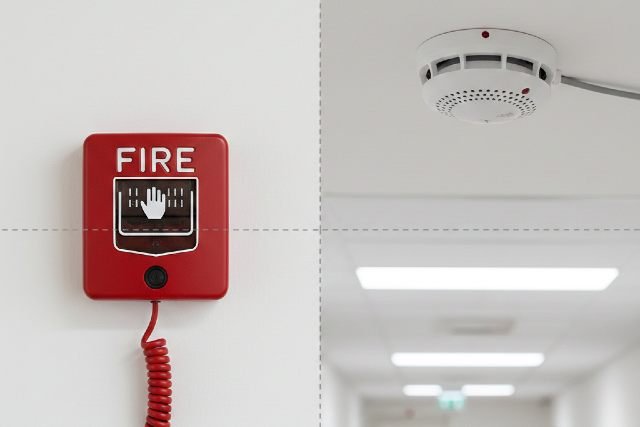
Fire safety systems are only as effective as the devices that trigger them. Two of the most common initiating devices in any fire alarm system are the manual call point and the smoke detector, but they work in very different ways.
- What Is a Manual Call Point?
- What Is a Smoke Detector?
- Manual Call Point vs Smoke Detector (Quick Comparison Table)
- How Each Device Works
- Key Differences That Matter in Real Buildings
- Where Manual Call Points Work Best
- Where Smoke Detectors Work Best
- Which One Is Required by Code?
- Real-World Examples and Scenarios
- Installation and Maintenance Considerations
- Common Mistakes to Avoid
- FAQs
- Conclusion
A manual call point depends on a person to activate the alarm, while a smoke detector automatically detects smoke particles and sends a signal to the fire alarm panel. Understanding the difference helps you design safer buildings, comply with regulations, and reduce nuisance alarms without compromising life safety.
In this guide, you’ll learn the key differences, best-use scenarios, compliance notes, and real-world examples so you can confidently choose the right device — or combine both for maximum protection.
What Is a Manual Call Point?
A manual call point is a fire alarm activation device that requires a person to manually trigger the alarm, usually by pressing a button or breaking a glass element. These devices are typically installed on escape routes, near exits, and in areas where occupants can quickly raise an alarm.
Manual call points are widely recognized under international standards such as EN 54-11, which defines requirements and testing methods for manual call points used in fire detection and fire alarm systems.
Depending on the region, a manual call point may also be called a break glass unit, manual pull station, or fire alarm call point.
What Is a Smoke Detector?
A smoke detector is an automatic fire detection device that senses smoke particles in the air and sends a signal to the fire alarm control panel. This triggers evacuation alarms and emergency response without needing human intervention.
Smoke detectors are covered under standards such as EN 54-7, which describes requirements for point-type smoke detectors using optical (light scattering) or ionization principles.
It’s also worth noting that fire safety authorities often distinguish between a smoke alarm and a smoke detector. A detector typically connects to a control panel, while an alarm often includes the sounder in the device itself. NFPA explains these differences clearly.
Manual Call Point vs Smoke Detector (Quick Comparison Table)
| Feature | Manual Call Point | Smoke Detector |
|---|---|---|
| Activation | Human-operated | Automatic |
| Detection Type | Manual initiation | Smoke particle detection |
| Response Time | Depends on human reaction | Faster detection (especially at night) |
| Common Placement | Near exits, corridors | Ceilings, rooms, hallways |
| Best For | Immediate human reporting | Early fire detection |
| False Alarm Risk | Misuse, accidental activation | Dust, steam, cooking fumes |
| Code Consideration | Often required in escape routes | Often required in sleeping/high-risk areas |
How Each Device Works
How a Manual Call Point Works
A manual call point works when a person sees a fire or smoke and activates the device. Once activated, it sends a signal to the fire alarm control panel, which triggers sounders, strobes, and evacuation procedures. Many modern call points are addressable, meaning they identify the exact location of the activation at the panel.
How a Smoke Detector Works
A smoke detector works by sensing smoke particles entering the detection chamber. Optical detectors respond to changes in light scattering caused by smoke, while ionization detectors react to changes in electrical current. Once smoke reaches a threshold, the detector signals the panel, which triggers alarms and may activate other systems such as smoke control or suppression. Smoke movement and airflow play a major role in how quickly the device responds.
Key Differences That Matter in Real Buildings
1) Speed of Detection
Smoke detectors often provide faster detection, especially in situations where occupants are asleep or the building is unoccupied. Research from the National Institute of Standards and Technology (NIST) highlights that smoke alarms significantly improve detection timing, particularly during nighttime fires when people are less likely to notice danger.
A manual call point can be extremely fast too, but only if someone notices the fire quickly and can safely reach and activate the device.
2) Human Dependency
Manual call points depend on a human being present, alert, and physically capable of reaching the unit. This can be a limitation in storage facilities, unmanned buildings, nighttime conditions, or high-risk areas where occupants may not have time to approach the device safely.
Smoke detectors remove this dependency by detecting smoke automatically, which is why they are essential for early warning.
3) False Alarm Patterns
Manual call points are more likely to experience false activations due to misuse, vandalism, accidental bumps, or prank triggers. Smoke detectors tend to cause nuisance alarms due to environmental conditions like dust, steam, aerosols, cooking fumes, and poor placement.
Nuisance alarms are a recognized challenge in the fire alarm industry, and NFPA guidance frequently emphasizes careful selection and placement of detection devices to minimize unnecessary activations.
4) Placement and Coverage
Manual call points are installed along escape routes, near exits, and in places where occupants can activate them while evacuating. Smoke detectors are generally installed on ceilings, in corridors, in rooms, and in high-risk zones where early detection is important.
Where Manual Call Points Work Best
Manual call points are most effective in buildings where people are present and able to react quickly. This includes offices, commercial facilities, hospitals, schools, malls, and staffed warehouses. In these environments, occupants often identify danger before enough smoke accumulates at the ceiling for a detector to activate.
In public buildings, manual call points also provide immediate alarm initiation for staff members who see a fire start at ground level or inside a room.
Where Smoke Detectors Work Best
Smoke detectors are ideal where early detection is critical and where fires may go unnoticed for long periods. They are especially important in sleeping areas, hotels, dormitories, and residential properties. They are also valuable in server rooms, electrical rooms, IT facilities, and storage spaces where a fire may begin without obvious human presence.
Because these devices respond to smoke rather than visible fire, they can provide earlier warning, allowing evacuation and fire response to happen sooner.
Which One Is Required by Code?
Whether you need manual call points, smoke detectors, or both depends on your local fire codes, your building type, occupancy classification, and fire risk profile.
NFPA 72 provides detailed rules regarding the placement and necessity of manual fire alarm boxes and also outlines situations where exceptions may apply depending on the building layout, supervision, and detector coverage.
In Europe and many other regions, standards such as EN 54-11 and EN 54-7 define performance and design rules for manual call points and smoke detectors respectively.
In practical system design, most commercial buildings use both because manual call points allow immediate activation by occupants, while smoke detectors provide automatic early detection.
Real-World Examples and Scenarios
Consider an office pantry where cooking fumes frequently trigger smoke detectors. In this case, a better design might use a heat detector in the pantry and maintain smoke detection in corridors and escape routes, while keeping a manual call point near the exit. This reduces nuisance alarms while maintaining safety.
In a warehouse at night, smoke detectors are essential because the building may be unoccupied. A manual call point has limited value if no one is present to activate it. In such cases, smoke detection paired with monitoring can alert security or emergency services early.
In a shopping mall, staff may notice smoke or fire inside a store long before smoke accumulates near ceiling detectors. A manual call point allows immediate activation, which can speed up evacuation across the entire building.
Installation and Maintenance Considerations
Manual call points should be installed at accessible heights and in visible locations near exits and escape routes. In environments prone to misuse, protective covers and clear signage can reduce accidental or malicious activations.
Smoke detectors should be installed away from cooking areas, bathrooms, and HVAC vents where airflow or steam can create nuisance activations. Correct spacing and placement according to manufacturer and code guidance is essential.
NFPA 72 also emphasizes routine system inspection and testing schedules, reinforcing the importance of maintaining both manual and automatic devices as part of a complete fire alarm system strategy.
Common Mistakes to Avoid
One major mistake is placing smoke detectors too close to kitchens or bathrooms, which increases false alarms and encourages occupants to ignore alerts. Another common issue is installing manual call points in locations that are difficult to reach quickly or are blocked by furniture or fixtures.
Some buildings also fail by relying too heavily on one device type, assuming smoke detectors alone are enough or assuming manual call points alone will provide adequate protection. The best systems are risk-based and use both where appropriate.
FAQs
What is the difference between a manual call point and a smoke detector?
A manual call point requires a person to activate the alarm, while a smoke detector automatically detects smoke and triggers the fire alarm system.
Do I need both manual call points and smoke detectors?
Many commercial buildings use both. Smoke detectors provide early automatic detection, and manual call points allow occupants to trigger the alarm instantly when they spot danger.
Which is faster in detecting fire?
Smoke detectors are often faster overall, especially at night or when people are unaware. NIST research shows smoke alarms significantly reduce detection time during nighttime events.
Can manual call points be removed?
Some systems may allow exceptions under NFPA 72 depending on the building type and detector coverage, but removal must be approved by the authority having jurisdiction.
Where should manual call points be installed?
They are typically installed near exits, stairwells, and escape routes so occupants can activate them as they evacuate.
Conclusion
A manual call point is a vital fire alarm device for immediate human-triggered activation, especially in staffed and public environments. A smoke detector provides automatic early warning, which is essential when fires might go unnoticed or when occupants are asleep or absent.
In most real-world installations, the most effective and compliant approach is using both. Smoke detectors offer early detection, while manual call points enable rapid activation the moment someone sees danger. If you’re planning or upgrading a fire alarm system, always consider the building type, occupancy behavior, false alarm risk, local code requirements, and your maintenance capacity. When designed correctly, this combination can save lives, prevent costly damage, and ensure occupants respond quickly and confidently.