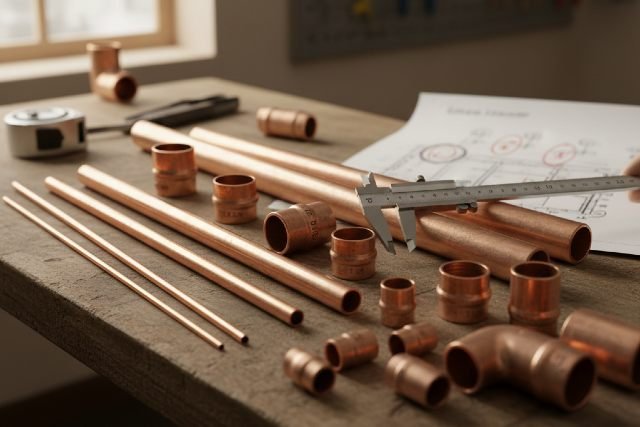
Choosing the correct copper pipe sizes isn’t just a technical detail. It affects water pressure, flow rate, noise levels, safety, cost, and how long your plumbing lasts. Many people get confused because copper plumbing is labeled using a nominal size system, meaning the printed size is not always the same as the actual measured outside diameter. For example, a “1/2-inch” copper tube is commonly 5/8-inch outside diameter in standard copper tube sizing, and the outside diameter is typically 1/8-inch larger than the nominal size for many common copper sizes.
- What Are Copper Pipe Sizes?
- Nominal Size vs Actual Size (OD vs ID)
- Copper Tube Types Explained: Type K, Type L, and Type M
- Copper Pipe Sizes Chart
- How to Choose the Correct Copper Pipe Diameter
- Copper Pipe Sizes for Plumbing vs HVAC
- How Copper Size Affects Water Pressure and Performance
- Quick Rules for Copper Pipe Sizing
- Common Copper Pipe Sizing Mistakes to Avoid
- FAQ: Copper Pipe Sizes
- Conclusion: Choosing Copper Pipe Sizes the Right Way
In this guide, you’ll learn how copper pipe sizing works, how Type K, L, and M change thickness and flow, and how to select the correct diameter for plumbing, heating, and HVAC applications.
What Are Copper Pipe Sizes?
Copper pipe sizes refer to the standardized system used to label copper tubing based on nominal size, outside diameter (OD), inside diameter (ID), and wall thickness. Most domestic plumbing copper tubing follows Copper Tube Size conventions, which means the OD stays consistent for a given nominal size, while the ID changes depending on wall thickness and copper type. This system helps fittings remain compatible while allowing different strength grades of tubing.
Nominal Size vs Actual Size (OD vs ID)
The nominal size is the name used in plumbing and product labeling. It is not the measured outside diameter. The outside diameter is what you measure with a caliper. For copper tubing under common standards like ASTM B88, the OD is typically 1/8 inch larger than the nominal size designation. That’s why a 1/2-inch nominal copper pipe measures about 5/8-inch OD.
The inside diameter is the part that matters most for water flow. ID depends on the OD and wall thickness. Thicker copper types have a smaller ID, meaning less flow area, even when the nominal size is identical.
Copper Tube Types Explained: Type K, Type L, and Type M
Copper water tube comes in three primary wall thickness categories, commonly known as Type K, Type L, and Type M. These types are recognized in ASTM B88 standards and summarized in industry references such as the Copper Development Association handbook.
Type K has the thickest wall and is typically used for underground service lines or situations requiring higher durability and pressure capacity. Type L has a medium wall thickness and is widely used for interior plumbing because it offers a strong balance between durability and cost. Type M has the thinnest wall and may be used in some residential interior plumbing where allowed, but it provides less margin for damage, corrosion, and pressure. The Copper Tube Handbook explains that Type K is thicker than Type L, and Type L is thicker than Type M for any given size.
Copper Pipe Sizes Chart
The table below shows the common relationship between nominal copper pipe sizes and their actual outside diameter in the Copper Tube Size system.
| Nominal Copper Size | Actual Outside Diameter (OD) |
|---|---|
| 1/4″ | 3/8″ |
| 3/8″ | 1/2″ |
| 1/2″ | 5/8″ |
| 5/8″ | 3/4″ |
| 3/4″ | 7/8″ |
| 1″ | 1 1/8″ |
This sizing relationship is part of standard copper tube conventions used widely in plumbing and supported by copper tube dimension references.
How to Choose the Correct Copper Pipe Diameter
The correct copper pipe size depends on what the system is used for, how far the water needs to travel, how many fixtures run at the same time, and how much pressure drop is acceptable. Plumbing sizing must consider demand and distribution, while heating and HVAC lines may rely on different engineering factors such as pump head, temperature, and refrigerant velocity.
For household plumbing, the most common approach is to use a larger trunk line and smaller branches. Many homes use 3/4-inch as a main distribution size and 1/2-inch branches for fixtures. Larger homes or long runs often require 1-inch mains to reduce pressure loss. Water supply sizing methods are supported by plumbing code sizing principles that account for fixture loads and distribution design, such as those included in the International Plumbing Code Appendix E.
If you’ve ever experienced weak water pressure at the farthest bathroom, it’s often because a line was undersized for the distance and number of fittings, rather than because the incoming pressure was low.
Copper Pipe Sizes for Plumbing vs HVAC
Copper used for plumbing is usually labeled by nominal CTS sizing, while refrigeration copper in HVAC is often referred to by actual outside diameter. This is why HVAC copper line sets are commonly sold as 1/4-inch, 3/8-inch, or 1/2-inch in a way that directly matches OD measurement practice. Mixing these naming conventions can cause ordering mistakes and fitting incompatibility, so it’s essential to confirm whether the size you’re seeing is nominal CTS or true OD.
How Copper Size Affects Water Pressure and Performance
Copper pipe diameter impacts flow velocity, friction loss, pressure drop, and noise. Smaller pipes create higher velocity, which can produce noise and increase erosion risk over time. They also increase friction losses, which shows up as low pressure at showers or fixtures when multiple taps run at once. Larger pipes reduce friction loss but increase cost and can cause hot water to take longer to reach fixtures due to increased volume. The goal is to use pipe large enough to avoid pressure problems without oversizing so much that performance becomes inefficient.
Wall thickness also plays a role because thicker tubing reduces inside diameter. A thicker Type K tube will carry slightly less flow than a thinner Type M tube of the same nominal size, which matters in long runs or high-demand systems. Engineering Toolbox and similar technical references provide dimensional and working pressure data showing how wall thickness changes between Type K, L, and M and how that influences performance.
Quick Rules for Copper Pipe Sizing
For most residential water supply systems, 3/4-inch copper is commonly used for main supply and trunk distribution, while 1/2-inch copper is used for fixture branches. Short fixture connections may use 3/8-inch in some installations depending on code and device requirements. Type L is typically considered the best default for interior plumbing because it balances durability and price, while Type K is best suited for underground service lines or more demanding conditions. Type M is sometimes used in residential interiors but should be chosen carefully and only when permitted and appropriate for the environment.
Common Copper Pipe Sizing Mistakes to Avoid
One of the most common mistakes is assuming that nominal size equals the measured outside diameter. A 1/2-inch copper tube is usually 5/8-inch OD, which leads to confusion when ordering fittings or measuring for replacement.
Another mistake is using Type M where Type L is recommended. While Type M can be acceptable in some cases, it offers less durability margin and may lead to issues in higher demand or more corrosive conditions. A third common mistake is failing to account for fittings. Every elbow, tee, valve, and restriction adds friction loss, and on smaller pipe sizes those losses can become significant quickly. Finally, mixing HVAC OD labeling with plumbing CTS nominal labeling leads to wrong part orders and wasted time on site.
FAQ: Copper Pipe Sizes
Why is 1/2-inch copper actually 5/8-inch?
Because common plumbing copper uses Copper Tube Size naming, where the outside diameter is typically 1/8-inch larger than the nominal designation. This system keeps fittings consistent and is widely referenced in ASTM copper tube standards.
What is the most common copper pipe size in homes?
The most common sizes are 1/2-inch for fixture branches and 3/4-inch for main distribution lines, though larger homes may use 1-inch mains for better pressure across long runs.
What type of copper is best for water lines?
Type L is widely used for indoor plumbing because it balances strength and cost. Type K is used for underground service lines or higher pressure durability needs. Type M is thinner and should be selected carefully based on local code and system requirements.
How do I measure copper pipe size correctly?
Measure the outside diameter with a caliper, then match it to a copper sizing chart to identify nominal size. Always verify whether the copper is plumbing CTS or HVAC OD-based sizing.
Conclusion: Choosing Copper Pipe Sizes the Right Way
Choosing copper pipe sizes correctly starts with understanding that copper tubing uses a nominal sizing system, where the outside diameter is often larger than the labeled size. This is why 1/2-inch copper typically measures 5/8-inch OD and why inside diameter changes depending on wall thickness.
To avoid pressure issues, noise, and costly rework, select pipe diameter based on demand, distance, and acceptable pressure drop. Use Type L as your general best choice for interior plumbing, choose Type K for underground service lines or demanding applications, and use Type M only when suitable and permitted. When you match copper type and diameter to real-world flow needs, you get better performance, fewer leaks, and a system that lasts.