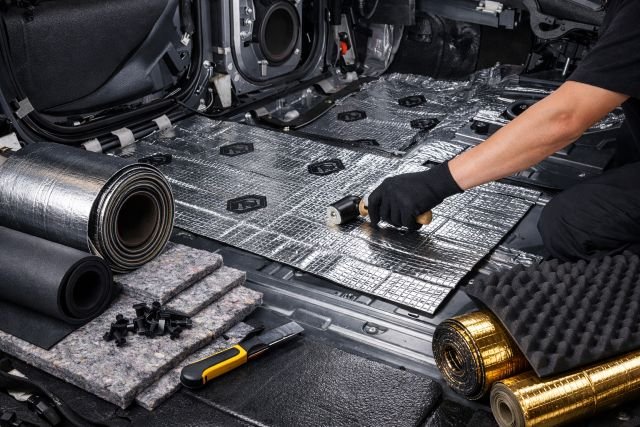
Sound deadening is one of the most effective upgrades you can make if you want a quieter, smoother, and more premium driving experience. Road noise, tire hum, wind turbulence, rattling door panels, and vibration from thin sheet metal can make a car feel noisy even if it runs perfectly. When installed correctly, sound deadening reduces the harshness of those noises and improves cabin comfort, especially during highway driving.
- What Is Sound Deadening?
- How Sound Deadening Works in Cars
- Benefits of Sound Deadening for Cars
- Best Sound Deadening Materials for Cars
- Butyl Mats: The Most Popular Sound Deadening Choice
- Closed-Cell Foam: Best for Reducing Rattles and Echo
- Mass Loaded Vinyl (MLV): The Best Material for Blocking Road Noise
- Fiber Insulation: Factory-Style Absorption for High Frequencies
- Spray-On Sound Deadening: Useful for Wheel Wells and Underbody Areas
- The Best Sound Deadening Strategy: Layered NVH Control
- Where to Apply Sound Deadening for the Best Results
- How Much Sound Deadening Do You Really Need?
- Sound Deadening Installation Tips
- Common Mistakes That Ruin Sound Deadening Results
- Sound Deadening and Hearing Comfort
- FAQ: Sound Deadening for Cars
- Conclusion: Why Sound Deadening Is One of the Best Car Upgrades
Manufacturers often use limited insulation because of cost and weight constraints, but aftermarket sound deadening allows you to focus on the loudest and most vibration-prone areas. This guide explains what sound deadening is, how it works, what the best materials are, and how to install them correctly for maximum results. The methods described here are supported by widely used engineering principles in NVH control, where vibration damping and noise blocking are used to reduce cabin noise through layered treatments.
What Is Sound Deadening?
Sound deadening is the process of reducing unwanted noise and vibration inside a car using specialized materials. These materials either damp vibrations in metal panels, absorb airborne sound waves, or block outside noise from entering the cabin. The most effective sound deadening solutions use a layered approach rather than relying on a single product.
How Sound Deadening Works in Cars
Car noise comes from many sources, but the most common contributors are road and tire noise traveling through the floor and wheel arches, wind noise entering through seals and gaps, engine and exhaust vibrations transferring into the cabin, and panel resonance from doors, trunks, or roofs. Thin sheet metal tends to amplify vibration much like a drum. When that panel vibrates, it produces sound energy and creates rattles, especially around speakers and trim pieces.
Sound deadening works by reducing the vibration amplitude and lowering the resonance of those panels. Engineering studies on damping treatments show that viscoelastic damping layers can significantly reduce vibration in panels and improve acoustic comfort. This is one of the reasons why constrained-layer damping systems are so widely used in vehicle noise reduction strategies.
Benefits of Sound Deadening for Cars
The most obvious benefit of sound deadening is a quieter cabin, which reduces fatigue and makes long drives more comfortable. It also improves audio system performance by controlling door resonance and preventing speakers from vibrating surrounding panels. Many people notice tighter mid-bass response, clearer vocals, and fewer buzzing vibrations once the doors and trunk are treated properly.
Sound deadening is also valuable for eliminating rattles, particularly in older cars where plastic clips loosen over time. Beyond comfort, reduced cabin noise can also have health benefits. CDC and NIOSH guidance notes that repeated exposure to noise levels at or above 85 dBA can cause hearing damage over time. While cars vary widely by tires, speed, and road surface, lowering cabin noise reduces stress and improves listening comfort during daily driving.
Best Sound Deadening Materials for Cars
The best sound deadening material depends on what noise problem you are trying to solve. Most materials fall into three main categories: vibration damping, absorption and decoupling, and noise blocking. While there are many brands, the underlying material types remain consistent.
Butyl Mats: The Most Popular Sound Deadening Choice
Butyl mats are widely considered the most effective option for damping vibration in car panels. These mats are dense, flexible, and adhesive-backed, allowing them to bond directly to metal surfaces like door skins and floor pans. When the panel tries to vibrate, the butyl material converts that vibration energy into heat, reducing resonance and preventing the metal from acting like a speaker cone.
Butyl mats are particularly effective in doors, trunk floors, and roof panels. They are easy to install and offer reliable performance. Compared to cheaper asphalt-based mats, butyl products are generally more stable in hot environments and less likely to emit strong odors or soften over time.
Closed-Cell Foam: Best for Reducing Rattles and Echo
Closed-cell foam is not a vibration damper in the way butyl mats are, but it plays a critical role in a well-designed sound deadening system. Its main benefit is acting as a decoupling layer between hard surfaces, preventing plastic trim and panels from rubbing against metal and creating squeaks. It also absorbs some airborne sound energy, especially higher frequencies, improving the overall acoustic comfort of the cabin.
Closed-cell foam is commonly used behind door cards, under trim panels, and as a separation layer under MLV. It is lightweight, inexpensive, and easy to cut, making it a practical addition to most installations.
Mass Loaded Vinyl (MLV): The Best Material for Blocking Road Noise
If your goal is reducing road noise and tire noise, mass loaded vinyl is one of the most effective materials available. MLV works as a dense barrier that blocks airborne sound from passing through surfaces such as the floor pan or trunk wall. It is especially effective when installed with a decoupling layer like foam beneath it, because the air gap and decoupling improves sound transmission loss.
MLV is heavier than most other materials and more difficult to shape around complex curves, but it delivers strong improvements in cabin quietness when installed correctly in large flat areas like floors and trunk pans.
Fiber Insulation: Factory-Style Absorption for High Frequencies
Many factory cars use felt, jute, and fiber insulation because they absorb higher-frequency noise well and help reduce cabin echo. These materials do not damp vibration as effectively as butyl mats and do not block low-frequency road noise like MLV, but they are useful as supplemental layers in headliners, carpets, and trim panels.
Spray-On Sound Deadening: Useful for Wheel Wells and Underbody Areas
Spray-on sound deadeners are often used on wheel wells and underbody areas where mats may not adhere easily. These products can add damping and help seal small gaps, but they typically do not match the effectiveness of layered mat and barrier systems. Their real value is in uneven surfaces, exposed metal areas, and hard-to-access zones, particularly where added corrosion protection may also be beneficial.
The Best Sound Deadening Strategy: Layered NVH Control
The most effective sound deadening approach in cars usually combines three layers. The first layer is vibration damping, typically done with butyl mats. The second layer is decoupling, often done with closed-cell foam. The third layer is noise blocking, usually done with mass loaded vinyl. This layered strategy mirrors widely accepted NVH engineering approaches used to reduce cabin noise by addressing vibration at the source and blocking transmission into the cabin.
Where to Apply Sound Deadening for the Best Results
Doors are one of the best starting points because they are large, thin, and prone to vibration. Treating doors improves audio quality and reduces outside noise. The floor pan is another high-impact area because road noise and tire noise often enter the cabin through the lower body of the vehicle. Treating the trunk is especially useful if you have a loud exhaust or a subwoofer system, since the trunk acts like a sound chamber that can amplify vibration.
Wheel arches and wheel wells are excellent targets for road noise reduction, while the roof can benefit from damping treatments to reduce rain noise and improve thermal comfort. Firewall work can also help reduce engine noise, but it is typically more complex and requires more disassembly.
How Much Sound Deadening Do You Really Need?
Many beginners assume sound deadening requires full coverage everywhere. In reality, vibration damping mats often do not need 100% coverage to be effective. Strategic placement on large flat panels is often enough to stop resonance. The floor and trunk areas benefit from broader coverage, especially if you add MLV barriers, but you still want to balance results with weight, cost, and time.
The goal is not to create the thickest possible layer, but to reduce vibration and block noise efficiently. This is why professionals focus on panel resonance points, structure-borne noise paths, and transmission points rather than blanket coverage.
Sound Deadening Installation Tips
A successful installation begins with planning. You should decide whether your main goal is reducing road noise, improving audio quality, eliminating rattles, or all three. From there, choose materials that match your goals. Surface preparation is essential because sound deadening mats need clean metal to adhere properly. Dust, oil, or moisture will reduce adhesion and cause lifting over time.
Trim removal should be done carefully using proper trim tools to avoid breaking clips. Once exposed, the metal surfaces should be cleaned and dried before applying mats. After application, mats should be firmly rolled to eliminate air pockets and improve contact. Foam layers can then be added behind trim panels, and MLV barriers can be applied to the floor and trunk areas for maximum noise reduction.
After reassembly, it helps to test results using a consistent driving route and speed. Many people use smartphone decibel meters to compare before-and-after results, and while these are not laboratory accurate, they can provide a helpful baseline for measuring improvement.
Common Mistakes That Ruin Sound Deadening Results
One of the most common mistakes is blocking door drainage holes, which can cause water retention and corrosion. Another issue is using cheap asphalt-based mats that soften in heat and create odor or adhesive failure. Poor rolling and incomplete adhesion also reduce effectiveness, because vibration damping works best when the mat is tightly bonded to the metal.
Many DIY installers also expect butyl mats to block road noise entirely, but mats are primarily dampers, not barriers. If road noise reduction is the primary goal, MLV and decoupling layers become far more important. Finally, overusing heavy materials everywhere can add unnecessary weight and reduce fuel efficiency without proportional acoustic gains.
Sound Deadening and Hearing Comfort
Noise exposure impacts comfort and long-term hearing health. CDC and NIOSH emphasize that repeated exposure at or above 85 dBA can contribute to hearing damage over time. Highway driving with loud tires, rough roads, and thin insulation can increase fatigue and reduce comfort. Sound deadening reduces interior noise levels, making conversation easier, reducing audio volume needs, and creating a calmer, more focused driving environment.
FAQ: Sound Deadening for Cars
What is sound deadening in a car?
Sound deadening is a method of reducing unwanted noise and vibration inside a car using materials that damp metal resonance, absorb sound, and block outside noise transmission.
Does sound deadening actually work?
Yes, sound deadening works when installed correctly. Damping treatments reduce panel vibration and resonance, which improves cabin acoustics and reduces noise perception. This approach is supported by established engineering methods used in vehicle NVH control.
What is the best sound deadening material?
Butyl mats are best for vibration damping, mass loaded vinyl is best for noise blocking, and closed-cell foam is best for decoupling and reducing rattles. The best solution typically combines all three.
Where should I apply sound deadening first?
Doors and floors deliver the best improvement for most vehicles. Doors improve audio quality and reduce resonance, while floor treatment significantly reduces road and tire noise.
Is sound deadening worth it?
Sound deadening is worth it for drivers who want improved comfort, quieter highway driving, fewer rattles, and better audio quality. It is one of the most noticeable upgrades you can make without changing performance.
Conclusion: Why Sound Deadening Is One of the Best Car Upgrades
Sound deadening is a practical and high-impact way to make your car feel quieter, smoother, and more refined. By addressing both vibration and noise transmission using the right materials, you can reduce road noise, improve audio clarity, and eliminate annoying rattles that make driving less enjoyable.
The most effective results come from a layered approach that combines vibration damping mats, decoupling foam, and mass loaded vinyl barriers in the areas where noise enters most. These same principles are widely used in automotive NVH strategies and supported by research into damping and vibration control. If you want a calmer cabin and a more comfortable driving experience, sound deadening is a smart investment that delivers immediate and long-lasting benefits.