Choosing the right swing arm can make a bigger difference to real-world performance than many riders realize. The swing arm isn’t just a bracket holding your rear wheel in place — it directly influences traction, stability, squat control under acceleration, cornering feel, and how consistently your suspension works. Whether you ride a sportbike, a streetfighter, an adventure motorcycle, or a track-focused build, the swing arm is one of the most important structural and handling components on the entire bike.
- What Is a Swing Arm and Why Does It Matter?
- The Performance Checklist: What the “Right” Swing Arm Actually Means
- Swing Arm Length: Stability, Traction, and the Wheelbase Effect
- Swing Arm Geometry and Anti-Squat: The Hidden Key to Rear Grip
- Swing Arm Stiffness: Why Flex Can Be Good
- Swing Arm Materials: Aluminum vs Steel vs Carbon Fiber vs Titanium
- Swing Arm Design Types: Box Section vs Banana vs Braced Racing Arms
- Swing Arm Pivot and Bearings: Small Parts, Big Results
- Compatibility and Fitment: What Most Buyers Get Wrong
- Choosing the Right Swing Arm for Your Riding Style
- Real-World Scenario: Track Rider vs Street Rider Swing Arm Choice
- How to Tune Swing Arm Performance Without Replacing It
- Common Questions About Swing Arms (FAQ)
- Conclusion: Choosing the Right Swing Arm for Maximum Performance
In this guide, you’ll learn how to choose a swing arm for maximum performance, not just based on looks or brand reputation, but based on the factors that actually matter: swing arm length, stiffness, geometry, anti-squat characteristics, materials, pivot design, compatibility, and how it interacts with your suspension setup. We’ll also cover common rider mistakes, real-world scenarios, and the best way to match a swing arm upgrade to your riding style and goals.
What Is a Swing Arm and Why Does It Matter?
A swing arm is the rear suspension linkage that connects the rear wheel to the motorcycle frame. It pivots at the chassis and moves vertically with the suspension, allowing the rear wheel to track bumps while keeping the tire planted. While that sounds simple, the swing arm’s geometry and stiffness strongly affect how your motorcycle accelerates, grips, and turns.
When a bike accelerates, weight transfers to the rear and tries to compress the suspension, which is commonly called squat. The swing arm and chain line geometry can counteract or amplify that squat through a phenomenon known as anti-squat. If you pick a swing arm that creates too much anti-squat, it can stiffen the rear, reduce compliance over bumps, and even reduce traction in certain conditions. If anti-squat is too low, you may get excessive squat, poor drive, and unstable geometry changes under throttle. The balance is where performance lives.
The Performance Checklist: What the “Right” Swing Arm Actually Means
The “right” swing arm isn’t always the lightest one or the most expensive one. It’s the one that creates the most consistent traction and stability for your conditions and your goals.
For track riders, a swing arm often needs high lateral stiffness with carefully controlled flex so the rear tire stays loaded during corner exit. For street riders, the swing arm needs durability and a balance of comfort and handling stability. For drag racing, swing arm length and squat behavior can matter more than cornering feel. For adventure riders, impact resistance and strength may be priority number one.
The key is understanding what a swing arm changes and how it changes it.
Swing Arm Length: Stability, Traction, and the Wheelbase Effect
Swing arm length is one of the biggest factors in how a motorcycle behaves, because it influences wheelbase and weight transfer characteristics.
A longer swing arm generally increases wheelbase, which can improve stability and reduce the tendency to wheelie under acceleration. That’s why drag bikes and high-horsepower builds often extend swing arms—to keep the front down and maximize drive. A longer swing arm can also make the bike feel calmer on corner exits because the geometry is less twitchy under power.
A shorter swing arm usually creates a more agile feel, helping the bike change direction quicker. The trade-off is that short swing arms can increase wheelie tendency and can make throttle transitions feel more abrupt. For many riders, the best balance is not “longer is better,” but “long enough for stability without making the bike sluggish.”
This is why performance bikes often aim for a carefully tuned compromise rather than extreme length.
Swing Arm Geometry and Anti-Squat: The Hidden Key to Rear Grip
If you want maximum performance, you must understand swing arm anti-squat behavior. Anti-squat is the swing arm’s ability to counteract the rear suspension compression that happens when you accelerate.
When a motorcycle accelerates, weight transfer naturally loads the rear wheel and compresses the rear suspension. But chain pull and swing arm angle can create forces that partially extend the suspension and resist squat. This is what anti-squat does, and it can improve traction when tuned correctly.
The geometry usually depends on the relationship between the swing arm pivot, countershaft sprocket, rear axle, and chain line. Technical suspension analysis sources note that sportbikes are often designed with countershafts placed in a way that creates anti-squat geometry for strong acceleration performance.
Why Anti-Squat Too High Can Hurt Performance
Many riders assume more anti-squat always equals better acceleration. In reality, too much anti-squat can make the rear suspension resist compression so strongly that the tire loses contact patch consistency on bumps. When the suspension can’t move, the tire must slip or hop instead.
This can show up as chatter, harshness, or that feeling that the rear “skates” slightly under power on imperfect pavement. If you’ve ever watched high-performance motorcycles on track, you’ll often notice controlled rear squat—not a locked rear end. That controlled squat is part of traction management.
Cycle World’s suspension analysis describes how the forces acting on the swing arm change through suspension travel, and how the dynamic effect can shift as the swing arm approaches horizontal. That’s one reason why anti-squat tuning is complex and why “static geometry” isn’t the whole story.
Swing Arm Stiffness: Why Flex Can Be Good
One of the most misunderstood topics in performance handling is stiffness. Riders often believe that the stiffest swing arm automatically performs best. But stiffness isn’t a single value, and more stiffness isn’t always better.
Swing arm stiffness includes lateral stiffness, torsional stiffness, and vertical stiffness. Too much lateral flex can make the bike feel vague mid-corner, while too much stiffness can cause harsh feedback and reduce traction on bumpy surfaces.
Engineering-focused explanations describe swing arm stiffness as a combination of stiffness directions rather than one number. The goal is to resist unwanted flex while allowing the suspension to work smoothly under real loads.
This is why top-level racing teams don’t simply chase stiffness—they chase the right stiffness. MotoGP and superbike-level engineering often aims for tuned flex characteristics rather than total rigidity.
Swing Arm Materials: Aluminum vs Steel vs Carbon Fiber vs Titanium
Material choice affects performance through weight, stiffness-to-weight ratio, durability, and fatigue behavior.
Aluminum swing arms are extremely common in sport and performance bikes because aluminum provides an excellent strength-to-weight ratio and can be shaped into high-stiffness box-section designs. Many high-performance aftermarket swing arms also use aluminum for these reasons.
Steel swing arms can be heavier, but steel offers excellent toughness and can provide a more compliant flex pattern, which may be desirable for comfort or off-road durability. Steel is still common in many adventure and dual-sport designs.
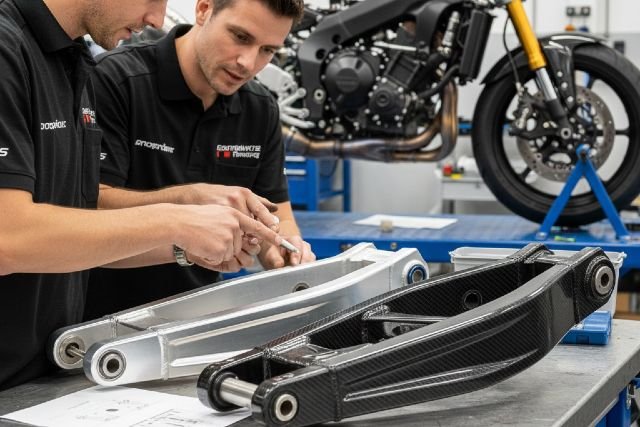
Carbon fiber is lightweight and can be engineered for very high stiffness-to-weight, but it is expensive and manufacturing complexity can reduce cost efficiency. Research and engineering papers discussing carbon fiber swing arms note significant stiffness-to-weight advantages and major weight reduction potential, though practical production challenges remain.
Titanium is strong and lightweight, but it’s expensive and typically used in highly specialized applications rather than common aftermarket swing arms.
Swing Arm Design Types: Box Section vs Banana vs Braced Racing Arms
The design of a swing arm changes stiffness, clearance, and how it behaves under load.
A box-section swing arm is common in modern sportbikes because it balances stiffness, weight, and manufacturing efficiency. It often provides strong lateral rigidity and predictable handling feel.
Banana-style swing arms have a curved shape that can provide more exhaust clearance, especially for sportbikes with under-engine routing. The design is also used for packaging advantages and can help maintain rigidity while creating clearance space.
Braced swing arms are often used for racing or drag builds where additional structural reinforcement helps resist flex under heavy acceleration loads. These are common in high-power motorcycles because the rear tire can generate huge torque forces through the swing arm.
When choosing between designs, focus less on shape aesthetics and more on functional clearance, rigidity, weight, and compatibility with your bike’s geometry.
Swing Arm Pivot and Bearings: Small Parts, Big Results
Performance isn’t only about the swing arm itself—it’s also about the pivot system.
A swing arm pivots around bearings and a pivot shaft. If that system has play, binding, or worn bearings, your suspension can behave inconsistently. That inconsistency can appear as vague rear feedback, mid-corner instability, or unpredictable traction.
If you’re upgrading a swing arm, the pivot condition and bearing type matter. Some race-focused designs use very rigid bearing systems and stronger pivot plates to resist flex under load. When your bike is leaned over, pivot stiffness and bearing smoothness are directly related to cornering stability.
Compatibility and Fitment: What Most Buyers Get Wrong
Many riders choose a swing arm based on brand hype, then discover fitment problems that affect performance more than the upgrade improves it.
A swing arm upgrade must match or integrate correctly with:
Rear shock linkage geometry and leverage ratio
Axle diameter and wheel compatibility
Chain alignment and sprocket offset
Rear brake caliper bracket setup
ABS sensor placement if applicable
Exhaust routing clearance
Rear ride height and geometry setup
If any of these are off, the swing arm could create new handling problems, chain wear, or suspension behavior you didn’t intend.
The best approach is to think of the swing arm as part of a system, not a standalone component.
Choosing the Right Swing Arm for Your Riding Style
The most effective way to choose a swing arm is to start with the performance problem you want to solve.
If your bike wheelies easily under acceleration and struggles to put power down, a slightly longer swing arm and improved anti-squat setup can help stabilize the chassis and improve drive.
If your bike feels nervous on corner exit, a swing arm with improved stiffness characteristics and stable geometry can increase confidence.
If your rear tire feels inconsistent on bumpy roads, a swing arm that isn’t overly rigid and a geometry setup that avoids excessive anti-squat can improve compliance and traction. Technical discussions about anti-squat adjustment emphasize that swing arm angle and ride height are key tuning tools.
If you ride off-road or adventure terrain, strength and impact resistance may matter more than ultra-low weight. A swing arm needs to survive real hits without cracking.
Real-World Scenario: Track Rider vs Street Rider Swing Arm Choice
Imagine two riders buying the same aftermarket swing arm.
The track rider wants maximum corner exit grip and stable handling under full lean. They benefit from a swing arm with strong lateral stiffness and geometry tuned for controlled anti-squat. They might also adjust rear ride height to optimize swing arm angle for the circuit’s grip level.
The street rider wants comfort, predictable traction, and reliability on uneven pavement. A swing arm that is overly stiff may feel harsh, causing the rear to skip over bumps. The better choice could be a design that balances rigidity with compliance, paired with correct suspension tuning.
The point is simple: maximum performance is relative to your environment.
How to Tune Swing Arm Performance Without Replacing It
A surprising truth is that many riders can unlock better performance from their existing swing arm by adjusting geometry.
You can change swing arm angle by adjusting rear ride height, changing shock length, adjusting linkage settings, or altering rear sag. This affects anti-squat behavior and traction. Suspension tuning resources specifically note ride height changes as a common method to adjust anti-squat.
This means that before investing in a swing arm upgrade, it’s often smarter to check whether your current setup is optimized. A swing arm upgrade won’t fix poor sag setup, worn bearings, or an incorrect shock spring rate.
Common Questions About Swing Arms (FAQ)
What does a swing arm do on a motorcycle?
A swing arm connects the rear wheel to the frame and allows it to move with the suspension while maintaining alignment. It also influences traction, stability, and handling through stiffness and geometry.
Does a longer swing arm improve performance?
A longer swing arm can improve stability and reduce wheelies, often improving traction under acceleration. However, too much length can reduce agility and make the bike feel slower to turn.
What material is best for a swing arm?
Aluminum is the most common high-performance choice due to its strength-to-weight ratio. Steel can be tougher for off-road use, while carbon fiber can offer exceptional stiffness-to-weight but is costly and complex to manufacture.
What is anti-squat and why does it matter?
Anti-squat is a geometry effect where chain forces and swing arm angle help resist rear suspension compression during acceleration. Proper anti-squat improves traction, but too much can reduce compliance and grip on bumps.
Can I improve swing arm performance without upgrading?
Yes. Adjusting rear ride height, sag, and suspension setup can change swing arm angle and anti-squat behavior, often improving traction and handling without replacing parts.
Conclusion: Choosing the Right Swing Arm for Maximum Performance
Choosing the right swing arm is one of the smartest ways to improve real-world motorcycle performance because it affects traction, stability, anti-squat behavior, and suspension consistency. The best swing arm isn’t always the lightest or most expensive option — it’s the one that matches your riding style, your bike’s geometry, and your performance goals.
To get maximum value, focus on the fundamentals: swing arm length for stability, stiffness balance for traction, geometry for anti-squat, and correct compatibility with your suspension linkage and drivetrain alignment. Anti-squat behavior, in particular, is a major driver of how your rear tire hooks up under throttle, and technical suspension resources show it can be tuned through swing arm angle and ride height.