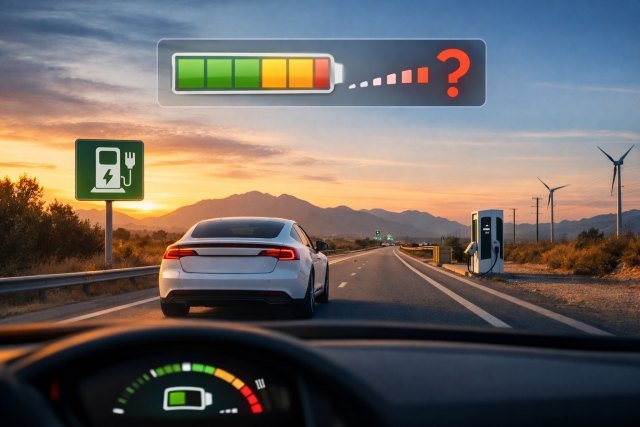
Range Anxiety is that uneasy “what if I run out?” feeling that pops up when you’re behind the wheel of an electric vehicle (EV), watching the battery percentage tick down, and wondering whether the next charger will actually be available. If you’re new to EVs, it can feel like the #1 barrier between you and stress-free driving.
- What is Range Anxiety?
- Why Range Anxiety still exists (even as EVs improve)
- What actually affects your miles
- Charging infrastructure is expanding (and that reduces Range Anxiety)
- The practical toolkit: how to reduce Range Anxiety on every drive
- EV road-trip planning that actually works
- Range Anxiety and buying an EV: what shoppers worry about (and why)
- A realistic scenario: commuting vs road trips
- FAQs
- Conclusion: Range Anxiety is solvable — with the right habits
The good news: Range Anxiety is usually more about uncertainty than actual risk. Once you understand how EV range really works, how charging infrastructure is growing, and how to plan like experienced EV drivers do, the worry shrinks fast — and your confidence grows.
This guide breaks Range Anxiety down into practical, real-world steps you can use today, whether you already own an EV or you’re considering one.
What is Range Anxiety?
Range Anxiety is the fear or stress that an EV won’t have enough charge to reach your destination (or the next reliable charger). Many definitions focus only on “fear of being stranded,” but newer research argues it’s broader than that — covering uncertainty, trust in infrastructure, and even cognitive load while driving.
Think of it like this: gas cars rarely make you think about fuel until the needle gets low, because stations are everywhere and refueling is fast. EV driving asks you to think a little earlier — especially on road trips or in cold weather — until it becomes routine.
Why Range Anxiety still exists (even as EVs improve)
EVs have improved quickly, but Range Anxiety can linger for a few common reasons:
The charger availability problem feels unpredictable
If you’ve ever pulled into a busy charging station and found a queue — or broken stalls — you understand why “range” is also about access. That uncertainty is a big driver of anxiety in consumer studies.
Drivers often compare EVs to the convenience of gas
Gas stations set an expectation: refuel almost anywhere in ~5 minutes. EV charging is different — more like “top up while you eat” than “stop only for fuel.” Once people adopt that mindset, Range Anxiety tends to drop.
Real-world range is not a single number
EPA ratings are useful, but real life includes speed, wind, hills, tires, passengers, and temperature. Some outlets track how EPA estimates compare to real-world driving results to help drivers build more realistic expectations.
What actually affects your miles
If you want to beat Range Anxiety, you need to understand the “why” behind range changes. Here are the big levers.
Speed matters more than most people expect
Going from 60 mph to 75 mph doesn’t feel dramatic — but aerodynamic drag rises fast, and EVs feel it. On long highway stretches, a slightly slower cruising speed can be the difference between arriving relaxed vs arriving stressed.
Temperature and cabin heating can cut range
Cold weather reduces battery efficiency and increases energy used for heating. Hot weather can also reduce range, though usually less dramatically than cold. Preconditioning (warming or cooling the battery while plugged in) helps a lot.
Elevation, wind, and tires quietly add up
Hilly routes can increase consumption on the way up (though regen can help on the way down). Headwinds act like higher speed. Underinflated tires increase rolling resistance.
Battery percentage isn’t a “fuel gauge” in the same way
EVs estimate remaining range based on recent driving and conditions. If your last 15 miles were uphill at 75 mph, your displayed range can drop faster than expected. That doesn’t mean anything is wrong — it’s just math adapting to reality.
Charging infrastructure is expanding (and that reduces Range Anxiety)
One reason Range Anxiety is easing over time is simple: there are more places to charge.
For example, U.S. charging infrastructure has grown substantially over the last decade. The U.S. Alternative Fuels Data Center (AFDC) tracks public and private EV charging ports, showing steady growth through 2023. The Joint Office of Energy and Transportation also publishes charging growth views based on AFDC locator data.
Globally, the International Energy Agency (IEA) emphasizes that accessible, affordable public charging is a key requirement for mass adoption and projects major expansion needs over time.
That said, rollout speed and policy can shift, and program changes can affect how quickly new chargers get built in certain regions.
Bottom line: infrastructure is improving, but smart planning still matters — especially in rural routes or peak travel times.
The practical toolkit: how to reduce Range Anxiety on every drive
Here’s how experienced EV drivers stay calm — even when driving long distances.
Start with the “charging-first” habit (not “range-first”)
Instead of asking “Do I have enough range for the whole trip?” ask:
- “Where is my most reliable charging stop?”
- “What’s my backup charger if the first one is busy?”
This mindset flips EV driving from worry to strategy.
Use the 20–80 approach for road trips
Charging from 20% to 80% is often faster (and more time-efficient) than trying to go from very low to 100%, especially on DC fast chargers. Many drivers find they arrive sooner by taking slightly more frequent, shorter charging stops.
Treat charging stops like breaks you already need
If you plan your stop around coffee, lunch, a restroom break, or a quick walk, charging feels less like “waiting” and more like normal travel.
Build a personal buffer that fits your comfort level
Some drivers feel fine arriving with 8–10%. Others prefer 15–20%. There’s no prize for arriving at 1%. Your buffer is your stress shield.
Watch your consumption, not just your battery percentage
Most EVs show real-time energy use (e.g., mi/kWh or Wh/mi). If consumption climbs unexpectedly, you’ll catch it early and adjust speed or cabin heating before it becomes stressful.
EV road-trip planning that actually works
If Range Anxiety spikes for you on road trips, you’re not alone. Here’s a method that keeps things simple.
Step 1: Plan one primary stop and one backup
Pick a charging station you trust as your main stop. Then pick a backup charger roughly 10–25 miles before or after it.
Step 2: Arrive with enough charge to reach your backup
This single rule removes most stress. You’re never “all in” on one charger.
Step 3: Expect small detours and variability
Wind, rain, construction, or a packed station can change your timeline. Planning with flexibility is the difference between “EV travel is stressful” and “EV travel is easy.”
Range Anxiety and buying an EV: what shoppers worry about (and why)
Surveys consistently show that charging access and range concerns remain major hurdles for buyers. AAA’s EV survey reporting highlights that consumer hesitation persists, including concerns tied to charging and range. J.D. Power’s EV consideration study also notes that charging concerns continue to be a key friction point.
If you’re shopping, the best way to reduce Range Anxiety is to choose an EV that matches your life:
- If you drive mostly locally: home charging and a moderate range may be perfect.
- If you road-trip often: prioritize fast-charging performance and route coverage, not just the biggest battery.
A realistic scenario: commuting vs road trips
Imagine two drivers:
Driver A commutes 22 miles round-trip and can charge at home. Range Anxiety fades quickly because the daily routine is predictable. Even a modest-range EV easily covers the week with frequent top-ups.
Driver B drives 200 miles for client meetings twice a week and sometimes changes routes last minute. Range Anxiety can remain unless they:
- choose an EV with strong DC fast-charging performance,
- identify reliable chargers on common corridors,
- keep a comfortable buffer.
Same technology. Different lifestyle. Different solution.
FAQs
What is Range Anxiety in electric vehicles?
Range Anxiety is the stress or fear that an electric vehicle won’t have enough battery charge to reach your destination or a reliable charging station, often driven by uncertainty about real-world range and charger availability.
How do I stop worrying about EV range?
Reduce Range Anxiety by planning one reliable charging stop plus a backup, keeping a personal arrival buffer (like 15–20%), and using your car’s consumption data to adjust speed or climate settings early.
Does cold weather increase Range Anxiety?
Yes. Cold temperatures can reduce battery efficiency and increase heating energy use, lowering real-world range and making the range estimate drop faster, especially at highway speeds.
Is EV range improving over time?
In many markets, EV options and charging networks have expanded, and organizations tracking charging infrastructure show continued growth over recent years.
Are EPA range numbers accurate?
EPA ratings are a standardized benchmark, but real-world range varies with speed, temperature, terrain, and driving style. Some independent testing compares EPA estimates to real-world results to help drivers set expectations.
Conclusion: Range Anxiety is solvable — with the right habits
Range Anxiety is real, especially when you’re new to EVs or planning longer trips. But it’s rarely a permanent problem. Once you learn what impacts range, how to plan a primary charger plus a backup, and how to drive with a comfortable buffer, the stress fades into the background.
The most confident EV drivers aren’t the ones with the biggest batteries — they’re the ones with the best routines. Build those routines, and Range Anxiety stops being a fear and becomes a simple planning step on the way to stress-free EV driving.