Steel Buildings have quietly become the go-to choice for projects that want a crisp, modern look without sacrificing speed, strength, or long-term flexibility. Whether you’re planning a warehouse that doesn’t feel industrial, a retail space with architectural edge, or a sleek home-adjacent studio, Steel Buildings can deliver that “clean build” aesthetic — straight lines, open spans, and finishes that age well.
- Why Steel Buildings Feel “Modern” When Designed Right
- Steel Buildings Design Idea #1: Clean “Box + Shadow” Massing
- Steel Buildings Design Idea #2: Mixed Cladding for a Warmer Modern Look
- Steel Buildings Design Idea #3: Long-Span Interiors That Stay Minimal
- Steel Buildings Design Idea #4: Daylighting That Looks Sharp (Not Industrial)
- Steel Buildings Design Idea #5: A Roof That Works Hard (Cool Roof + Solar Ready)
- Steel Buildings Design Idea #6: Concealed Gutters, Clean Edges, and “No Visual Noise”
- Steel Buildings Design Idea #7: Hybrid Front-of-House “Architectural Sleeve”
- Steel Buildings Design Idea #8: Plan for Expansion Without Ruining the Look
- Sustainability Notes People Should Know About Steel Buildings
- Common Mistakes That Make Steel Buildings Look Dated
- FAQ: Steel Buildings for Modern, Clean Builds
- Conclusion: Steel Buildings That Stay Modern, Clean, and Flexible
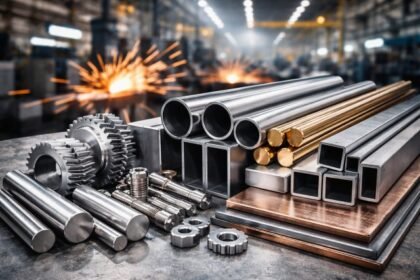
The real advantage isn’t just structure. It’s the design freedom: large column-free interiors, razor-sharp façade details, easy expansion, and a material that aligns with circular construction goals because steel can be recycled repeatedly without losing its core properties.
Below are the most practical, modern design ideas to help your Steel Buildings look intentional, premium, and future-proof — plus answers to the questions people ask before they commit.
Why Steel Buildings Feel “Modern” When Designed Right
Modern design usually boils down to a few principles: simplicity, proportion, light, and honest materials. Steel supports all four.
Long spans are one of the biggest reasons. With steel, you can achieve wide, unobstructed interiors that are hard (and often expensive) to replicate with other systems. That means clean sightlines, adaptable layouts, and less visual clutter from columns — especially useful for showrooms, gyms, aircraft hangars, and contemporary commercial spaces.
Steel also plays well with prefabrication and tight tolerances. In plain terms: straighter lines, consistent reveals, cleaner junctions, and fewer “field fixes” that ruin minimalist architecture.
Steel Buildings Design Idea #1: Clean “Box + Shadow” Massing
If you want modern without over-designing, start with a simple volume and make it feel architectural through shadow lines and depth.
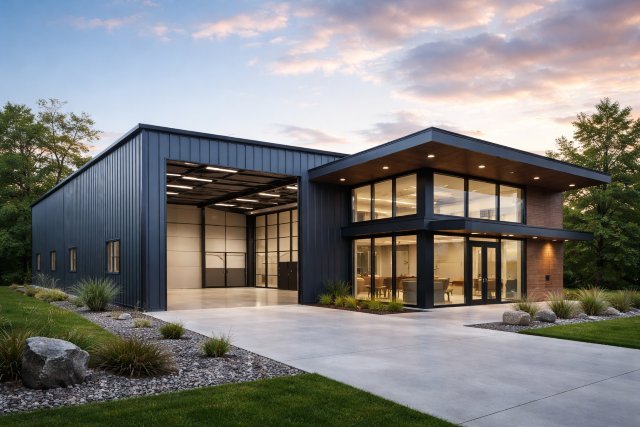
A reliable approach is “box + shadow”: a primary rectangular form with a recessed entry, a cantilevered canopy, or a setback façade plane. Steel framing makes these moves straightforward because you can support overhangs and create crisp edges with less bulk.
Where it works best:
- retail storefronts and medical offices (clean, professional curb appeal)
- modern industrial offices (warehouse + front-of-house showroom)
- accessory buildings (studios, workshops, garage expansions)
Tip: Keep one “hero move” (like a recessed entry) and let materials do the rest — metal panel alignment, a refined soffit, and consistent window heights.
Steel Buildings Design Idea #2: Mixed Cladding for a Warmer Modern Look
A common fear is that Steel Buildings will look like a plain metal shed. That only happens when exterior finishes aren’t composed like architecture.
A modern strategy is mixing 2–3 façade materials with a clear hierarchy:
- standing seam metal roofing or wall panels for clean planes
- wood-look or fiber cement accents for warmth
- glass at public-facing elevations for transparency
The key is restraint. Use one dominant material (often metal), one accent, and one “light” material (glass). Keep transitions aligned with structural gridlines so the building feels intentional.
Steel Buildings Design Idea #3: Long-Span Interiors That Stay Minimal
H2: Long-span Steel Buildings for column-free space
Modern spaces feel better when they’re open, adaptable, and uncluttered. Steel is a natural fit because long-span systems can create flexible, column-free interiors and can reduce substructure demands in many scenarios.
If you’re designing for future change — new equipment, reconfigured retail aisles, different tenancy — long spans are your best friend. They reduce the “locked-in” feeling that comes from too many supports dictating layout.
Real-world scenario: A logistics client starts with racking + loading lanes. Two years later they add light assembly and need different circulation. A long-span steel bay lets them re-plan without fighting columns.
Steel Buildings Design Idea #4: Daylighting That Looks Sharp (Not Industrial)
Daylighting is one of the fastest ways to make Steel Buildings feel premium — if you do it with control.
Modern daylighting approaches include:
- continuous clerestory bands at high walls
- north-facing sawtooth roof profiles for soft, consistent light (especially for studios and fabrication)
- oversized sectional glazing at public elevations (showrooms, offices)
The trick is glare control and heat management. You want bright interiors, not harsh hotspots. Pair daylighting with:
Steel Buildings Design Idea #5: A Roof That Works Hard (Cool Roof + Solar Ready)
Roofs are a design feature in modern builds — not an afterthought. For Steel Buildings, the roof can also be a major energy lever.
A “cool roof” reflects more sunlight and absorbs less solar energy, which helps reduce roof surface temperatures significantly versus conventional roofs under the same conditions.
The U.S. EPA also notes cool roofs can reduce peak cooling demand in air-conditioned residential buildings by 11–27% (context varies by building and climate, but it’s a meaningful signal).
For modern, clean builds, a smart roof stack looks like:
- high-reflectance roof finish (cool roof strategy)
- well-detailed insulation and air sealing
- planned pathways and attachment points for solar (even if you install later)
If you want to quantify benefits, DOE’s Oak Ridge National Laboratory hosts a Cool Roof Calculator to estimate savings for certain building profiles.
Steel Buildings Design Idea #6: Concealed Gutters, Clean Edges, and “No Visual Noise”
Modern design is won or lost in the details. Steel Buildings especially need clean “edge discipline” because trims, fasteners, and downspouts can quickly look busy.
High-impact detailing upgrades:
- concealed gutters and internal downspouts where feasible
- simplified trim profiles (fewer transitions)
- aligned panel seams and window mullions
- consistent parapet heights or consistent eave lines
If budget is tight, prioritize concealment and alignment over fancy materials. A simple palette with perfect alignment looks more expensive than a complex palette with messy junctions.
Steel Buildings Design Idea #7: Hybrid Front-of-House “Architectural Sleeve”
For commercial and industrial projects, a popular modern solution is an architectural “sleeve” on the front elevation — basically a more refined façade system attached to the steel structure.
You keep the efficiency of Steel Buildings for the main volume, and elevate street presence with:
- a curtain wall entry
- a rainscreen panel system
- a feature canopy and signage band
This approach is common in modern warehouses, self-storage, and manufacturing HQs where the business wants a clean brand-forward front without rebuilding the entire structural concept.
Steel Buildings Design Idea #8: Plan for Expansion Without Ruining the Look
One of the most underrated design features is future expandability.
Steel Buildings can be designed for:
- end-wall removal and bay additions
- lateral expansion with pre-planned frame spacing
- future mezzanines (if loads are considered early)
To keep expansion “clean,” plan where the building will grow and place architectural features accordingly. Don’t put your main façade rhythm on the future expansion side.
Sustainability Notes People Should Know About Steel Buildings
Sustainability isn’t just operational energy — it’s also material cycles and end-of-life outcomes.
Steel is widely cited as 100% recyclable, and can be recycled repeatedly without losing its fundamental properties, making it compatible with circular-economy thinking.
For the U.S., USGS estimates a 2024 recycling rate of 98% for structural steel from construction (construction and demolition stream).
That doesn’t automatically make every steel project “low-carbon,” because emissions depend on production routes, electricity grids, and design efficiency. But it does mean steel fits well with design-for-disassembly, salvage, and reuse strategies — especially when you choose bolted connections and standardized members.
Common Mistakes That Make Steel Buildings Look Dated
A modern, clean build isn’t about spending more — it’s about avoiding a few predictable missteps.
The biggest issues:
- random window placement that doesn’t align with panel seams
- too many trim profiles and color changes
- undersized canopies and shallow entries (no shadow or depth)
- value-engineering details that create “visual clutter” (exposed downspouts everywhere, misaligned corners)
If you fix alignment and simplify transitions, the building usually jumps a full tier in perceived quality.
FAQ: Steel Buildings for Modern, Clean Builds
What makes Steel Buildings “modern” compared to traditional construction?
Steel Buildings support long spans, clean geometry, and precise detailing. That enables open interiors and minimalist exteriors with aligned panel joints, crisp openings, and fewer bulky structural elements. Long-span steel solutions are commonly used to create flexible, column-free spaces.
Are Steel Buildings energy efficient?
They can be, if you treat the envelope (roof/walls), insulation, and thermal bridging details seriously. Roof strategy matters a lot: DOE notes cool roofs reflect more sun and can stay substantially cooler than conventional roofs in the same conditions.
Do Steel Buildings look “industrial” by default?
Not if the exterior is composed intentionally. Modern Steel Buildings often use mixed cladding, clean trim strategies, and a defined entry feature (recess, canopy, or glazed storefront) to avoid the plain “box” look.
Are Steel Buildings sustainable?
Steel is repeatedly recyclable without losing its properties, and USGS estimates structural steel recycling rates around 98% in the U.S. construction stream (2024 estimate).
Overall sustainability still depends on design efficiency, sourcing, and operational performance.
How do I keep a modern steel building looking clean over time?
Choose durable finishes, simplify exterior details, and design water management carefully (gutters, downspouts, drips, and flashing). Most “aging badly” issues come from staining and streaking — good detailing prevents that.
Conclusion: Steel Buildings That Stay Modern, Clean, and Flexible
Steel Buildings are at their best when the design leans into what steel does naturally well: long spans, precise lines, fast erection, and easy adaptation. When you combine that structural freedom with smart façade composition, controlled daylighting, and a roof strategy like cool-roof principles, you get a modern, clean build that performs and still looks sharp years later. Steel’s recyclability and high structural steel recycling rates also support circular construction goals, especially when you design for future reuse.