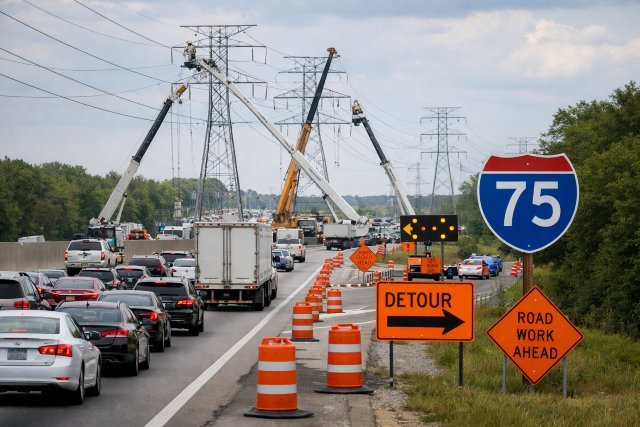
An I-75 Power Line Shutdown can turn a normal drive into a standstill in minutes — especially when downed or damaged lines force crews to close lanes (or the entire interstate) to protect drivers and allow utility repairs. Because I-75 is a major north–south artery running about 1,786 miles from Florida to Michigan, even a short closure can ripple into hours of delay, overloaded local roads, and higher crash risk on detour routes.
- What an “I-75 Power Line Shutdown” actually means
- Why traffic gets so bad so quickly on I-75
- How long does an I-75 Power Line Shutdown last?
- I-75 Power Line Shutdown traffic impact: what to expect (and when it’s worst)
- Best detour strategy during a shutdown
- Safety first: what NOT to do around downed power lines
- What to do if you’re already stuck in the backup
- Real-world scenarios: what drivers learn the hard way
- How to get reliable I-75 closure updates fast
- FAQs
- Conclusion: staying calm, informed, and safe during an I-75 Power Line Shutdown
What typically happens during a shutdown, how traffic backups form, how to choose safer detours, and what to do if you encounter a downed line — plus how to get reliable updates fast.
What an “I-75 Power Line Shutdown” actually means
An I-75 Power Line Shutdown usually refers to one of these scenarios:
- Emergency closure from downed lines: Severe weather, a crash, or falling trees/poles brings live wires onto or near the roadway, so law enforcement and DOT close the interstate until utilities confirm it’s safe. This has happened in multiple I-75-adjacent areas — like the April 2, 2024 closure near Monroe, Ohio, where storms knocked power lines down across I-75 and the highway was closed for hours.
- Planned utility work near/over the highway: Crews may need rolling lane closures or nighttime shutdowns to repair transmission infrastructure, install equipment, or remove hazards.
- Related closures at major interchanges: Sometimes the closure is on a feeder route or interchange connected to I-75 (for example, a nearby interstate segment or bridge closure due to power-line-related hazards).
No matter the cause, the key issue is the same: electricity + traffic = a high-risk scene, and reopening depends on utility verification — not just debris removal.
Why traffic gets so bad so quickly on I-75
When I-75 shuts down, congestion often feels “instant.” That’s because interstates function like pipelines: once flow is cut, vehicles keep arriving at high volume until the closure point fills.
A few factors make I-75 closures uniquely painful:
It’s heavily traveled in metro areas
In places like Atlanta, I-75 is among the nation’s most traveled roadway segments by Annual Average Daily Traffic (AADT) — FHWA’s “top traveled locations” list includes I-75 in Atlanta at over 400,000 AADT (2019 data).
Detours funnel onto streets that aren’t built for interstate volumes
Local arterials have traffic lights, lower speeds, driveways, and school zones. That means detours can look “short” on a map but take much longer in reality.
Secondary crashes rise during detours
Stop-and-go traffic, sudden lane changes, and confused navigation increase crash risk — especially near ramps and at the first few major intersections off the interstate.
Freight delays compound the problem
I-75 is a major freight corridor connecting industrial regions and border crossings; when trucks are diverted, roundabouts, narrow lanes, and tight turns can become bottlenecks.
How long does an I-75 Power Line Shutdown last?
There’s no universal timeline, but closures generally follow this sequence:
- Immediate shutdown (minutes): Troopers/DOT block lanes; traffic begins to stack.
- Scene stabilization (30–90 minutes): Utilities assess if lines are energized and identify isolation steps.
- Repair / removal (hours): Crews remove lines from the roadway, replace poles/wires if needed, and test for safety.
- Reopening: Often phased — one direction or one lane first, then full opening once verified.
In the April 2, 2024 Monroe, Ohio event, I-75 reopened the same night after downed lines blocked both directions for hours.
A practical rule: if live lines are involved, reopening depends on utility confirmation, not just whether the road “looks clear.”
I-75 Power Line Shutdown traffic impact: what to expect (and when it’s worst)
The first 30–60 minutes: fastest-growing backups
If you’re approaching the closure from a distance, you may not see brake lights until the last minute. Navigation apps can lag behind reality early on.
60–180 minutes: detour routes saturate
As more drivers exit, the “best” detours become the same detours everyone is using. Expect major slowdowns at:
- the first few intersections after an exit ramp
- river crossings / bridges
- commercial corridors with frequent signals
After 3+ hours: delays can spread far beyond the closure
Local roads, parallel highways, and even unrelated interchanges can clog from spillover.
Best detour strategy during a shutdown
The “right” detour depends on where you are, but the best strategy is consistent.
1) Prioritize official DOT guidance over app routing (when possible)
During major incidents, DOTs may designate detours that avoid low bridges, weight restrictions, or residential streets that can’t handle heavy traffic. Some real-time traffic hubs compile DOT posts and conditions along I-75.
2) Exit earlier than the crowd — if you have enough distance
If you’re within a few miles of a full closure, the nearest exits can jam immediately. Exiting earlier gives you more route options and fewer forced turns.
3) Use “parallel corridor” thinking
Instead of bouncing through city streets, look for:
- a parallel state route that runs alongside I-75 for several miles
- a beltway/bypass that reconnects beyond the closure
- a major U.S. highway with fewer stoplights than commercial strips
4) If you’re in a truck/RV: avoid tight urban detours
Large vehicles should favor:
- wider state highways
- routes with fewer turns and fewer low-clearance risks
- designated truck routes where available
5) Decide early: “detour now” vs “wait it out”
If the shutdown just happened, detouring may be best. If it’s already been hours and detours are gridlocked, sometimes stopping safely (fuel/food/rest) and rechecking updates can save time and reduce stress.
Safety first: what NOT to do around downed power lines
This is the part too many drivers get wrong — especially when trying to “help” or squeeze through.
Never assume a wire is dead
You cannot reliably tell by sight whether a line is energized. Safety organizations stress treating all downed lines as live.
Keep your distance (and don’t drive over it)
Downed lines can energize the ground and nearby objects. ESFI warns the ground around power lines may be energized up to ~35 feet from the line.
Also: guidance for motorists repeatedly emphasizes do not drive over downed lines — even if they’re not sparking.
If a line falls on your vehicle: stay inside (usually)
Multiple utilities and safety agencies give the same core advice:
- Stay in your vehicle until utility workers or emergency responders tell you it’s safe to exit.
- If you must escape due to fire or immediate danger, the recommended method is to jump clear without touching the car and ground at the same time, then move away with feet together (shuffle/hop).
Don’t become the second victim
Trying to move a wire with a stick, strap, or “non-metal” object is still dangerous — wet materials can conduct electricity, and energized zones can extend beyond what you expect.
What to do if you’re already stuck in the backup
When you’re in a standstill caused by an I-75 Power Line Shutdown, small choices matter:
Keep lanes clear for responders
Emergency vehicles and utility trucks need room to reach the scene. Follow law enforcement direction and avoid blocking shoulders.
Conserve fuel safely
If you expect a long stop:
- reduce idling if weather permits
- keep enough fuel reserve for detours or extended slow traffic
Share location clearly if you need help
If you call for assistance, mention:
- direction (northbound/southbound)
- nearest mile marker or exit
- nearby landmarks (rest area, interchange)
Watch for secondary hazards
Downed trees, debris, and other vehicles attempting risky maneuvers can cause additional incidents behind the closure.
Real-world scenarios: what drivers learn the hard way
Scenario A: Severe storms knock lines down across I-75 (Monroe, Ohio example)
In the April 2, 2024 incident near Monroe, Ohio, storms brought down lines across I-75 and the interstate was closed for hours before reopening later that night.
Lesson: In storm-driven events, reopening often requires utility confirmation and can extend beyond the end of the storm itself.
Scenario B: Downed line closes a connected interchange before rush hour (Michigan example)
MDOT reported a closure due to a downed power line near the I-75 area (I-696 at I-75), and the route reopened after utility crews completed repairs.
Lesson: Even if “I-75 itself” isn’t shut, connected interchanges can disrupt your plan — check the broader network.
Scenario C: Local road shutdown near I-75 causes interstate congestion (Kentucky example)
In Scott County, Kentucky, downed power lines shut down a key local route near an I-75 mile marker, causing significant congestion and uncertain reopening timing at the time of reporting.
Lesson: Detours can fail if nearby arterials are also impacted — storm events often break multiple links at once.
How to get reliable I-75 closure updates fast
During a power-line-related shutdown, “the truth” changes quickly. Use sources that update in real time or cite official agencies:
- State DOT traffic advisories (best for official closures and detour instructions). For example, ODOT posts district traffic advisories and construction/closure updates.
- Highway Patrol / local emergency management social updates (often fastest on full closures).
- Utility company safety pages for what to do around downed lines.
- Traffic dashboards that aggregate DOT feeds (useful, but treat as secondary).
Pro tip: If one app says “road open” but DOT says “closed,” trust DOT.
FAQs
What caused the I-75 Power Line Shutdown?
Most I-75 power-line shutdowns happen when storms, crashes, or falling trees bring energized lines onto or close to the roadway, forcing a closure until utilities secure and de-energize the area.
How long will I-75 be closed for downed power lines?
It can range from under an hour to several hours (or longer if major repairs are needed). Live-line incidents reopen only after utility crews confirm the roadway is safe.
Is it safe to drive around a downed line if it’s not sparking?
No. You can’t tell if a line is energized by looking at it, and the surrounding ground may be energized as well. Treat every downed line as live and keep your distance.
What should I do if a power line falls on my car?
Stay inside the vehicle and wait for help. If you must escape due to fire or immediate danger, jump clear without touching the car and ground at the same time, then move away with feet together.
What’s the safest way to handle detours during an I-75 shutdown?
Follow official DOT directions when available, exit early if you have distance, and avoid small residential roads — especially if you’re driving a truck or towing.
Conclusion: staying calm, informed, and safe during an I-75 Power Line Shutdown
An I-75 Power Line Shutdown is more than an inconvenience — it’s a high-risk environment where electricity, traffic, weather, and impatience collide. The safest approach is to trust official updates, choose detours that match your vehicle and conditions, and treat any downed wire as energized. If a line is on your vehicle, staying put until professionals clear you is usually the safest move.
If you want, I can also tailor the detour section to a specific metro area (like Atlanta, Cincinnati/Monroe, Knoxville, Tampa, or Detroit) by pulling the most common alternates and DOT resources for that region.