Himalayan pink salt is widely known because of its soft pink color and 84 natural minerals and trace elements. Many people see these pink crystals in their kitchens every day, but most people do not really know where the salt comes from or how it reaches their table.
The complete Himalayan pink salt processing system has several steps. It begins deep inside the mountains of Pakistan with rock salt extraction. Before being shipped to buyers in other countries, it undergoes cleaning, crushing, washing, drying, grading, testing, and bulk packing. Want to know more? In this blog post, we will explain the complete Himalayan salt processing step-by-step. By the end, you will understand how Himalayan pink salt is produced from the mine to export.
Where Does Himalayan Pink Salt Come From?
The story of Himalayan pink salt begins in the ancient Salt Range located in Punjab, Pakistan. This region has very large layers of natural rock salt. These layers formed millions of years ago when ancient seas slowly dried and left thick salt beds under the ground.
One famous location in this region is the Khewra Salt Mine. It is one of the largest salt mines in the world. A large amount of Himalayan salt comes from this area.
Deep inside the mountains, there are strong layers of rock salt. These layers stayed protected for a very long time under thick rock. Because of this, the salt remained clean and natural.
The pink color of the salt comes from tiny amounts of minerals inside it. Iron is one of those minerals. That is why Himalayan salt has its unique pink shade.
How Does the Pink Salt Mining Process Begin?
The pink salt mining process begins deep inside underground tunnels. Workers follow a system known as the room and pillar method.
In this method, miners remove large parts of salt but leave strong pillars behind. These pillars support the roof of the mine, so the tunnels stay safe.
Workers drill into the salt walls and break them into large blocks. They avoid heavy blasting in most areas. This helps keep the salt crystals strong and in good shape.
After the blocks are separated, workers move them out of the mine. Small carts, conveyor belts, or trucks carry the salt to the surface.
At this stage, the salt is still raw. The real Himalayan pink salt processing work starts after the salt reaches the processing plant.
1. Primary Cleaning and Sorting
As soon as the salt arrives at the factory, the workers start an inspection. They check the salt blocks and remove clay stones or dirt that may be attached to them. This first cleaning step prepares the salt for further processing.
Workers also decide what will happen to each batch. Some large pieces stay in their natural form as Himalayan salt chunks. These chunks are used for decoration, spa stones, or salt lamps.
Other pieces move forward to the next stage, where they are broken into smaller grains.
2. Crushing and Grinding Himalayan Pink Salt
Large rock salt blocks cannot be used directly in cooking or food products. They first need to be broken into smaller sizes.
Crushing machines break the big salt blocks into medium pieces. After that, grinding machines reduce the size even more.
During this step, Himalayan salt is prepared in different grain sizes, such as:
- Fine Himalayan pink salt
- Coarse Himalayan pink salt
- Medium Himalayan pink salt
- Extra fine Himalayan pink salt
- Himalayan pink salt chunks
Each type has its own use. Fine salt is common for daily cooking. Coarse grains are often used in grinders. Extra fine Himalayan pink salt is used by food companies in spice mixes and processed foods. This allows the salt to meet the needs of different markets.
3. Washing Himalayan Salt
After crushing, some salt batches move to the washing stage. During mining and grinding, small dust particles can appear on the salt surface. Washing removes this dust and other foreign particles from the salt.
Workers use clean water for this step. No chemicals are used because the goal is to keep the salt natural. The washing process is quick. It removes surface dust while the natural minerals remain inside the salt crystals. After washing, the salt moves to the drying area.
4. Drying Process for Salt
The drying process for salt removes extra moisture from the salt. Wet salt can form lumps, and it does not pass easily through sorting machines. Because of this, the factories dry the salt before the next step.
Warm air systems blow through the salt while it stays inside the drying chambers. Slowly, the extra moisture disappears. Once the salt becomes dry, it can move easily through the next machines. Dry salt is also easier to store and ship. After drying, the salt is ready for grading.
5. Sieving and Grading Salt
The next step in Himalayan pink salt processing is sieving and grading salt. Factories use vibrating screens to separate the salt grains by size. Each screen has holes of a certain size.
Through this system, the salt is sorted into different forms, such as:
- Fine Himalayan pink salt
- Coarse Himalayan salt granules
- Pink salt powder
- Himalayan salt chunks
This sorting step is very important for buyers. Restaurants, food companies, and traders expect the same grain size in every shipment. Grading helps keep the salt size equal in every bag.
6. Salt Quality Control Process
Testing is another important step in salt production. Each batch passes through a salt quality control process before packing. Workers take small samples from every batch.
These samples are tested in laboratories. The tests check mineral levels, moisture, and cleanliness. Factories also check if the salt follows food-grade salt standards used in many countries.
This step builds trust between producers and buyers.
7. Bulk Packaging for Himalayan Salt
Once the salt passes testing, it moves to the packing section.
For large shipments, bulk packaging for Himalayan salt is very common. Factories usually pack the salt in
- 25 kg bags
- 50 kg export bags
- One-ton jumbo bags
These bags protect the salt during long-distance sea shipping. They keep moisture and dirt away from the product. Each bag also carries a label with details such as salt type, size, and batch number. Proper packaging keeps the salt safe during transportation and export.
Ittefaq Salt is a trusted Himalayan pink salt manufacturer and exporter from Pakistan, supplying high-quality salt products for bulk, private label, and global export markets.
9. Preparing Himalayan Salt for Export
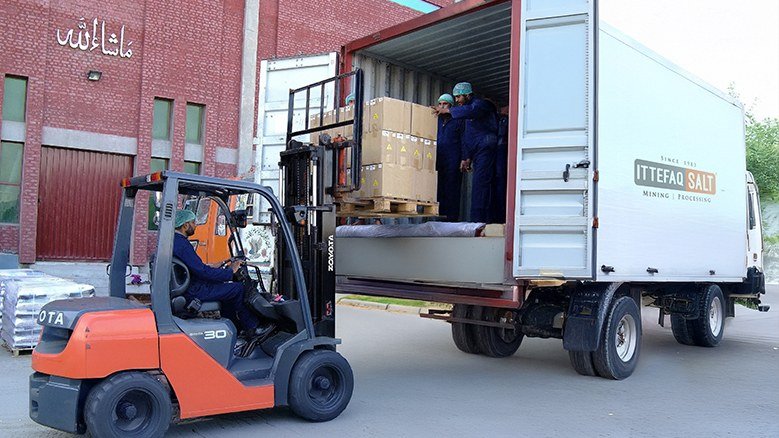
After packing, the final step is export preparation. The logistics team completes the necessary shipping documents and product checks. After that, the workers load the salt bags into large containers.
The bags are stacked carefully, so they stay stable during transport. From Pakistan, the salt travels to many countries, including Europe, Asia, the Middle East, and North America. Because of this global demand, Pakistan is one of the largest suppliers of Himalayan pink salt.
How Is Himalayan Pink Salt Produced from Mine to Market?
In simple words, how Himalayan pink salt is produced follows a clear path.
The process begins with rock salt extraction inside the Himalayan salt mines in Pakistan. After mining, the salt passes through crushing and grinding to produce pink salt. Some batches also move through washing Himalayan salt, and then the drying process.
Next comes sieving and grading salt, where the crystals become fine Himalayan pink salt, coarse Himalayan salt granules, pink salt powder, and Himalayan salt chunks.
After the salt quality control process, the salt moves to bulk packaging for Himalayan salt before it is shipped to buyers around the world.
Each stage helps keep the salt clean, stable, and ready for global markets.
Conclusion
Himalayan pink salt has a long journey before reaching homes, restaurants, and food factories. It begins deep inside the mountains of Pakistan. After mining, the salt passes through several careful steps, such as cleaning, crushing, washing, drying, grading, testing, and packing.
Each step plays an important role in keeping the salt natural and safe.
From the salt mines to processing plants and export ports, this system helps Himalayan pink salt reach kitchens and businesses across the world.