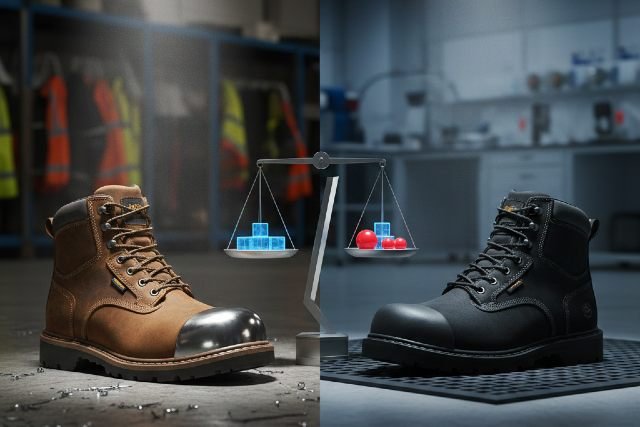
Choosing the right safety shoes is more than a workplace requirement — it’s a daily decision that affects your comfort, productivity, and long-term safety. If you’ve been comparing steel toe vs composite options, you’re already asking the right question. Both types of protective footwear can meet strict safety standards, but they behave differently depending on working conditions, temperature exposure, and the type of hazards you face.
- What Are Steel Toe and Composite Toe Safety Shoes?
- Do Both Steel and Composite Safety Shoes Meet Safety Standards?
- Featured Answer: Steel Toe vs Composite Toe
- Steel Toe vs Composite Toe Safety Shoes: Key Differences Explained
- Steel Toe Safety Shoes: What They’re Best For
- Composite Toe Safety Shoes: What They’re Best For
- Which Safety Shoes Are Better for Your Job? Real-World Scenarios
- Understanding ASTM Ratings in Safety Shoes
- Comfort vs Safety: The Real Decision Most Workers Overlook
- Steel Toe vs Composite Toe: Cost Comparison and Value
- How to Choose the Best Safety Shoes for You
- Practical Buying Tips for Safety Shoes
- FAQ: Steel Toe vs Composite Toe Safety Shoes
- Conclusion: Which Safety Shoes Should You Choose?
This guide explains the differences in plain language so you can choose the best safety shoes for your job without confusion. You’ll learn how each toe type performs, what the safety standards actually mean, and which option works best for different industries and environments.
What Are Steel Toe and Composite Toe Safety Shoes?
Steel toe and composite toe safety shoes share a core purpose: protecting your feet from impact and compression hazards. These hazards are common in work environments where heavy tools, equipment, or materials may fall, roll, or shift unexpectedly. The critical difference is what the toe cap is made from.
Steel toe safety shoes contain a hardened steel cap inserted in the toe area. This design has been used for decades and is known for durability and strong performance in many demanding work conditions.
Composite toe safety shoes use non-metal materials such as carbon fiber, fiberglass, Kevlar, or advanced composite plastics. Although the materials differ, properly certified composite toe shoes can still meet the same safety standards as steel toe footwear. This makes them a legitimate option for many job roles, especially when comfort and specialty conditions matter.
Do Both Steel and Composite Safety Shoes Meet Safety Standards?
Yes, both steel toe and composite toe safety shoes can meet the same safety standards, provided they are certified. In the United States, workplace protective footwear is typically expected to comply with ASTM standards such as ASTM F2413. OSHA requires employers to ensure protective footwear meets appropriate standards for the hazards present, and ASTM certification is the most common benchmark used to confirm performance compliance.
This means composite toe footwear is not “weaker” simply because it is not metal. If it carries the right ASTM rating, it can provide the same impact and compression protection as steel toe shoes.
When shopping for safety footwear, the best approach is to check the label inside the tongue or lining of the shoe. This label usually displays the ASTM standard along with specific protection codes that tell you exactly what the shoe is designed to handle.
Featured Answer: Steel Toe vs Composite Toe
Steel toe safety shoes are usually better for workers who want durable toe protection at a lower cost and who operate in heavy-duty industrial environments. Composite toe safety shoes tend to be better for workers who prioritize lighter footwear, improved insulation, electrical safety needs, or metal-detector-friendly workplaces.
Steel Toe vs Composite Toe Safety Shoes: Key Differences Explained
In practical use, the biggest difference most people notice is weight. Steel toe safety shoes often feel heavier, particularly during shifts that involve a lot of walking. Composite toe shoes are typically lighter, making them appealing for long shifts where fatigue becomes a serious factor.
Temperature is another major difference. Steel is a conductor, meaning it can transfer cold or heat quickly. This can be uncomfortable for workers in extreme environments such as winter outdoor sites, cold storage warehouses, or high-heat work zones. Composite materials tend to insulate better, which is one reason composite toe footwear is frequently preferred in cold conditions.
Workplace access and security can also influence the decision. Steel toe shoes may trigger metal detectors, which can slow down workers who pass through secure checkpoints. Composite toe safety shoes are often chosen in those environments because they are non-metal and less likely to trigger detection systems.
Another key difference is how the toe box feels. Steel toe shoes sometimes feel narrower, especially if the model is designed with a snug fit. Composite toe shoes can feel roomier because some composite caps require more thickness, which can affect the shape of the toe area and provide additional space.
Finally, cost plays a role. Steel toe safety shoes are often cheaper upfront, while composite toe footwear frequently costs more due to advanced materials and manufacturing.
Steel Toe Safety Shoes: What They’re Best For
Steel toe safety shoes remain the most common choice in traditional heavy-industry environments. Construction workers, mechanics, factory workers, and logistics employees often choose steel toe shoes because they have a long track record and typically offer reliable protection at a lower price point.
Steel toe footwear is a strong fit when your daily tasks involve heavy materials, frequent impact hazards, and environments where durability matters more than weight. If you work around pallets, machinery, forklifts, steel beams, or heavy tools, steel toe shoes remain a practical option that’s widely trusted.
However, steel toe shoes can feel heavier by the end of the day, and the temperature transfer can be uncomfortable in specific climates. Some workers also find steel toe models less comfortable when they have wide feet or when they stand for long periods without adequate cushioning.
Composite Toe Safety Shoes: What They’re Best For
Composite toe safety shoes are increasingly popular because they offer strong protection without the weight penalty associated with steel. Workers who walk long distances during their shifts often prefer composite toe models because the lighter feel reduces fatigue and improves overall comfort.
Composite toe footwear is also common in temperature-sensitive environments, especially cold conditions, because composite materials do not conduct cold as quickly as steel. People working in freezer warehouses, outdoor winter construction, or cold climates often report greater comfort with composite toe shoes.
Another big advantage is workplace compatibility. Because composite toe shoes are non-metal, they are often preferred in security-sensitive environments where metal detectors are used. This can include airports, secure manufacturing plants, and certain government facilities.
Composite toe shoes are also frequently recommended for electrical workers, although the most important factor in electrical environments is whether the shoe is labeled as electrical hazard rated. Composite toe shoes are often favored because they are non-metallic, but certification still matters, and workers should never assume safety without checking the label.
The main downside is that composite toe footwear often costs more. Some models may also feel slightly bulkier due to the thickness of composite reinforcement.
Which Safety Shoes Are Better for Your Job? Real-World Scenarios
For construction and heavy industrial work, steel toe safety shoes remain a strong match because they deliver high durability and proven long-term performance. Workers in these fields often prioritize protection and longevity, and steel toe models tend to be widely available in jobsite-ready designs.
For electrical work, composite toe safety shoes are commonly chosen due to their non-metal construction and the practicality of pairing them with electrical hazard rated designs. Electricians, technicians, and utility workers often prefer composite toe footwear because it reduces risk related to conductive materials while maintaining compliance. Still, it’s critical to confirm EH ratings rather than relying on toe type alone.
For warehouse, logistics, and distribution jobs, composite toe safety shoes often outperform steel toe simply because workers spend long hours walking on hard floors. Lightweight footwear can reduce fatigue and discomfort, which makes composite toe shoes a frequent favorite in high-mobility roles.
For secure facilities and airport-related jobs, composite toe safety shoes are typically the better option because metal detectors can slow down access and disrupt workflow. Composite toe footwear helps workers move efficiently while still staying protected.
Understanding ASTM Ratings in Safety Shoes
The most important step when choosing safety footwear is understanding certification. In the U.S., ASTM F2413 labeling is commonly used to verify whether footwear meets impact and compression performance requirements. When you see an ASTM rating, it typically includes codes that represent the level of protection and additional safety features.
Impact resistance is often shown as I/75, while compression resistance may appear as C/75. Electrical hazard ratings may appear as EH, and this label matters greatly for workers in electrical environments. These ratings provide clarity and prevent you from relying on assumptions like “composite is always safer for electricity” or “steel is always stronger.” The label is your proof.
Comfort vs Safety: The Real Decision Most Workers Overlook
The best safety shoe is the one you can wear consistently without pain. That sounds simple, but it’s one of the most overlooked truths in jobsite protection.
If your safety shoes are heavy or uncomfortable, you might loosen laces too much, skip wearing them, or choose the wrong sock to cope with discomfort. Over time, discomfort leads to poor compliance, and poor compliance leads to risk.
This is where composite toe safety shoes often win. Even if they cost more, workers who walk all day or work long shifts often feel better choosing lighter footwear, because fatigue can become a safety issue itself. When you’re tired, you make mistakes, and footwear comfort directly affects fatigue.
Steel Toe vs Composite Toe: Cost Comparison and Value
Steel toe safety shoes are usually cheaper upfront. Many workers choose steel toes because they deliver good protection without stretching the budget. This makes steel toe a strong choice for entry-level jobs, seasonal work, or environments where shoes get worn out quickly.
Composite toe shoes often cost more because advanced materials are more expensive to manufacture. But composite toe models can offer long-term value by improving comfort, reducing fatigue, and supporting better mobility. In jobs where you walk thousands of steps per shift, comfort can become a productivity advantage, not just a personal preference.
How to Choose the Best Safety Shoes for You
Steel toe safety shoes tend to be the better choice if your environment is heavy-duty, your hazards involve frequent impact and compression, and you want the most cost-effective protection possible. If your job involves heavy tools, rolling equipment, or harsh jobsite environments, steel toe remains a reliable choice.
Composite toe safety shoes tend to be the better option if you spend long hours walking, work in extreme temperatures, pass through metal detectors frequently, or operate in environments where non-metal footwear is preferred. Composite toe shoes are also widely recommended for electrical-related work when paired with correct EH-rated certification.
Practical Buying Tips for Safety Shoes
The first and most important step is to confirm the ASTM label inside the shoe. Without certification, you cannot assume the footwear offers the protection you need, regardless of whether it’s steel or composite.
The second step is matching protection features to your hazards. Not every job requires the same protection profile, and choosing the wrong safety shoe can lead to discomfort or insufficient coverage.
The third step is to consider slip resistance. Toe protection matters, but slips and falls are among the most common workplace injuries. A safety shoe with a protective toe but poor traction can still create risk.
The fourth step is to break in safety shoes properly. Wearing them gradually during short periods helps prevent blisters and discomfort, especially when switching brands or toe types.
The fifth step is to use high-quality work socks. Moisture-wicking socks can improve comfort, reduce odor, prevent blisters, and help regulate temperature, especially in steel toe models.
FAQ: Steel Toe vs Composite Toe Safety Shoes
Composite toe safety shoes can be as strong as steel toe shoes when they meet ASTM standards. The material is different, but the performance rating is what determines protection.
Steel toe shoes often trigger metal detectors because the toe cap is metal. Composite toe shoes are non-metal and usually pass through without triggering detection.
Composite toe safety shoes are often better for cold weather because composite materials insulate better than steel, which transfers cold faster.
Composite toe safety shoes are often preferred for electricians because they are non-metal, but the most important factor is whether the footwear is certified for electrical hazard resistance.
Composite toe safety shoes usually cost more than steel toe shoes because the materials and manufacturing processes are more advanced.
Conclusion: Which Safety Shoes Should You Choose?
If your job involves heavy impact hazards, tight budgets, and rugged industrial conditions, steel toe safety shoes remain a dependable choice with a long-standing reputation. If your work demands long walking shifts, insulation for extreme temperatures, non-metal footwear for security environments, or improved comfort for all-day wear, composite toe safety shoes often offer the best overall experience.
Both types can protect you well when they are properly certified. The key is choosing the option that matches your workplace hazards and the conditions you face every day.