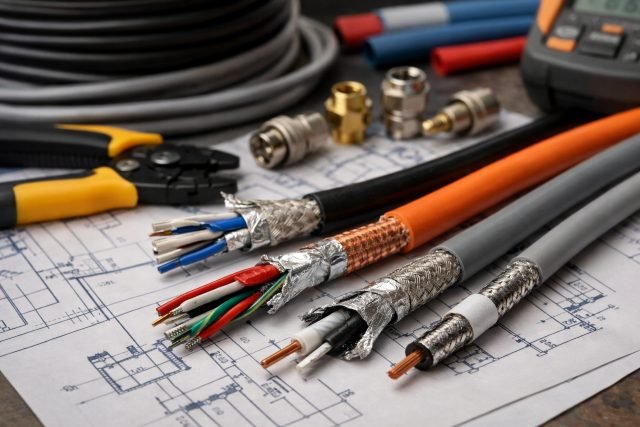
Choosing the right shielded cable isn’t just about buying a cable with metal around it. It’s about matching the shielding type, cable construction, grounding method, and installation conditions to the noise environment of your project. In applications such as industrial automation, high-speed data, audio systems, and precision instrumentation, electromagnetic interference (EMI) can corrupt signals, create data errors, and cause unpredictable equipment behavior. A shielded cable reduces this risk by adding conductive layers—often foil, braid, or a combination — that reflect, absorb, and redirect interference energy to a controlled ground path.
- What Is a Shielded Cable?
- When Do You Need a Shielded Cable?
- Shielded vs Unshielded Cable: Quick Comparison
- Types of Shielded Cable (Foil vs Braid vs Combination)
- Shielded Cable Construction Terms You Should Understand
- How to Choose the Right Shielded Cable
- Shielded Cable Grounding: Practical Guidance
- Shielded Cable Recommendations for Common Project Types
- Shielded Cable Specification Checklist
- Example Scenario: Shielded Cable for VFD and Encoder Noise
- Common Mistakes to Avoid When Choosing Shielded Cable
- FAQs
- Conclusion: The Best Way to Choose a Shielded Cable
What Is a Shielded Cable?
A shielded cable is a cable designed with a conductive shielding layer—such as aluminum foil, copper braid, or both—that helps protect the signal conductors from electromagnetic interference (EMI) and reduces the amount of noise that can enter or leave the cable.
When Do You Need a Shielded Cable?
A shielded cable is most useful when your system operates in a noisy electrical environment or when signal integrity is critical. In practice, that includes projects involving variable frequency drives (VFDs), motor controls, industrial PLC systems, long cable runs near power conductors, high-speed network connections, or precision sensors such as encoders, thermocouples, and instrumentation loops. Medical devices, lab equipment, and professional audio also benefit from shielding because they rely on clean signals and often operate near interference sources. Industrial environments are particularly challenging because EMI can be radiated through the air or conducted through wiring, and insulation alone does not stop electromagnetic energy from coupling into your signal path.
Shielded vs Unshielded Cable: Quick Comparison
| Feature | Shielded Cable | Unshielded Cable |
|---|---|---|
| EMI resistance | High | Medium to low |
| Cost | Higher | Lower |
| Installation complexity | Higher (grounding matters) | Lower |
| Best for | Industrial, high-noise, precision | Basic office/data/home |
| Risk if installed incorrectly | Can worsen noise | Lower risk |
The key difference is that shielding adds performance in harsh EMI conditions, but it also adds responsibility. If shielding is poorly terminated or incorrectly grounded, it can sometimes introduce problems such as noise coupling or ground loops rather than eliminating them.
Types of Shielded Cable (Foil vs Braid vs Combination)
Foil Shield (FTP / F/UTP)
Foil shielding is a thin metallic layer wrapped around conductors or pairs. It offers very high coverage, which makes it especially effective for blocking certain high-frequency interference sources. Foil shields are common in data, instrumentation, and control cabling because they are lightweight and generally cost-efficient. The tradeoff is durability. Foil can tear if repeatedly flexed, which is why it is often less suitable for constant motion environments.
Foil shields are widely described as providing near-complete coverage, which is one reason they perform well for many EMI conditions in signaling and networking environments.
Braided Shield (STP / S/UTP)
A braided shield uses woven strands of copper (or tinned copper) to form a protective screen around conductors. Braided shields are mechanically tough, hold up well in industrial environments, and tolerate vibration and movement better than foil. They are often effective against low-frequency interference because the braid can provide a lower resistance path compared to foil alone, depending on braid coverage and construction. However, braids do not typically provide 100% coverage because of the woven structure, and braided shield cables are usually thicker, heavier, and more expensive.
Braided shielding is commonly used where durability and robust shielding performance are both needed.
Combination Shield (Foil + Braid / S/FTP or Similar)
Combination shielding uses both foil and braid, giving you the full coverage benefits of foil and the strength and low-resistance benefits of braid. This is often the best choice in harsh industrial environments, in long runs passing through high-noise zones, or when downtime is expensive and stability matters. The downside is that combo-shield cables are typically the most expensive and can be harder to route due to larger diameter and stiffness.
Combination shielding is often considered the most robust approach, especially in high-interference conditions.
Shielded Cable Construction Terms You Should Understand
A drain wire is a conductor that runs along the shield, making it easier to connect the shield to ground consistently. Many shielded cables include a drain wire because it improves termination reliability. You should also understand the difference between an overall shield and individually shielded pairs. An overall shield wraps all conductors in one layer, while individually shielded pairs wrap each twisted pair separately, which can improve performance in high-speed data applications and reduce crosstalk.
It’s also useful to know that some regions and manufacturers use “screened” to refer to foil shielding and “shielded” to refer to braided shielding, although real-world labeling can vary and sometimes overlaps depending on standards and local practices.
How to Choose the Right Shielded Cable
Step 1: Identify the EMI Source and Frequency Behavior
Start by identifying the interference sources near the cable run. Motors, VFDs, welders, transformers, switching power supplies, and RF emitters all produce different interference patterns. Shield performance depends heavily on frequency. High-frequency EMI is often blocked effectively by foil due to its continuous coverage, while lower-frequency noise may benefit from a braid structure that provides a stronger conductive path. Shield design, termination style, and grounding method must match the type of interference you expect.
Step 2: Choose Shield Type Based on Environment and Mechanical Needs
Your environment and cable movement matter as much as your EMI needs. If the cable is mostly stationary and the primary concern is interference suppression, foil shielding can be a smart and cost-effective option. If the cable will be exposed to vibration, repeated bending, or industrial wear, braid is often more durable and reliable. If your project is high-risk, high-noise, or mission-critical, a combined foil-and-braid cable is frequently the best long-term investment even though it costs more.
Step 3: Match the Cable to the Signal Type
Signal type should guide your construction choice. For analog sensors and instrumentation, shielded twisted pair is commonly used because it reduces both radiated noise and crosstalk. In high-speed data cabling such as Ethernet, shielding can improve noise immunity but requires careful bonding and grounding across the entire system, including connectors, panels, and equipment. For power and control tray environments, selection often depends on compliance needs and cable rating requirements, such as tray cable standards that align with the installation method and environment.
Step 4: Evaluate Cable Routing and Installation Constraints
Routing determines real-world performance. If your shielded cable will run parallel to power conductors for long distances, pass through trays with motor or VFD cables, or cross high-noise zones, shielding becomes more important. You should also account for exposure to oil, chemicals, UV, temperature swings, or washdown processes. In continuous-flex or robotic applications, choose constructions designed for motion rather than rigid or fragile shielding designs.
Step 5: Plan Grounding and Termination Correctly
Shielding only works as intended when grounding is handled correctly. If the shield is left floating when it shouldn’t be, or if it is grounded in a way that creates ground loops, you can experience increased noise instead of reduced noise. Multiple grounding guides note that improper termination can create unpredictable results, especially in shielded twisted pair systems where bonding consistency is critical.
A practical approach is to treat shielding as a complete system that includes the cable, connectors, termination hardware, routing, bonding, and equipment grounding—not just the cable itself.
Shielded Cable Grounding: Practical Guidance
A good grounding approach ensures continuity, prevents the shield from becoming an antenna, and avoids accidental ground loops. In practice, that means terminating shields using correct connectors or glands designed to maintain full shield contact, avoiding unnecessary breaks at junction points, and ensuring compatibility between the cable shield and the termination hardware. It also means being consistent: mixing shielded cables with unshielded connectors or patch components often reduces effectiveness or causes inconsistent results.
Many expert references emphasize that shielded cabling performs best when bonding and grounding are designed and installed as a unified system rather than improvised at installation time.
Shielded Cable Recommendations for Common Project Types
In industrial automation and PLC control environments, shielded cables with strong EMI suppression—often foil plus braid—are frequently preferred because motors, VFDs, and switching systems create continuous electrical noise. In data center and enterprise networks, shielded twisted pair may be beneficial when EMI is known to be a problem, but it requires attention to bonding and grounding across racks, patch panels, and devices. In professional audio and studio installations, braided shielding is often favored because it is durable and provides consistent noise rejection under physical stress. For outdoor or harsh environments, jacket materials and environmental ratings matter as much as shielding, so UV resistance, chemical resistance, and mechanical robustness should be prioritized along with shield construction.
Shielded Cable Specification Checklist
When reading datasheets, focus on shield type, braid coverage percentage where applicable, whether a drain wire is included, conductor type (solid or stranded), twisting and pair construction, jacket material, temperature rating, environmental resistance, and compliance requirements such as tray cable ratings. In many power and industrial installations, compliance with tray cable or similar requirements can be essential, depending on local codes and the installation method.
Example Scenario: Shielded Cable for VFD and Encoder Noise
A common problem occurs when a factory installs a VFD motor drive and begins seeing unstable encoder readings nearby. VFDs generate switching noise that can radiate into adjacent signal cables or conduct interference through grounding paths. In this case, upgrading the encoder cable to a foil-plus-braid shielded cable, improving routing separation from motor power conductors, and ensuring continuous shielding through proper termination often restores stable readings. This scenario highlights an important truth: shielding works best when combined with routing discipline and correct grounding, not as a single “magic fix.”
Common Mistakes to Avoid When Choosing Shielded Cable
One of the biggest mistakes is choosing the highest-shield option without understanding your interference source. Another frequent issue is ignoring connector and termination compatibility, which can break shield continuity. Many projects also fail because they overlook mechanical stress; foil shields can degrade rapidly in motion-heavy applications. Finally, grounding mistakes are common. If grounding and bonding are not planned, shielded cable can produce inconsistent performance and sometimes introduce additional noise.
FAQs
What is a shielded cable used for?
A shielded cable is used to reduce electromagnetic interference (EMI) that can disrupt signal integrity, degrade data transmission, or cause equipment performance issues, especially in industrial and high-noise environments.
Is shielded cable better than unshielded?
Shielded cable is better in EMI-heavy environments or where signal integrity is critical, but it costs more and requires proper grounding and compatible connectors. If installed incorrectly, shielding can sometimes make noise issues worse rather than better.
What is the difference between foil and braided shielding?
Foil shielding offers near-complete coverage and is effective for high-frequency interference, while braided shielding provides stronger mechanical protection and often performs well in industrial or motion-heavy environments. A combined foil-and-braid design typically delivers the strongest overall performance.
Do shielded cables need grounding?
Yes. Shielding is most effective when grounding and bonding are designed correctly. Incorrect grounding can lead to ground loops and unpredictable noise behavior.
Can shielded cable remove EMI completely?
Shielded cable can significantly reduce EMI, but it cannot guarantee zero interference by itself. Routing, separation from power conductors, connector selection, termination quality, and overall system grounding also play a major role.
Conclusion: The Best Way to Choose a Shielded Cable
Choosing the right shielded cable comes down to understanding your noise environment, your signal sensitivity, and your installation constraints. The most reliable decisions are made when you identify interference sources first, select shielding based on both electrical and mechanical needs, and design grounding and termination as part of the overall system.
When done correctly, a shielded cable improves reliability, reduces troubleshooting time, and protects sensitive electronics from costly interference issues. In projects where stability matters — especially industrial automation, precision measurement, and high-speed data — this choice can directly improve uptime and performance.