Riding a motorcycle on dirt feels completely different from riding on pavement. The bike moves more, the tires slip sooner, and every input you make — throttle, brake, steering, even your body position — has a bigger effect on stability. That’s why riders who feel confident on the street can suddenly feel shaky the moment they hit gravel, sand, or loose soil. The good news is that dirt riding isn’t about being fearless — it’s about learning the right techniques so the bike can move underneath you without throwing you off.
- Why Riding a Motorcycle on Dirt Feels So Unstable
- The Core Principle of Motorcycle on Dirt Riding: Let the Bike Move
- Motorcycle on Dirt Body Position: The #1 Skill That Prevents Crashes
- How Traction Works on Dirt
- Throttle Control on a Motorcycle on Dirt: Smooth Is Fast
- Braking on Dirt Without Losing the Front End
- Cornering on Dirt: How to Turn Without Sliding Out
- Riding a Motorcycle on Dirt Uphill and Downhill
- Common Dirt Surfaces and How to Handle Each One
- The Most Common Motorcycle on Dirt Crashes
- A Practical Progression: How to Learn Dirt Riding Safely
- Gear That Makes Dirt Riding Safer
- Featured Snippet: Quick Definition
- FAQ: Motorcycle on Dirt Riding Questions
- Conclusion: Mastering Motorcycle on Dirt Riding Without Crashing
In this guide, you’ll learn exactly how to ride a motorcycle on dirt smoothly without crashing, including how traction works off-road, the correct body position, how to brake safely on loose surfaces, and how to handle corners, hills, ruts, and unexpected slides. You’ll also get real-world scenarios, common mistakes to avoid, and practical drills you can do to build confidence quickly. Along the way, I’ll reference authoritative safety resources and research-backed principles so you’re not just relying on “bro-science.”
Why Riding a Motorcycle on Dirt Feels So Unstable
The biggest difference between pavement and dirt is traction consistency. Pavement gives predictable grip, while dirt changes constantly. One patch may be packed and grippy, and the next might be loose gravel that behaves like tiny ball bearings under your tires.
On dirt, your tires are also more likely to spin or slide, even at lower speeds. That doesn’t mean you’re doing something wrong—it’s simply how low-traction surfaces behave. The goal is not to eliminate movement, but to learn how to stay balanced and calm while the bike moves underneath you.
This is why experienced off-road riders often look relaxed even when the rear tire wiggles. They understand that small slides are normal and can be managed with smooth control.
The Core Principle of Motorcycle on Dirt Riding: Let the Bike Move
If you want to master motorcycle on dirt riding, you need one mindset shift: stop trying to “lock” the bike perfectly upright. Dirt riding is controlled instability. The bike will wander slightly, the tires will break traction occasionally, and the suspension will react more visibly.
Your job is to stay loose, keep your inputs smooth, and maintain a stable body position so the bike can do its job without you panicking and overcorrecting. Overcorrection is a major reason riders crash on loose surfaces. They tense up, make abrupt throttle or steering changes, and turn a small skid into a full loss of control.
Motorcycle on Dirt Body Position: The #1 Skill That Prevents Crashes
Correct body position is the foundation of everything else. On dirt, your body becomes a key part of the suspension and balance system.
The “Neutral Standing” Position (Your Default Off-Road Stance)
Standing on the pegs is often recommended for dirt riding because it improves balance, visibility, and control. When you stand correctly, you can absorb bumps through your legs and shift weight forward or backward depending on terrain. This is discussed in rider training and off-road technique resources, including American Motorcyclist Association guidance on standing and weight distribution.
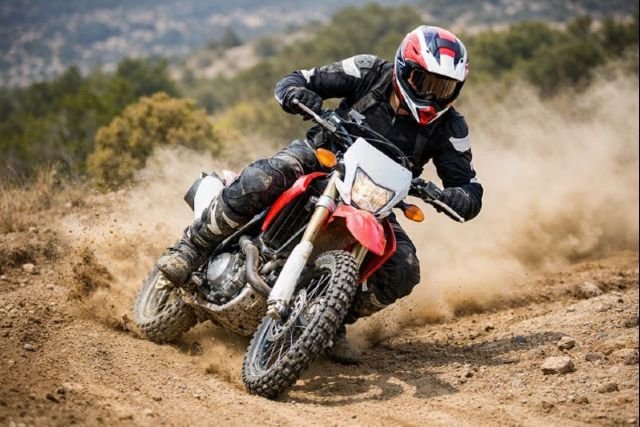
A solid neutral stance looks like this: knees slightly bent, hips over the foot pegs, chest slightly forward, elbows up and out, and your eyes looking far ahead. You grip the bike lightly with your legs, not your arms.
The biggest mistake is death-gripping the bars. That makes the front end unstable because it prevents the bike from self-correcting. Your hands should guide, not wrestle.
When Should You Sit vs. Stand?
You don’t have to stand every second. Standing is best when the terrain is loose, uneven, or unpredictable. Sitting can help in slow technical sections, especially when traction is consistent and speed is low. However, beginners often sit too much because it feels safer, and that can actually make the bike harder to control over rough ground.
A good rule is to stand when the surface is loose or bumpy, and sit briefly when you need precise low-speed control — while keeping your upper body relaxed and ready to shift weight.
How Traction Works on Dirt
Traction on dirt isn’t just “less grip.” It’s grip that changes depending on weight distribution, tire load, and throttle or braking force. This matters because you can control traction by controlling load.
When you accelerate, weight shifts rearward, increasing rear tire grip but reducing front grip. When you brake, weight shifts forward, increasing front grip but reducing rear grip. On dirt, these shifts are exaggerated because the surface already has less traction.
This is why abrupt acceleration can cause the rear to spin, and abrupt braking can cause the front to wash out. Smoothness matters more off-road than on-road.
Throttle Control on a Motorcycle on Dirt: Smooth Is Fast
Most dirt crashes happen because of poor throttle control, not because someone “can’t handle dirt.” The throttle is your stability tool. On loose surfaces, abrupt throttle changes break traction instantly.
The “Steady Throttle” Rule
On dirt, you want small, gradual throttle adjustments. A steady throttle helps keep the suspension settled and keeps the tires biting consistently. This is a key point in many adventure riding guides and off-road technique breakdowns.
If you feel the rear tire start to spin, the solution usually isn’t to slam the throttle shut. Instead, gently ease off until traction returns. Cutting throttle suddenly can cause the rear to regain traction too abruptly, which can flick the bike sideways and throw you off.
Real-World Scenario: Loose Gravel Corner Exit
Imagine you’re exiting a corner on gravel and the rear starts to slide. If you panic and chop the throttle, the rear can snap back violently when it regains grip. A safer approach is to keep your eyes up, maintain a steady throttle, and let the bike straighten gradually while you ease off just a touch.
This is how experienced riders stay upright while the bike wiggles.
Braking on Dirt Without Losing the Front End
Braking is where many street riders crash first when learning motorcycle on dirt riding. On pavement, the front brake is your strongest tool. On dirt, it can also be your fastest way to crash if used abruptly.
The Dirt Braking Approach
You still use both brakes, but your strategy changes. You rely more on gentle rear braking and progressive front braking. Progressive means you squeeze gradually, increasing pressure as the tire loads up and traction builds.
If you grab the front brake suddenly, the front tire can lose traction immediately and wash out. That’s the classic dirt crash: the bike falls instantly and you have no time to save it.
Why Progressive Braking Works
Progressive braking allows the front tire to dig in slightly and build grip, even on loose surfaces. It also keeps the suspension from compressing abruptly, which maintains stability.
A Safety Note on Speed and Risk
National safety agencies like NHTSA emphasize that motorcycle crashes often have severe injury consequences, which makes protective gear, training, and controlled environments crucial when learning new riding skills.
This matters because dirt riding often happens in remote areas where medical help can be slower. Even low-speed falls can cause injuries if you’re underprotected.
Cornering on Dirt: How to Turn Without Sliding Out
Cornering on dirt is all about understanding that the bike and your body don’t always lean the same way.
Counterweighting: The Dirt Turning Secret
A widely taught off-road method is counterweighting. That means the motorcycle leans into the corner while your body stays more upright, shifting weight slightly to the outside. The American Motorcyclist Association explains how counterweighting helps the bike lean more while keeping the rider balanced, especially in tight turns.
This technique increases control because it allows the tires to grip while you maintain balance and can react quickly if the surface changes.
The Biggest Cornering Mistake on Dirt
The biggest mistake is turning your handlebars sharply like you would on a bicycle. On a motorcycle on dirt, you steer more with body weight shifts, throttle balance, and small steering inputs. Oversteering creates front tire slip.
Also, don’t stare at the ground right in front of your tire. Look through the corner where you want to go. Dirt riding punishes target fixation because the bike will drift naturally toward whatever you’re staring at.
Riding a Motorcycle on Dirt Uphill and Downhill
Hills are where riders panic because gravity adds pressure and traction changes quickly.
Uphill Technique
On an uphill climb, you want to shift your weight forward to keep the front tire planted while maintaining steady throttle. If you lean too far back, the front gets light and wanders. If you accelerate too hard, the rear spins and you lose momentum.
The trick is to maintain controlled power. You’re not trying to blast up the hill — you’re trying to keep traction.
Downhill Technique
Downhill is where riders often overuse the front brake and wash out. Instead, shift your weight slightly rearward, keep your knees gripping the bike, and brake progressively using both brakes while letting engine braking help.
The goal is controlled descent, not fast descent.
Common Dirt Surfaces and How to Handle Each One
Gravel
Gravel is unpredictable because the surface rolls under your tires. Your best approach is relaxed arms, steady throttle, and progressive braking. Let the bike wander slightly without fighting it.
Sand
Sand demands momentum. If you slow down too much, the front tire digs in. Keep your weight slightly back, maintain steady throttle, and avoid abrupt steering changes.
Mud
Mud can be either sticky or slippery. In slippery mud, you want smooth throttle and minimal lean angle. In sticky mud, momentum matters because stopping can trap you.
Hardpack Dirt
Hardpack is the most forgiving dirt surface because grip is more consistent. It’s an ideal surface for beginners to practice on.
The Most Common Motorcycle on Dirt Crashes
The most common crash is the front tire washing out during braking or cornering. This usually happens because the rider is too tense, uses abrupt front brake input, or leans too much like they’re on pavement.
The second most common crash is a rear traction snap. This happens when the rear slides and then regains traction suddenly, often caused by chopping the throttle.
The third common issue is target fixation, where a rider stares at a rock, rut, or edge and unconsciously rides into it.
Avoiding these comes down to the fundamentals: smooth inputs, relaxed upper body, eyes up, and progressive braking.
A Practical Progression: How to Learn Dirt Riding Safely
The safest way to develop dirt skill is to practice in a controlled environment with predictable terrain.
Start with flat hardpack or a smooth gravel road, ride at low speed, and practice standing posture. Then add gentle braking practice using progressive front and rear. Then add shallow corners. Then hills.
This progression is common in training programs because it builds muscle memory without overwhelming the rider.
If you want to accelerate learning, consider a formal course. NHTSA and other safety organizations regularly emphasize training as a major factor in reducing crash risk.
Gear That Makes Dirt Riding Safer
The right gear doesn’t just protect you—it increases confidence, which improves decision-making and reduces panic reactions.
At minimum, you should wear a DOT or ECE-certified helmet, gloves, boots with ankle protection, and abrasion-resistant clothing. Off-road boots are especially valuable because foot dabs are common on dirt and ankle injuries happen easily.
According to NHTSA, helmets are a key safety factor in reducing fatalities and injuries, and their motorcycle safety pages provide data-driven guidance on rider protection.
Featured Snippet: Quick Definition
A motorcycle on dirt ride refers to operating a street motorcycle, dual-sport, adventure bike, or dirt bike on loose surfaces like gravel, sand, mud, or off-road trails, requiring different braking, body position, and traction control techniques than riding on pavement.
FAQ: Motorcycle on Dirt Riding Questions
Is it harder to ride a motorcycle on dirt than on pavement?
Yes, because dirt has less predictable traction. The bike moves more, and your inputs must be smoother. With proper technique, most riders adapt quickly.
Should you stand up when riding a motorcycle on dirt?
Often, yes. Standing improves balance, lets your legs absorb bumps, and allows weight shifts that help traction. AMA guidance highlights how standing helps riders move weight forward or backward for terrain changes and improves control.
Can you ride a street motorcycle on dirt roads?
You can, especially on hardpack or light gravel, but it’s riskier due to tire choice and suspension travel. Use low speed, smooth braking, and avoid deep sand or mud.
What’s the biggest mistake beginners make on dirt?
Tensing up and making abrupt inputs. Most dirt crashes come from grabbing the front brake, chopping throttle, or staring at obstacles instead of looking ahead.
How do you stop sliding on dirt?
You don’t “stop” all sliding—you manage it. Keep your body loose, maintain steady throttle, and make gradual corrections rather than sudden ones.
Conclusion: Mastering Motorcycle on Dirt Riding Without Crashing
Learning to ride a motorcycle on dirt smoothly without crashing comes down to mastering fundamentals: relaxed body position, standing when appropriate, steady throttle, progressive braking, and counterweighting in corners. Dirt riding feels unstable at first because traction changes constantly, but once you accept that the bike will move and you learn to work with that movement, your confidence increases fast.
The safest way to improve is to practice on predictable terrain, build skills step-by-step, and wear proper protective gear. Safety organizations like NHTSA stress the importance of training and protective measures, reinforcing that skill development and preparation are key to reducing crash risk.
With the right technique, riding a motorcycle on dirt becomes less about fear and more about control — and it can quickly become one of the most enjoyable skills you add to your riding toolbox.