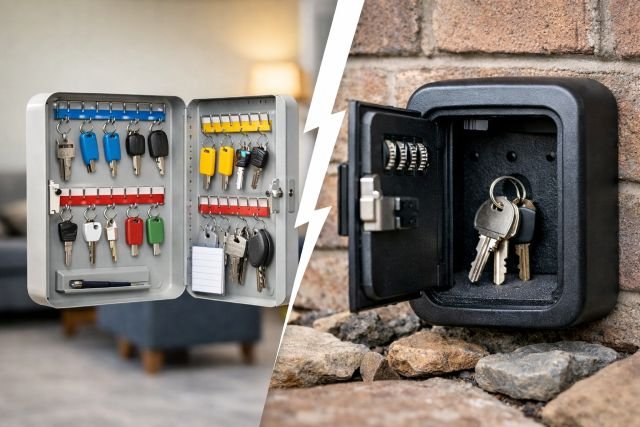
If you’ve ever needed to hand over access to your home, rental property, office, or jobsite—without physically being there—you’ve probably come across the terms key box and key safe. At first glance, they seem interchangeable. Both are designed to store keys securely and make access easier for trusted people. But in practice, they’re built for different environments, different threat levels, and different users—and choosing the wrong one can create real security gaps.
- Understanding the Core Difference Between a Key Box and a Key Safe
- What Is a Key Box?
- What Is a Key Safe?
- Key Box vs Key Safe: The Most Important Differences
- Which Is More Secure: Key Box or Key Safe?
- Which One Is Better for Your Situation?
- Key Box vs Key Safe for Real-World Use Cases
- The Biggest Security Risks and How to Fix Them
- Do Key Boxes or Key Safes Affect Insurance?
- Frequently Asked Questions
- Conclusion: Key Box vs Key Safe — Which One Should You Choose?
In this guide, we’ll break down the true difference between a key box and a key safe, when each is best, and how to make the safest choice based on your property, who needs access, and how frequently access changes. We’ll also cover real-world scenarios (like Airbnb turnover, caregiver access, contractors, and real estate showings), plus expert tips that make either option significantly more secure.
Understanding the Core Difference Between a Key Box and a Key Safe
The easiest way to understand the difference is to look at how each device is intended to live on your property. A key box is typically made to be portable and removable. Most models hang from a doorknob, gate, railing, or fence using a shackle, and they can be repositioned whenever needed. A key safe, on the other hand, is generally meant to be mounted permanently to a solid surface like brick or concrete, using heavy-duty fixings that are difficult to remove.
This difference changes everything. Portability makes key boxes extremely convenient, but it also means they can be more vulnerable to tampering if they’re left in obvious locations for long periods. Key safes sacrifice a bit of flexibility, but they gain stability and often stronger resistance against forced removal when installed properly.
What Is a Key Box?
A key box is a lockable container designed to hold one or more keys and allow access using a code or controlled entry method. In most cases, key boxes are associated with real estate, contractors, and temporary access needs. They’re popular because they don’t require permanent installation and can be used on doors, gates, fences, and even temporary entry points.
Many key box models use mechanical combination locks. These are straightforward, affordable, and do not require batteries or internet access. Some newer models include app-based access, allowing you to generate temporary codes or unlock the box remotely depending on the brand and connectivity method.
In real estate, professional lockboxes are widely used because they allow agents to access properties without the homeowner needing to be present. Industry platforms like Supra report millions of annual property accesses through their lockbox ecosystem, which reflects just how central this technology has become to property showings. SentriLock similarly reports large-scale usage in the real estate market, positioning its systems as controlled-access solutions tied to agent credentials.
What Is a Key Safe?
A key safe is a more permanent security solution designed to be mounted to the exterior of a property. It’s often used in situations where reliable access is needed over time, such as for caregivers, family members, property managers, and emergency services. Unlike a hanging key box, a key safe is usually installed using bolts and fixings that are intended to withstand tampering, making it better suited for long-term use.
Many police and council resources emphasize that key safes are only as strong as their installation. A high-quality unit mounted correctly into brick or concrete is significantly harder to remove than a key box hanging from a door handle. But if installed into weak materials, fitted poorly, or placed in obvious locations, even a key safe can become an easy target.
Key Box vs Key Safe: The Most Important Differences
The difference between a key box and a key safe is not just about terminology. It’s about how and where each is used, what level of security it’s designed to provide, and how it responds to real-world threats.
A key box is usually visible and designed to be quickly accessed. That makes it ideal for temporary use, but it also means it can attract attention. A key safe is typically installed with discretion and is meant to stay in place as part of the home’s ongoing access system. Security experts and community guidance often recommend hiding key safes from view and avoiding predictable placements near the front entrance.
Another difference is access control. Mechanical key boxes and key safes rely on shared codes, which can be convenient but risky if the code is not changed often. Smart lockboxes and advanced real estate systems can provide access logs, identity verification, and time-sensitive entry permissions. That level of accountability can be an advantage in high-turnover situations.
Which Is More Secure: Key Box or Key Safe?
In most long-term situations, a properly installed key safe is considered more secure. This is mainly because a mounted safe is much harder to remove quickly, especially if bolted into strong surfaces. A key box can sometimes be compromised simply through removal attempts, particularly if the unit is hung in a visible or easy-to-reach spot.
However, it’s also important to consider the quality of the product and how it’s used. A premium electronic key box with credential-based access and logging may provide stronger real-world control than a low-grade key safe with a predictable code and poor placement. The truth is that security is a combination of build quality, installation, and user habits.
Some security and consumer guidance warns that visible key safes and lockboxes can attract burglars, especially when mounted near the main entrance in obvious spots. The safest approach is always placement plus product quality, not just one or the other.
Which One Is Better for Your Situation?
The best choice depends on how often access needs to be shared and how permanent you want the solution to be. A key box is usually better when access needs to be flexible, temporary, or frequently changing. A key safe is usually better when access needs to be stable, dependable, and long-term.
If you are managing a rental property where guests change frequently, you may benefit from a smart key box that lets you rotate codes and revoke access. If you are supporting a family member who needs caregiver entry every day, a wall-mounted key safe is often the better and more reliable choice.
Key Box vs Key Safe for Real-World Use Cases
For short-term rentals like Airbnb, the biggest concern is code control. If you use a basic mechanical system, the same code might end up shared, reused, or leaked over time. That risk increases when guests check in and out frequently. In those scenarios, smart access options allow better control and reduce the risk of someone returning later with old access details. For rentals where trust is high and turnover is low, a key safe can still work well if the code is rotated consistently.
For caregivers, key safes are commonly recommended because they allow emergency access without relying on the occupant to answer the door. Many local authorities and safety resources stress that correct installation is essential, especially for homes where vulnerable people live.
For real estate showings, professional-grade electronic lockboxes are widely used because they support controlled access, often tied to verified agent credentials. That reduces the risk of uncontrolled code sharing and allows entry monitoring. Supra and SentriLock present their systems as secure solutions that track access across large professional networks.
For contractors and renovation teams, a key box is often more practical because it can be removed when the job is done. It is especially useful when you do not want permanent mounting or drilling into exterior surfaces. For longer renovation projects, homeowners sometimes prefer a mounted key safe placed discreetly so the device is not exposed in obvious areas, but still provides dependable access for trusted workers.
The Biggest Security Risks and How to Fix Them
The most common mistake people make is placing the key box or key safe in an obvious location. When a lockbox is clearly visible, it creates an instant clue that keys are stored nearby. That does not automatically mean your home will be targeted, but it increases the likelihood of attention, especially if the device is located near the front door or in a highly trafficked area. Many safety and consumer security sources recommend discreet placement to reduce targeting.
The second biggest mistake is weak installation. A key safe that is not bolted correctly into brick or concrete loses one of its main security advantages. Councils and police-focused safety guidance often highlight that correct installation is a critical part of making a key safe secure.
The third mistake is code management. Many households set a code once and forget about it. This becomes risky when access changes, such as after staff turnover, changing contractors, new tenants, or even visitors who no longer need entry. A key safe or key box is only as safe as the people who know its code.
The fourth risk applies mostly to smart lockboxes and electronic systems. While these devices can offer better access control, they also introduce cybersecurity considerations. Some researchers and security experts have published findings showing that smart access devices can be vulnerable if users fail to update firmware, use weak passwords, or neglect account security. The solution is not to avoid smart devices entirely, but to use reputable brands and follow basic digital security practices.
Do Key Boxes or Key Safes Affect Insurance?
Insurance rules vary widely, but many security and insurance guidance articles warn against spare-key hiding practices because they can complicate claims, especially if there is no forced-entry evidence. While lockboxes and key safes can be a safer alternative than hiding a key under a mat, they still need to be used responsibly. Some home security guidance recommends avoiding predictable placements and using robust secure devices rather than obvious hiding spots.
If your insurer has requirements for security practices, it can be worth checking whether they have any guidance on key storage devices, especially for rental properties or high-value homes.
Frequently Asked Questions
What is the difference between a key box and a key safe?
A key box is usually portable and hangs on a door handle or gate, while a key safe is typically mounted permanently to a solid surface like brick or concrete. Key safes are generally better for long-term secure access, while key boxes are often used for temporary access.
Which is safer, a key box or a key safe?
A key safe is usually safer when installed correctly on a solid surface and placed discreetly. A key box can be secure for short-term use, especially professional-grade systems with credential access and logging, but portable units can be more vulnerable if left exposed.
Can burglars break into key safes?
Yes, especially if the key safe is visible, poorly installed, or low quality. Some guidance warns that visible key safes can attract attention and recommends better placement and stronger products to reduce the risk.
Are realtor lockboxes more secure than home key safes?
Many realtor lockboxes offer controlled access systems tied to verified credentials, and some provide logs and access tracking. That can make them more secure in professional high-turnover environments than a simple mechanical key safe that relies only on a shared code.
Conclusion: Key Box vs Key Safe — Which One Should You Choose?
Choosing between a key box and a key safe comes down to how you plan to use it. A key box is often better for short-term convenience, flexibility, and temporary access needs, especially when you want something portable that can be removed after a project or sale. A key safe is usually better for stable, long-term access, particularly when it’s installed correctly and used for caregiver entry, family sharing, or emergency backup access.
If you want the safest option for long-term use, a properly installed key safe placed discreetly is generally the better choice. If you want controlled access and accountability for frequent entry changes, a professional-grade electronic key box system may offer stronger access management features.
Either way, the most important factor isn’t only the device you buy. It’s how you install it, where you place it, and how responsibly you manage access codes over time. That’s what truly determines whether your key storage solution becomes a convenience tool or a security risk.