Bay windows are one of those features that instantly make a room feel bigger, brighter, and more expensive. They can also make your life slightly annoying. Glare moves across the glass all day. Afternoon sun turns the seating area into a warm spot you didn’t ask for. And when the lights come on at night, it can feel like you’re living in a display case. The right blinds for bay windows fix those issues without hiding what makes the bay special in the first place.
- Why bay windows are different from “normal” windows
- Best blinds for bay windows when you want privacy, light control, and heat comfort
- Choosing the right option based on what matters most
- Understanding SHGC and why sun feels “worse” in bay windows
- Measuring and mounting bay window blinds without frustration
- Real-world scenarios to help you pick faster
- Common questions (FAQ) for featured snippets
- Conclusion: choosing blinds for bay windows without regrets
This isn’t just about looks. The U.S. Department of Energy points out that about 30% of a home’s heating energy can be lost through windows, and in cooling seasons about 76% of sunlight hitting standard double-pane windows enters the home as heat. Bay windows, with their larger area and multiple angles, can amplify both the comfort problem and the privacy problem. Once you choose a blind style that matches your bay’s shape and your room’s habits, you’ll notice the difference immediately.
This guide walks you through the best options, how each one handles privacy, light, and heat, and how to make sure your measurements and mounting choices don’t sabotage an otherwise perfect pick.
Why bay windows are different from “normal” windows
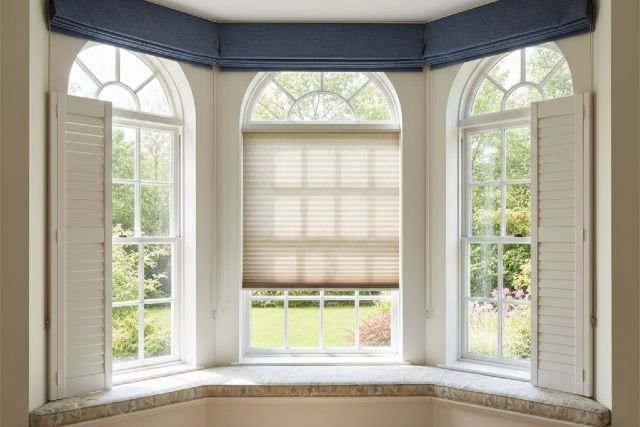
A standard window treatment assumes a single flat plane. Bay windows rarely cooperate. They’re usually made up of three or more separate panes that meet at angles, often with returns on the sides and a deep sill. That geometry creates three practical challenges.
First, privacy isn’t only about the center pane. Side panes and angled views can expose the room even when you think you’re covered. Second, light doesn’t hit all panes equally. One section might be in full sun while the others are shaded, which is why “one setting” often feels wrong. Third, hardware clearance becomes a real issue. Headrails and brackets can collide at corners if you choose bulky systems or mount too close to the angles.
So the “best” choice is usually the one that respects the bay’s segmented structure. In many homes, that means treating each pane as its own window and choosing a style that can look cohesive even when split across multiple sections.
Best blinds for bay windows when you want privacy, light control, and heat comfort
Cellular (honeycomb) shades for comfort and insulation
If you want the strongest improvement in temperature comfort, cellular shades are often the front-runner. Their honeycomb structure creates air pockets that slow heat transfer at the glass, which is exactly where you feel cold drafts in winter and radiant heat in summer.
The energy argument for better window coverings is well-supported. The Department of Energy highlights both major heat loss in heating season and significant solar heat gain in cooling season through windows. Oak Ridge National Laboratory also reported that cellular or honeycomb shades can provide higher winter savings than generic venetian blinds, and their work has been described as showing up to 24% heating energy savings in a residential home context. That’s not a vague “it helps,” it’s measured performance.
In a bay window, cellular shades shine because they’re tidy, they don’t fight the angles, and they can be mounted pane-by-pane to keep control flexible. If your bay faces the street, top-down/bottom-up versions are especially useful because you can keep the lower portion closed for privacy while still letting daylight in from above.
Roman shades for a softer, designed look
Roman shades are the choice when you want your bay window to look finished and intentional, not simply “covered.” They bring texture and softness, which is helpful because bay windows often introduce a lot of hard lines and reflective surfaces into a room.
Romams work well in bays because you can mount them as separate shades per pane while keeping the fabric consistent across the whole bay. When raised, they stack neatly and preserve the view. When lowered, they soften harsh daylight without always needing to block it completely.
If privacy at night is your main concern, pay attention to lining. A sheer linen Roman shade can look beautiful in the daytime but may become see-through at night when the interior lights are on. A privacy lining fixes that while keeping the same face fabric.
Wood and faux wood blinds for classic privacy with tilt control
Wood and faux wood blinds remain popular for bay windows because they offer something many shades don’t: easy, precise control through slat tilting. You can block direct sightlines while still keeping daylight. That’s ideal for living rooms and dining areas where you want privacy without losing the bright feel.
In bay windows, faux wood is often the practical pick when there’s strong sun exposure, big temperature swings, or occasional humidity, because it typically resists warping better than real wood in challenging conditions. Real wood has a richer look and lighter weight, but it’s best in spaces where heat and moisture aren’t extreme.
Compared with cellular shades, slatted blinds are usually less effective as an insulating layer because they don’t create the same air-trapping structure at the window. The DOE’s discussion of window energy loss and solar heat gain helps explain why a more insulating attachment can matter if comfort is a priority.
Roller and solar shades for modern glare control and view preservation
If your bay window’s main job is providing a view, roller and solar shades can be a great fit. Solar fabrics are designed to reduce glare while maintaining some outward visibility in daylight. This makes them especially appealing in home offices, media rooms, and living spaces where screen glare is a daily frustration.
Heat control is a big part of this story. The DOE notes that in cooling seasons a large share of sunlight through standard windows becomes heat inside the home. Solar shades can reduce that incoming solar energy during peak sun hours, and even when they don’t fully “black out” the room, they can make the space feel calmer and cooler.
Night privacy depends on the fabric and the lighting balance. Many solar fabrics give you strong daytime privacy, but at night, if the room is bright and it’s dark outside, silhouettes can become visible. If you need consistent privacy, you can choose a tighter weave, add a privacy lining, or pair the shade with side panels.
Vertical blinds and panel-track systems for wide or complex bays
Some bay windows are wide enough that they behave more like a small glass wall. Others have unusual angles or mild curves. In those cases, a vertical system can be practical because it operates along a track and stacks to the side.
Vertical blind setups typically hang from a headrail, and some solutions can be configured to follow shapes more easily than rigid horizontal products. Many retailers and installers describe vertical blinds as a workable approach for bay windows specifically because the track can be fitted to angled or curved forms.
Panel-track blinds are a more contemporary cousin of vertical blinds. They use larger panels that slide smoothly and look clean when closed. They can work well when the bay is very wide and you want a minimal, architectural effect.
This category can be excellent when done right, but it’s also the most sensitive to correct planning. Track layout, stacking direction, and clearance at angles matter more here than with most pane-mounted shades.
Choosing the right option based on what matters most
If privacy is the primary goal, start by thinking about when you need privacy most. Daytime street-facing privacy often benefits from top-down/bottom-up cellular shades because they cover sightlines while keeping daylight. Night privacy tends to be strongest with lined Roman shades, cellular shades, and wood or faux wood blinds that close tightly.
If light control is the priority, decide whether you’re fighting brightness, glare, or both. Glare on screens usually calls for solar shades or light-filtering cellular shades. Harsh morning or afternoon brightness in a living room can be softened beautifully by Romans or light-filtering cellular shades.
If heat comfort is the main issue, cellular shades deserve serious attention. The DOE’s energy guidance emphasizes how significant windows are for heat loss and solar heat gain, and that window coverings can help regulate temperatures and lower energy bills. ORNL’s findings on honeycomb shades reinforce that performance advantage in winter conditions compared with generic blinds.
Understanding SHGC and why sun feels “worse” in bay windows
If your bay window faces strong sun, you’ve probably experienced the “greenhouse” effect. A useful term here is Solar Heat Gain Coefficient, commonly shortened to SHGC. The U.S. Department of Energy defines SHGC as the fraction of solar radiation admitted through a window, either transmitted directly or absorbed and then released as heat inside the home. Lower SHGC means less solar heat enters.
You may not be changing the window itself, but understanding SHGC helps you think clearly about solutions. If the bay bakes in summer, your goal is to reduce solar energy entering through the glass during peak times. Solar shades, insulating cellular shades, and properly lined fabrics can all help manage that experience, even though they’re not the same as changing the window rating.
Measuring and mounting bay window blinds without frustration
Most disappointments with bay window blinds come down to fit. Bay windows magnify small errors because the angles make everything feel tighter.
A good rule is to treat each pane as its own unit unless your bay design clearly supports a continuous track. Pane-by-pane mounting allows independent control and reduces hardware collisions at corners. It also helps you adjust for slight variations between panes, which are common in older homes.
Inside mount versus outside mount matters a lot here. Inside mounts look sleek, but they require adequate depth and they reveal more of the window frame. Outside mounts can improve light blocking and sometimes simplify clearance issues, but they change the visual proportions of the bay. If your bay has shallow depth or protruding handles, outside mount can save you from daily irritation.
Also consider what happens at the corners. If two adjacent blinds have bulky headrails, they can bump each other when you raise or lower them. Slimmer systems like cellular shades and many roller shades reduce that risk. If you love a chunkier look like wood blinds, careful bracket placement and depth planning becomes important.
Real-world scenarios to help you pick faster
If your bay window sits in a breakfast nook and catches strong morning sun, you might want bright light without squinting. Light-filtering cellular shades are a strong fit because they soften glare and help with temperature swings, and you can lower just the panes that are currently in sun.
If your bay window faces the street in a living room, daytime privacy is the headache. Top-down/bottom-up cellular shades can give you privacy at eye level while keeping the room feeling open and naturally lit.
If your bay window is in a formal dining room and style matters most, Roman shades can give you a tailored look that works with décor. Choosing a lining that supports privacy at night keeps the room from turning into a fishbowl when the chandelier is on.
Common questions (FAQ) for featured snippets
What type of blinds are best for bay windows?
The best blinds for bay windows are usually cellular shades for heat and comfort, Roman shades for a softer designer look, or wood/faux wood blinds for strong privacy and light control. The best choice depends on whether you prioritize privacy, glare reduction, insulation, or style.
Should bay windows have one blind or separate blinds?
Most bay windows work best with separate blinds or shades for each pane so you can control privacy and light independently. A single treatment across angled sections is harder to fit and often operates less smoothly.
Do cellular shades really help with heat?
Yes. The DOE explains that windows contribute significantly to heating loss and cooling-season heat gain, and energy-efficient window coverings improve comfort and can reduce energy bills. ORNL research found cellular shades achieved up to 24% heating energy savings in a real-home comparison.
What’s best for daytime privacy in a living room bay window?
Top-down/bottom-up cellular shades are one of the best solutions because they block sightlines at eye level while still letting in light from above.
Are vertical blinds good for bay windows?
They can be, especially for wide or unusual bay layouts, but they require the right headrail/track configuration. Vertical and panel-track systems are often used for wide expanses and can stack neatly when open.
Conclusion: choosing blinds for bay windows without regrets
Choosing blinds for bay windows is really about matching your priorities to the bay’s shape. If you want the strongest all-around performance — especially for comfort and energy — cellular shades are a top-tier choice, backed by DOE guidance on window heat loss/solar heat gain and real-world research showing meaningful heating savings. If your main goal is a softer, designed look, Roman shades shine. And if you want classic tilt-based control, wood or faux wood blinds still deliver.
Pick the style that fits your room’s daily reality (privacy needs, sun direction, temperature swings), measure carefully per pane, and you’ll end up with a bay window that looks amazing and feels better to live with.