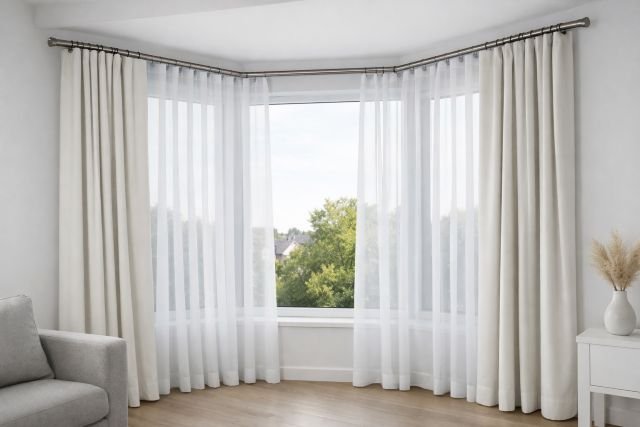
A bay window can make a room feel bigger, brighter, and more architectural. It can also make you question every DIY decision you’ve ever made the second you try to hang curtains. The angles, the multiple faces, and the way light hits the space all conspire to make a normal rod feel “almost right” but never truly finished.
- What a bay window curtain pole actually is
- The easiest setup for most homes
- Why this setup looks more modern than the alternatives
- Measuring a bay window curtain pole the easy way
- What to buy for a clean, modern bay window curtain pole
- Installation that stays simple and looks professional
- How to keep the bay looking clean when curtains are open
- Comfort and efficiency: why bay window treatments matter
- A modern bay window note if your radiator sits below
- FAQs
- Conclusion
The good news is that you don’t need a complicated track system or a custom-bent rail to get a crisp, modern result. The easiest approach is choosing the right bay window curtain pole hardware and installing it so the pole line looks continuous, the curtains glide without snagging, and the ends return neatly toward the wall.
This guide covers the simplest setup that still looks high-end, how to measure without guesswork, what to buy for a clean modern look, and how to avoid the most common bay window mistakes. Along the way, you’ll also see why getting window coverings right can matter for comfort and energy use, since heat gain and heat loss through windows accounts for roughly 25%–30% of residential heating and cooling energy use.
What a bay window curtain pole actually is
A bay window curtain pole is a curtain pole system designed to turn corners so it can follow the shape of a bay window. Instead of one straight run, it’s typically made from multiple straight pole sections joined at the bay angles with corner connectors. Those connectors can be fixed-angle or adjustable, and the adjustable type is usually the reason a “simple install” stays simple when your bay angles aren’t perfectly standard.
If you want a clean, modern look, you’re aiming for one visual line that wraps the bay, not three separate rods that look patched together.
The easiest setup for most homes
For the majority of three-sided bays, the easiest modern setup is a modular pole kit that uses straight sections and adjustable corner connectors, mounted with low-profile brackets and finished with return ends.
This works because it respects the geometry of a bay window instead of fighting it. Each face gets its own straight run, and the corners do the job of changing direction. When you align the connector angles properly, the whole pole reads like a single continuous frame around the bay.
General fitting guidance from specialist curtain pole retailers tends to recommend this “built around the bay” approach because it’s adaptable and realistic for DIY installation across different bay shapes.
Why this setup looks more modern than the alternatives
Modern window styling tends to look best when lines are consistent and intentional. A modular bay pole gives you straight segments that feel architectural, and corners that look designed rather than improvised.
It also helps you avoid the two most common “not quite modern” outcomes. One is the wavy or drooping look that comes from forcing a flexible rod into a shape it doesn’t like. The other is the broken-up look from using separate rods on each face with visible gaps at the angles.
With an adjustable-connector bay window curtain pole, you can dial in the exact corner angle so the runs meet cleanly, which is the difference between “installed” and “finished.”
Measuring a bay window curtain pole the easy way
Measuring for a bay is simpler when you stop thinking in totals and start thinking face-by-face.
Begin by deciding your pole height. A modern look usually benefits from mounting above the window frame so the curtains visually lift the space. If you have limited wall space above the frame due to coving or low ceilings, you can still mount just above the frame, but consistency matters more than height. Whatever you choose, keep the same height across all faces.
Next, measure each face of the bay separately. You’ll typically have a left face, a center face, and a right face. These measurements help you choose or cut pole sections so each run fits neatly without forcing the corners.
Then consider overhang at the outer ends. Overhang is what allows curtains to stack away from the glass, which is a big part of the clean modern effect. When curtains can sit mostly off-window when open, the bay looks lighter and the window feels larger.
Finally, think about curtain heading style and clearance. Eyelet curtains can look modern, but they also require more space around brackets and connectors for smooth movement. Softer headings like pencil pleat or wave-style systems can be more forgiving in bays, depending on the rings or gliders you use.
What to buy for a clean, modern bay window curtain pole
If your goal is modern, prioritize simplicity in shape and finish.
A slimmer diameter pole generally reads cleaner than an oversized one, especially on a bay where there’s already more hardware in view. Matte black is a popular modern choice, but brushed metallic finishes can look equally contemporary if your room has chrome, stainless, or nickel accents elsewhere.
The key functional choice is the corner connector. Fixed-angle corners can work if your bay angle matches the hardware exactly, but many bays don’t align perfectly with standard angles. Adjustable or hinged connectors let you match the real shape of your bay window rather than guessing and hoping.
Also look for brackets that are sturdy but not bulky. On bays, you’re mounting multiple brackets and you’ll notice them more. Low-profile brackets support the pole without becoming the feature.
Return ends are worth it if you want that tailored look. They help the curtain sit closer to the wall at the ends, reducing light gaps and making the whole installation feel “designed.” They can also help with privacy at the edges, especially at night when interior lights are on.
Installation that stays simple and looks professional
A smooth bay installation comes down to two things: keeping the pole line level across all faces, and placing brackets so they support the corners without creating snag points.
Start with the center face as your anchor. When the middle run is level and solid, it becomes much easier to align the left and right runs to match. Once the center is fixed, you can dry-fit the corner connectors and adjust them until the pole looks like one continuous shape wrapping the bay.
When you place brackets near corners, leave enough room so rings or gliders won’t jam right where the pole changes direction. This is where many bay installs go wrong, because a bracket that’s too close to a connector can pinch movement. If your curtains rarely need to travel across the corners, this matters less. If you want the curtains to draw smoothly around the bay, it matters a lot.
A final “pro move” is fine-tuning connector angles with the curtains actually hanging. Fabric weight reveals whether the corners sit naturally or whether you need a slight adjustment to eliminate a gap or a twist.
How to keep the bay looking clean when curtains are open
A bay window can look cluttered if the curtains bunch awkwardly across multiple faces. The cleanest modern look is when curtains stack neatly at the outer edges and the bay glass stays visually open.
You’ll get that by ensuring you have enough pole extension beyond the outer faces, so the curtains have somewhere to go. If your room layout doesn’t allow a lot of extension, you can still improve the look by choosing a heading that stacks tighter, or by using a slightly lighter fabric that doesn’t create a bulky gather.
Comfort and efficiency: why bay window treatments matter
A bay window is a lot of glass, and glass is where homes often gain or lose heat.
The U.S. Department of Energy notes that heat gain and heat loss through windows is responsible for roughly 25%–30% of residential heating and cooling energy use. That’s why even a stylish curtain setup can do double duty when you choose the right fabric and lining.
If you want a modern look without sacrificing comfort, consider lining your curtains or layering with an unobtrusive blind. There’s also research showing that certain insulating window coverings can meaningfully reduce energy use. Oak Ridge National Laboratory has reported results indicating cellular or honeycomb shades can deliver notable winter savings compared with generic blinds, and DOE materials summarize controlled testing of cellular shades in a residential setting.
Curtains aren’t identical to cellular shades, but the principle is similar: adding an insulating layer at the window can reduce heat transfer and drafts, which can make the room feel more stable and comfortable.
A modern bay window note if your radiator sits below
Many bay windows have radiators under them, and that’s where design can conflict with performance.
Multiple home-interiors experts and heating guidance sources warn that long, heavy curtains draped over radiators can trap heat and reduce circulation, which can make heating less effective and potentially increase energy use. If you love full-length curtains, one modern compromise is using a wider projection or a pole that allows you to pull the curtains fully clear of the radiator during heating periods, or pairing a blind for privacy with curtains that are more decorative than functional.
If you’re styling for both looks and warmth, the goal is to keep airflow from the radiator moving into the room rather than pooling behind fabric.
FAQs
What is the best curtain pole for a bay window?
The best option for most homes is a modular bay window curtain pole with adjustable or hinged corner connectors, because it can match real bay angles and still look like one continuous line. Adjustable connectors are widely recommended in DIY guidance because they reduce guesswork and improve fit.
How do you measure for a bay window curtain pole?
Measure each face of the bay separately at the height you plan to mount the pole, then allow extra length at the outer ends so curtains can stack away from the glass. This prevents the “crowded bay” look and helps the window feel bigger when curtains are open.
Can you use a normal curtain rod on a bay window?
A single straight rod usually won’t work because the bay changes direction, but you can use normal straight pole sections joined with corner connectors designed for bay windows. That’s essentially what most bay pole kits are built from.
Should bay window curtains touch the floor if there’s a radiator underneath?
From a style perspective, floor-length curtains can look very modern. From a heating perspective, experts often advise avoiding curtains that hang directly over radiators because they can trap heat and reduce circulation. A practical modern approach is to ensure curtains can be pulled fully clear of the radiator when the heating is on, or to use a blind for privacy and curtains for framing.
Conclusion
The easiest way to achieve a clean, modern bay window finish is to use a modular bay window curtain pole with adjustable corner connectors, keep the pole line consistent across all faces, and plan for neat stacking at the outer edges. When you measure face-by-face and install with corner movement in mind, you get curtains that look intentional and operate smoothly instead of fighting the angles.
And because windows account for a significant share of heating and cooling energy use, your bay window curtain pole setup isn’t just decoration. It’s also an opportunity to make the room feel more comfortable with the right fabric choices and smart layering at the glass.