Searching for thailand plug type can feel weirdly stressful because Thailand sits in that awkward middle ground where there is an official standard, but older buildings and tourist-heavy areas still show a mix of outlet styles. The result is that two travelers can stay in different hotels in the same city and have completely different “plug experiences,” and both will swear their answer is the right one.
- What is the Thailand plug type, officially?
- What you’ll actually find in Thai hotels, condos, cafés, and airports
- Thailand voltage and frequency, and why it matters more than plug shape
- Adapter vs converter in plain English
- Which adapter do you actually need for Thailand?
- A practical charging setup for real trips
- Common mistakes travelers make with Thailand plugs
- FAQ: Thailand plug type questions travelers ask most
- Conclusion: choose one adapter that covers Thailand plug type reality
The good news is you do not need to overpack or gamble. If you understand one simple idea—Thailand’s official plug is Type O, but Type C is also standard and many places still accept older styles—you can choose an adapter that works consistently, charge safely, and avoid the classic first-night problem of hunting the lobby for a spare converter.
This guide explains what plugs you’ll see, what Thailand’s voltage means for your devices, and which adapter choice is actually practical for real travel days.
What is the Thailand plug type, officially?
Thailand’s official standards include Type O and Type C, with Type O widely described as the official modern standard and Type C also recognized in common country plug references. Type O is particularly important because it is a Thailand-specific design that has been gradually phased in over time rather than instantly replacing older outlet styles.
If you want the most authoritative “standards” angle, Thailand’s Type O rollout is tied to the Thai Industrial Standard commonly referenced as TIS 166-2549, and the standard document describes plugs and socket-outlets for household and similar purposes.
In day-to-day travel, though, you’ll often encounter more variety than a standards document suggests, because buildings last decades and renovations happen in phases.
What you’ll actually find in Thai hotels, condos, cafés, and airports
The most useful way to think about outlets in Thailand is not “one country, one plug,” but “newer buildings trend toward the modern standard, and older buildings keep legacy compatibility.” That is why travelers sometimes plug in a US charger with no adapter in one place, then find it doesn’t fit in a newer place across town.
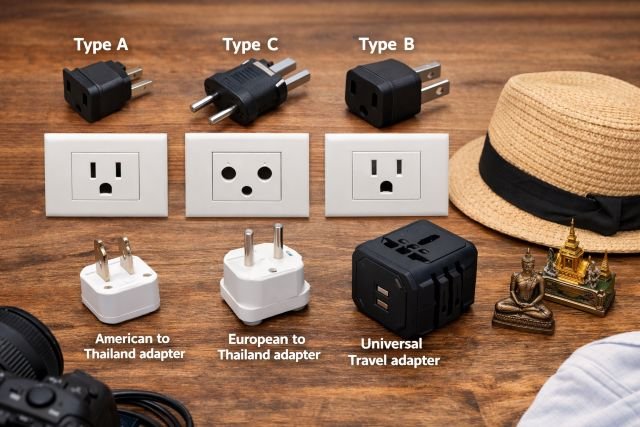
Type O is the one worth planning for because it is Thailand-specific and increasingly present as the official standard. In a newer hotel or a recently renovated apartment, you are more likely to see Type O sockets, sometimes alongside multi-standard sockets. Type C is also common and can appear in many mixed or “universal” outlets travelers encounter.
You may still see Type A and Type B compatibility in some locations, particularly where older American-style outlets were historically used or where “universal” receptacles were installed to satisfy international guests. Several travel references note a mix that can include A, B, C, and Type O, and sometimes additional types depending on the building. The key is to treat that as a convenience, not a guarantee.
Thailand voltage and frequency, and why it matters more than plug shape
Thailand’s mains electricity is commonly cited as 230V at 50Hz, and it’s often explained in contrast to older American-style plug usage that was historically present in some places. The practical takeaway is simple: for most modern electronics you only need a plug adapter, but for certain heat-based appliances you may need a voltage solution or a different plan.
The easiest check is the label on your charger brick. If it says something like “Input: 100–240V, 50/60Hz,” you are fine in Thailand from a voltage standpoint and only need the right plug shape. Most laptop chargers, phone chargers, camera battery chargers, and reputable USB chargers fall into this category.
Where people get into trouble is with devices that are single-voltage, especially hair tools. A hair dryer made for 120V countries can overheat or fail quickly when plugged into 230V, even if the plug fits with an adapter. That is not an outlet problem; it’s a voltage mismatch problem. If your device label only says 110–120V, you should not plug it directly into Thai power without a proper converter designed for high-wattage devices, and many travelers find it easier to use the hotel hair dryer or buy a dual-voltage travel tool instead.
Adapter vs converter in plain English
A travel adapter changes the physical shape so your plug fits the wall. A converter changes the voltage so a single-voltage device can run safely. Thailand’s 230V system means an adapter is enough for dual-voltage electronics, but a converter may be necessary for certain single-voltage appliances.
If you want a real travel scenario, imagine arriving in Bangkok late, plugging in your laptop charger, your phone charger, and your power bank. All of those usually work perfectly with a simple adapter because they are dual-voltage. Then imagine plugging in a 120V-only hair straightener. That is where the risk appears, because it draws high wattage and is often not designed for 230V. Your “I only need an adapter” assumption works for electronics, but not always for heat tools.
Which adapter do you actually need for Thailand?
If your goal is to make one purchase and stop thinking about it, the most reliable approach is choosing a travel adapter that explicitly supports Type O along with the other common global standards. Type O is the one travelers most often miss, because many older universal adapters were designed around the more common US, EU, UK, and AU plug families and may not include Thailand’s Type O design. Type O’s role as Thailand’s official standard and its gradual rollout is why it’s the plug you plan for rather than hope you don’t see.
If you are from the US or Canada, you might hear people say, “My plug worked everywhere in Thailand.” Sometimes that’s true, because many outlets accept Type A/B in certain buildings and some accommodations install multi-standard sockets for tourists. But you don’t want your charging strategy to depend on what your hotel happens to have, especially if you plan to work remotely, take internal flights, or spend time in newer cafés and co-working spaces where newer standards show up more. Sources discussing Thailand’s plug landscape consistently describe a mixed environment rather than a single guaranteed socket type across the country.
If you are from the UK, Ireland, or anywhere using Type G, you should assume you need an adapter because Type G does not match Thailand’s standard sockets. If you are from Australia or New Zealand using Type I, you should also assume you need an adapter. In both cases, a universal adapter that includes Type O support keeps things simple.
A practical charging setup for real trips
Most travelers today carry more USB-charged devices than wall-plug devices. That changes what “the right adapter” means. If your adapter includes USB ports, it can reduce how many wall sockets you need, but you should still prioritize build quality and fit. Loose-fitting adapters wobble, and wobble leads to heat and intermittent charging.
If you are traveling as a couple or with family, the simplest quality-of-life move is using one good adapter to power a compact charger hub or a small travel power strip rated appropriately for the voltage range you’ll be using. The goal is not to create a tower of adapters; it’s to create one stable connection to the wall and then distribute charging from there.
Also remember that outlets in some older rooms may be located in inconvenient places. If your phone needs to charge by the bed for an early Grab pickup, a slightly longer cable can save you a lot of annoyance.
Common mistakes travelers make with Thailand plugs
One common mistake is assuming that because the hotel room has a “universal” outlet, Thailand as a whole is universal. It isn’t. Thailand’s official standardization around Type O is real, and the gradual shift means you can see different sockets in different places.
Another mistake is confusing a plug adapter with a voltage converter. Many travelers have a tiny adapter and think it “converts power.” It does not. If your hair dryer is single-voltage, that tiny adapter only makes it easier to plug in the device that will then get the wrong voltage.
A third mistake is buying the cheapest adapter you can find at the airport kiosk after you land. Emergency purchases are sometimes necessary, but the quality varies. A poor adapter can fit loosely, and a loose connection is exactly what you don’t want with continuous charging.
FAQ: Thailand plug type questions travelers ask most
What plug type is used in Thailand?
Thailand is commonly described as using Type O as the official modern standard, with Type C also used, and many travel references note that you may encounter additional compatibility in practice depending on the building.
Do I need a travel adapter for Thailand?
Most travelers should bring an adapter because you cannot rely on your home plug fitting everywhere. A universal adapter that includes Type O support is a simple way to avoid surprises in newer buildings.
Is Thailand 220V or 230V?
Thailand is widely cited as operating around 230V at 50Hz in country plug and mains electricity references. In everyday terms, treat it as a 230V country and check your device input rating.
Will US plugs work in Thailand?
Sometimes, especially in older or tourist-focused installations that accept Type A/B, but it’s not guaranteed. Because Type O is the official standard and is being phased in, planning for Type O compatibility is the safer approach.
Do I need a voltage converter in Thailand?
Only if you have a single-voltage device that cannot accept 230V. If your charger or device label shows 100–240V input, you usually only need the correct adapter, not a converter.
Conclusion: choose one adapter that covers Thailand plug type reality
The easiest way to stop overthinking thailand plug type is to accept the reality: Thailand has an official modern standard, but the on-the-ground outlet mix depends on how new the building is and how it was renovated. Type O is the official standard and is gradually being phased in, while Type C is also commonly referenced, and many travelers still encounter broader compatibility in some locations.
If you want the simplest packing decision, bring a well-built universal adapter that explicitly supports Type O, and confirm your chargers are dual-voltage. That combination covers typical travel electronics safely, keeps your setup consistent across hotels and cafés, and prevents the classic “my plug fit yesterday but not today” surprise that can derail a trip at the worst moment.