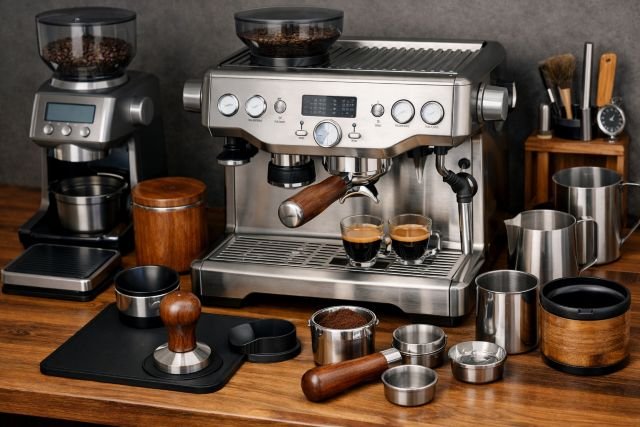
Owning a sage dual boiler puts you in a sweet spot: you already have a machine designed for serious espresso, with dual stainless-steel boilers, a heated group head, and PID temperature control intended to keep brew water steady shot after shot. That means upgrades shouldn’t feel like “rescuing” the machine. They should feel like removing friction from your routine and squeezing more consistency out of something that’s already capable.
- Why upgrades on the Sage Dual Boiler behave differently
- Water: the most important “upgrade” for a sage dual boiler
- Puck prep upgrades: where consistency is actually created
- Baskets: when a “precision” upgrade is worth it
- Puck screens: cleaner brewing and sometimes more even extractions
- Shower screen upgrades: subtle gains, best for tidy obsessives
- Bottomless portafilter: the best learning tool you can buy
- A scale: the upgrade that makes dialing in logical
- Milk accessories: small changes that make steaming feel effortless
- Maintenance accessories that protect performance long-term
- How to choose the right upgrade path without wasting money
- FAQ: Sage Dual Boiler upgrades that people ask most
- Conclusion: the upgrades that truly unlock the sage dual boiler
This guide focuses on upgrades that matter in the cup and in day-to-day use. Think cleaner flavor, fewer sudden channeling disasters, easier dialing-in, and better long-term reliability. You’ll also see where upgrades are mostly hype, or only worth it once your fundamentals are already solid.
If you want the short version before we go deep: great espresso on the sage dual boiler is usually won or lost in water and puck prep. The machine can do its part. Your accessories should help you do yours.
Why upgrades on the Sage Dual Boiler behave differently
Many home espresso machines benefit most from upgrades that compensate for weak temperature stability or limited steaming. The sage dual boiler already addresses those common pain points through its dual boiler system, heated group head, and PID control. So when you “upgrade,” you’re mostly improving the quality of the inputs and the repeatability of your workflow.
In practice, that means the highest-impact accessories tend to live in three areas: water quality, puck preparation, and the parts that influence how water meets the puck. If you prioritize those, your results improve quickly and predictably.
Water: the most important “upgrade” for a sage dual boiler
Water is the quiet variable that changes both taste and maintenance costs. It’s also the accessory category people underestimate because it doesn’t look exciting on a countertop.
Coffee is overwhelmingly water, and even mainstream food publications emphasize that water quality strongly affects flavor and extraction because the drink is mostly water. On top of that, water chemistry influences scale formation inside espresso machines, which can reduce heating efficiency and disrupt performance over time.
What “bad water” does inside a dual boiler
When hard water is heated, dissolved minerals can precipitate and form limescale. Over time, limescale can block pipes and reduce efficiency, and it can contribute to temperature instability and component stress. Some technical explainers highlight calcium carbonate as a particularly stubborn form of scale that can clog boilers and insulate heating elements, which is exactly what you don’t want in a machine prized for stable temperatures.
The result is sneaky: you might still pull “fine” espresso, but the machine becomes less consistent and more maintenance-prone. You end up chasing your tail with grind settings because the system is no longer behaving the same way week after week.
A practical target: use a recognized water standard as your baseline
The Specialty Coffee Association published a water standard for brewing specialty coffee, outlining target ranges for brewing water characteristics. You don’t need to become a chemist, but it helps to use a standard as a sanity check so you don’t swing too far in either direction. SCA resources also discuss how alkalinity can have a major impact on perceived acidity in the cup, which is a big deal when you’re dialing in espresso and trying to understand “why this tastes sharp today.”
A simple approach is to aim for water that avoids heavy hardness while still having a reasonable mineral balance for flavor, rather than chasing “as pure as possible.” If you strip water too far, coffee can taste flat or oddly sharp because extraction behaves differently.
Accessories and approaches that actually help
If you use the water tank on your sage dual boiler, an in-tank filtration or softening approach can reduce scale risk and keep the machine’s behavior more stable over time. If your water is very hard, this isn’t a luxury item; it’s part of ownership.
If you want maximum control, recipe-based water is the step-up option. The idea is to start with a consistent base and build mineral content intentionally, so your espresso isn’t at the mercy of seasonal tap water changes. This is especially useful if you frequently switch between lighter and darker roasts and want predictable extraction.
Puck prep upgrades: where consistency is actually created
The fastest way to make your espresso taste “more café” is to make it more repeatable. Most inconsistency at home comes from puck prep variability, not from the machine missing its temperature.
WDT tool: the tiny accessory that fixes “random” channeling
The Weiss Distribution Technique, usually shortened to WDT, is used to break up clumps and distribute grounds more evenly in the basket before tamping. Many espresso education articles describe WDT as a way to reduce channeling and improve extraction consistency by preventing uneven density in the puck.
Here’s why it matters for a sage dual boiler owner. Your machine can deliver stable water temperature very reliably. If the puck has weak spots, water will still take the path of least resistance and you’ll get a shot that looks fine on time but tastes thin, sharp, or hollow because parts of the puck were under-extracted while others were over-extracted. Channeling is exactly that uneven flow problem, and it’s a common cause of the “why did this shot suddenly go weird?” experience.
A WDT routine doesn’t need to be slow or fussy. The point is simply to create a more uniform puck so your machine’s stable brew delivery has something stable to work with.
A leveling tamper: the simplest way to remove a hidden variable
A perfectly level tamp is more important than a “hard” tamp. If your tamp is slightly tilted, water is encouraged to accelerate through one side first, which increases the risk of uneven extraction. A leveling tamper makes “flat and consistent” the default, especially when you’re making coffee early in the morning and your technique is… not at peak artistry.
On the sage dual boiler, this kind of accessory tends to show up as fewer messy, uneven shots and less time wasted re-pulling because “something wasn’t right.”
A dosing funnel: not glamorous, but it changes your workflow
A dosing funnel reduces mess, keeps your dose contained while you WDT, and makes it easier to maintain consistency. It also reduces the buildup of stray grounds around the rim of the basket, which can affect how cleanly the portafilter locks in and how tidy your routine feels.
If you make espresso daily, this is one of those accessories that doesn’t just improve coffee, it improves your willingness to make coffee.
Baskets: when a “precision” upgrade is worth it
A precision basket can improve consistency by making flow through the basket holes more uniform. The catch is that precision parts tend to be less forgiving. If your grinder produces lots of clumps and your distribution is inconsistent, a precision basket can highlight those flaws instead of masking them.
A useful way to time this upgrade is to treat it as a second-stage improvement. If you can already dial in a bean and repeat your results reliably, a basket upgrade can help you chase clarity and sweetness. If you’re still seeing frequent channeling, you’ll usually get a better return by tightening puck prep first.
Puck screens: cleaner brewing and sometimes more even extractions
A puck screen, often called an espresso shot screen, is a thin stainless-steel mesh disc placed on top of the coffee puck before pulling a shot. Many guides describe the goal as helping even out water flow, reducing channeling, and keeping the shower screen cleaner.
In plain terms, the puck screen adds a diffusion layer right where water first meets the puck. It can reduce the impact of localized water flow and help protect the puck surface from being disturbed. People also love them because they reduce residue and make cleanup faster, which helps maintain a cleaner group area over time.
This upgrade tends to shine if your puck prep is already good. If your distribution and tamp are inconsistent, a puck screen won’t magically fix that. Think of it as a “polish” accessory that rewards good fundamentals.
Shower screen upgrades: subtle gains, best for tidy obsessives
Your machine already includes a functional shower screen and dispersion design. A shower screen upgrade can be worthwhile if you prioritize ease of cleaning or you want to experiment with flow characteristics, but it’s typically a smaller improvement than water management or puck prep tools.
If you’re seeing uneven wetting patterns and you’ve already fixed the obvious prep variables, then a shower screen change can be a reasonable next step. If you’re still battling basic channeling, it’s probably not the first place to spend.
Bottomless portafilter: the best learning tool you can buy
A bottomless portafilter doesn’t automatically make espresso taste better. What it does is make problems visible. When you can see the extraction, you can diagnose issues like channeling, uneven flow, and spraying that are caused by distribution, grind, tamp, or freshness.
When espresso sprays with a bottomless portafilter, many explanations point back to channeling, where water finds weak paths through the puck due to uneven distribution or tamping. That immediate feedback loop is incredibly useful. It turns espresso from “mystery beverage” into a process you can actually improve.
Here’s a realistic scenario. You pull a shot that tastes harsh and looks chaotic, with spurts and uneven streams. You do a quick WDT, ensure a level tamp, and try again. Suddenly the flow becomes steadier and the taste becomes sweeter and more balanced. That’s not the portafilter improving the coffee by itself. That’s you correcting the puck prep because you could finally see what was happening.
A scale: the upgrade that makes dialing in logical
If you want fewer frustrating sessions, use a scale that can measure espresso doses and shot yields reliably. Espresso is easiest to dial in when you control the dose and measure the yield, because then you can adjust one variable at a time instead of guessing.
Once you start tracking dose, yield, and shot time, your sage dual boiler becomes even more predictable, because its temperature behavior is already designed to be stable. You’re essentially turning your routine into something repeatable rather than improvisational.
Milk accessories: small changes that make steaming feel effortless
The sage dual boiler is designed to steam and brew effectively, so you don’t need “steam power” upgrades. What helps most is control. A good milk pitcher with a shape you find easy to pour from makes microfoam easier to manage and latte art more predictable. If you’re learning, a thermometer can help you build consistency, but many people eventually rely on timing and feel.
If your goal is better milk drinks, focus on repeatability. Use the same milk volume, the same pitcher, and the same steaming routine until results are consistent, then adjust.
Maintenance accessories that protect performance long-term
Water management is still the main maintenance upgrade. Limescale buildup is widely described as preventable and damaging over time, with potential to reduce efficiency and cause blockages or performance issues.
It also helps to keep the group area cleaner, because coffee oils and fine particles accumulate. Puck screens can reduce shower screen residue for many users, but they don’t replace cleaning; they simply slow down how quickly things get messy.
If you find yourself descaling often, treat that as a signal that your water approach needs attention, not as a normal routine to accept forever.
How to choose the right upgrade path without wasting money
A smart upgrade path is the one that matches your current bottleneck. If your espresso tastes inconsistent, start with tools that reduce inconsistency: water, then puck prep, then measurement. If your espresso already tastes great but you want easier cleanup and nicer workflow, puck screens and quality-of-life accessories make more sense.
The main trap is buying “endgame” precision parts before you’ve made your process repeatable. When you do it the other way around, every upgrade feels like it actually worked, because it’s enhancing something stable rather than trying to compensate for chaos.
FAQ: Sage Dual Boiler upgrades that people ask most
What is the best first upgrade for a sage dual boiler?
The best first upgrade for a sage dual boiler is improving water quality, because it affects both flavor and the likelihood of scale buildup, which can reduce efficiency and contribute to performance problems over time.
Do puck screens actually improve espresso?
Puck screens are commonly described as helping even out water flow and keeping the shower area cleaner, and they can reduce channeling for some users when puck prep is already solid.
Is a bottomless portafilter worth it on the sage dual boiler?
A bottomless portafilter is worth it if you want to improve technique quickly, because it makes channeling and uneven extraction visible, giving immediate feedback on distribution, grind, and tamp quality.
Does WDT really make a difference?
WDT is widely discussed as a technique that breaks up clumps and improves distribution, which helps reduce channeling and improves consistency in espresso extraction.
How do I reduce scale risk in a dual boiler espresso machine?
Reduce scale risk by managing water hardness and mineral balance, using filtration or controlled water recipes rather than relying on frequent descaling as your primary defense. Limescale is commonly described as a buildup of mineral deposits that can block pipes and reduce heating efficiency.
Conclusion: the upgrades that truly unlock the sage dual boiler
The sage dual boiler already has the fundamentals you want for high-level espresso, including dual boilers, a heated group head, and PID temperature control designed for repeatable brewing temperatures. The upgrades that matter most are the ones that improve what you feed into that system: water that protects the machine and tastes better, puck prep tools that reduce channeling, and measurement that makes dialing in predictable.
When you prioritize those, everything else becomes easier. Your espresso improves, your workflow feels calmer, and your sage dual boiler delivers the consistency it was built for.