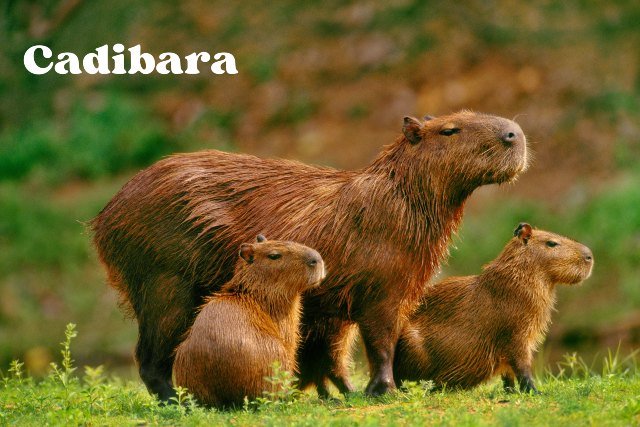
If you searched for Cadibara, you’re probably picturing that calm, barrel-shaped “giant of the marsh” that looks like a guinea pig in XXL. Most people actually mean the capybara (Hydrochoerus hydrochaeris) — the world’s largest living rodent — so in this article I’ll use Cadibara as the common name while also noting the scientific identity to keep everything accurate. Capybaras (Cadibaras) are semi-aquatic herbivores built for wetlands, and the more you learn about them, the more their “chill” vibe starts to look like a form of intelligence: social strategy, communication, and habitat savvy that keeps them thriving across huge parts of South America.
- What is a Cadibara?
- Cadibara habitat: why marshes make them smarter
- Cadibara behavior and intelligence in the wild
- Cadibara social structure: who’s in the group?
- Diet of the Cadibara: a grazing specialist built for fiber
- Reproduction and life cycle: why Cadibara babies keep up fast
- Are Cadibaras endangered?
- Cadibara and humans: pets, legality, and responsible curiosity
- Real-world “smart Cadibara” scenarios you can picture
- FAQ: common Cadibara questions
- Conclusion: why the Cadibara deserves its “smart giant” reputation
What makes the Cadibara so fascinating isn’t just size. It’s how a 50-kilogram-ish animal can live in a world full of predators, shifting water levels, seasonal grass shortages, and competition — yet still maintain stable groups, coordinate movement, raise precocial young, and use water as a multi-purpose survival tool. Researchers consistently describe capybaras as highly social, living in stable groups across their range, and that kind of complex social life almost always comes with complex decision-making.
What is a Cadibara?
A Cadibara (capybara) is a large, semi-aquatic rodent native to South America that lives near rivers, marshes, wetlands, and seasonally flooded savannas. Adults commonly weigh around 35–66 kg, with many references clustering near ~50 kg depending on habitat and season.
They’re not “giant rats.” They’re caviomorph rodents (closer in the broader group to guinea pigs than to rats), with partially webbed feet, eyes and ears positioned high on the head, and a lifestyle that’s basically designed around being one step from water at all times.
Cadibara habitat: why marshes make them smarter
A marsh looks peaceful until you’re the one trying to survive in it. Water levels change, food quality shifts with seasons, predators patrol the edges, and heat can become its own threat. One reason Cadibaras feel “surprisingly smart” is that they use wetlands like a Swiss Army knife:
They rely on water for escape from predators, thermoregulation, and access to semi-aquatic grasses — all at once. That’s not just a fun fact; it’s an ecological strategy that shapes how they socialize, feed, and move daily.
In practice, this means a Cadibara group isn’t wandering randomly. It’s making constant tradeoffs: graze where the grass is best, stay close enough to deep water to dive fast, and position vulnerable young where the group can protect them.
If you’re writing internal content around wetlands, pair this article with an internal page like /wetlands-ecosystems or /marsh-wildlife-guide to keep readers clicking deeper into your site.
Cadibara behavior and intelligence in the wild
“Intelligence” in animals isn’t only puzzle-solving. For species like the Cadibara, a more useful definition is: the ability to adapt behavior to social and environmental challenges — especially under predation risk.
Social intelligence: the Cadibara’s secret weapon
Across studies, capybaras are described as consistently group-living with stable social units. Group life isn’t free; it requires recognizing individuals, managing conflict, coordinating movement, and responding to threats as a team. That’s the backbone of social intelligence.
Research reviews highlight recurring features such as stable groups, territoriality in many contexts, and structured hierarchies. Those patterns can vary with habitat and resource distribution, which is another “smart” signal: they’re behaviorally flexible when conditions change.
Communication: more than “cute noises”
Capybaras are known for a rich communication toolkit that includes vocal signals and scent marking, especially relevant to social dynamics and territorial behavior. Even when you don’t label every sound, the important point is that communication helps groups stay cohesive and respond quickly to danger — exactly what a marsh herbivore needs.
Water strategy: practical intelligence
One of the strongest, most research-supported “smart” traits is how capybaras integrate water into daily life: refuge, cooling, and resource access. It’s a multi-function solution, and solutions that do three jobs at once are usually the product of strong adaptation.
Cadibara social structure: who’s in the group?
A typical Cadibara group can include multiple females, young, and males, often with a dominance structure among males. What matters for readers is the “why”: groups help reduce individual predation risk and increase vigilance while grazing. Research summaries across the geographic range emphasize that wherever they’ve been studied, capybaras live in groups, and those groups are relatively stable social units.
Group size and composition aren’t fixed; they shift with habitat, seasonality, and how resources are distributed. In other words, Cadibaras don’t just follow a rigid script — they adjust their social organization to local conditions.
Diet of the Cadibara: a grazing specialist built for fiber
Cadibaras are herbivores that feed heavily on grasses and aquatic or semi-aquatic plants, and their bodies are adapted for a high-fiber diet. Scientific references describe morphological and physiological adaptations supporting herbivory and efficient processing of tough vegetation.
A key “smart” angle here is that they exploit food sources tied to water — plants that other grazers may use differently — while using the same waterbody for safety and cooling. It’s an elegant ecological loop: the habitat that feeds them also protects them.
Reproduction and life cycle: why Cadibara babies keep up fast
Cadibara young are famously precocial: they can begin feeding on grasses very soon after birth, which is a major advantage for a prey species living in open, flooded landscapes.
Gestation is often reported around 5 months (about 130–150 days), and litters can be up to 8 pups.
That combination — relatively long gestation for a rodent and ready-to-move offspring — fits a survival strategy where the group needs young that can follow, graze, and respond quickly when the herd shifts toward water.
Are Cadibaras endangered?
At a global level, capybaras are commonly described as Least Concern on the IUCN Red List, with notes that local declines can occur due to hunting pressure or habitat issues.
The practical takeaway for readers: “not endangered” doesn’t mean “no threats.” Wetland drainage, fragmentation, and unmanaged hunting can still squeeze regional populations even if the species remains widespread overall.
Cadibara and humans: pets, legality, and responsible curiosity
The internet loves Cadibaras, and that popularity leads to one recurring question: “Can I keep one?” The ethical answer depends on legality where you live, welfare requirements, and whether you can meet their social and habitat needs. Their biology is adapted to water access, grazing, and group life — so solitary, dry, small enclosures are mismatched to the species’ fundamentals. Their social nature is one of the most consistent findings across research.
Real-world “smart Cadibara” scenarios you can picture
Imagine a group grazing at the marsh edge. A predator appears. The group doesn’t need every individual to be brilliant; it needs coordinated behavior that consistently reduces risk. Social living makes that possible: multiple eyes up, rapid signal spread, and immediate access to the water that functions as a safe zone.
Now imagine the dry season. Food patches shrink and competition rises. Research-based reviews describe how capybara social organization can vary with resource distribution and seasonality — an example of behavioral flexibility that looks a lot like “practical intelligence.”
FAQ: common Cadibara questions
Is a Cadibara the same as a capybara?
In most contexts, yes — Cadibara is commonly used online to refer to the capybara (Hydrochoerus hydrochaeris), the world’s largest rodent.
Why do Cadibaras live near water?
Water is central to their survival. Research summaries note water is used for escaping predators, cooling/thermoregulation, and accessing semi-aquatic food resources.
Are Cadibaras actually smart?
They’re “smart” in an ecological sense: they live in stable social groups, communicate, and show flexible behavior depending on habitat and resource distribution. That kind of social and environmental adaptability is a strong marker of functional intelligence.
How many babies does a Cadibara have?
Reports commonly note litters can be up to 8 pups, with gestation around 130–150 days (often summarized as about 5 months).
Are Cadibaras endangered?
They’re widely described as Least Concern globally, but some local populations can decline due to habitat and hunting pressures.
Conclusion: why the Cadibara deserves its “smart giant” reputation
The Cadibara isn’t just big — it’s brilliantly adapted. Its intelligence shows up in the ways that matter most for a marsh herbivore: stable group living, flexible social organization, effective use of water for safety and cooling, and a body designed to turn tough wetland vegetation into energy. Across authoritative references, capybaras consistently appear as social, habitat-savvy survivors with strategies shaped by predation risk and seasonal change.
If your readers came for “the chill rodent,” give them the deeper story: the Cadibara is a living example of how wetlands create animals that are not only resilient — but quietly, surprisingly smart.