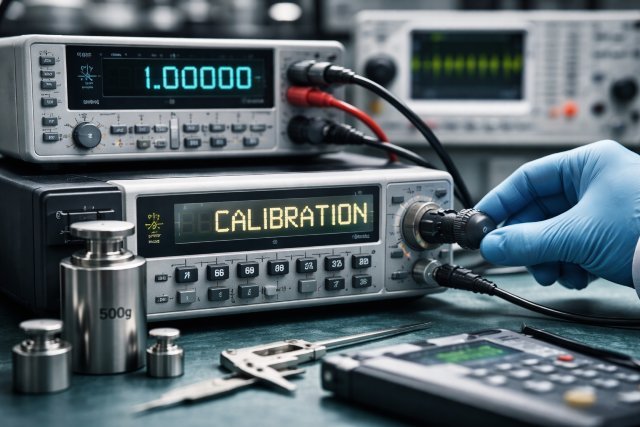
Kalibraatio is the foundation of reliable measurement. Whether you are working in manufacturing, healthcare, laboratories, or engineering, the accuracy of your data depends on properly calibrated instruments. Without calibration, measurements slowly drift away from reality, increasing risk, cost, and uncertainty.
- What Is Kalibraatio (Calibration)?
- Why Accuracy Depends on Kalibraatio
- Calibration vs. Verification vs. Adjustment
- The Importance of Traceability
- Real-World Impact of Poor Calibration
- How Calibration Is Performed
- How Often Should You Calibrate?
- What Happens If Equipment Is Out of Tolerance?
- Measurement Uncertainty: The Hidden Factor
- Common Questions About Kalibraatio
- Practical Tips for Effective Calibration Management
- Conclusion: Why Kalibraatio Is the Foundation of Accuracy
In simple terms, kalibraatio (calibration) ensures that a measuring instrument provides results that are consistent with recognized standards. It connects your device to a traceable reference, verifies its performance, and documents measurement uncertainty. Without this process, “accuracy” becomes an assumption rather than a verified fact.
You will learn what calibration means, why it is essential, how it works, and how to implement it effectively.
What Is Kalibraatio (Calibration)?
Kalibraatio refers to the process of comparing a measurement instrument against a known reference standard to determine its accuracy. The goal is not always to adjust the device, but to quantify its deviation and document the results.
A proper calibration typically involves:
- Measuring at multiple points across the instrument’s range
- Comparing results to a traceable reference standard
- Calculating measurement error
- Reporting measurement uncertainty
- Adjusting the device if required
It is important to note that calibration is different from adjustment. Calibration identifies error; adjustment corrects it.
According to the National Institute of Standards and Technology (NIST), metrological traceability requires an unbroken chain of comparisons to national or international standards, each contributing to measurement uncertainty (NIST, nist.gov).
Why Accuracy Depends on Kalibraatio
Every measurement instrument drifts over time. Environmental conditions, mechanical wear, electronic instability, and user handling all influence performance. Even high-quality devices cannot maintain perfect accuracy indefinitely.
Without kalibraatio:
- Manufacturing tolerances may be misjudged
- Laboratory results may become unreliable
- Safety systems may operate outside safe limits
- Regulatory compliance may fail
Measurement uncertainty plays a critical role here. It quantifies the doubt associated with a measurement result. As explained by Fluke Calibration, understanding uncertainty is essential for determining whether a device truly meets required tolerances (fluke.com).
In other words, calibration transforms measurement from guesswork into defensible data.
Calibration vs. Verification vs. Adjustment
These terms are often confused but have distinct meanings.
Calibration compares a device against a standard and documents the difference.
Verification checks whether the device meets specified requirements.
Adjustment changes the device to reduce its error.
Understanding this distinction is critical for quality management systems such as ISO 9001, which requires proper control of monitoring and measuring resources (ISO 9001:2015, Clause 7.1.5).
The Importance of Traceability
Traceability ensures that your measurement results are linked to national or international standards through documented comparisons. This “chain of trust” guarantees consistency across laboratories, industries, and countries.
For example, a laboratory scale may be calibrated using certified weights. Those weights are calibrated against higher-level standards, which are in turn linked to national metrology institutes. Each step contributes known uncertainty.
Without traceability, measurement comparisons across organizations become unreliable.
Real-World Impact of Poor Calibration
1. Manufacturing Errors
Imagine a production line filling containers with liquid. If a scale drifts by just 5 grams, thousands of products may be underfilled or overfilled.
Underfilling can violate regulatory requirements. Overfilling reduces profit margins. Both scenarios create avoidable costs.
Regular kalibraatio detects drift early and prevents financial losses.
2. Laboratory Inaccuracy
Analytical instruments used in chemical or pharmaceutical laboratories must produce consistent, reproducible results. Without calibration, even small deviations can invalidate research findings or regulatory submissions.
ISO/IEC 17025 requires accredited laboratories to evaluate and report measurement uncertainty as part of calibration activities.
3. Healthcare and Patient Safety
Medical infusion pumps, thermometers, and diagnostic devices depend heavily on accuracy. Studies highlight the importance of verifying performance to prevent dosing errors and measurement inaccuracies.
Calibration in healthcare is not merely operational — it directly affects patient safety.
How Calibration Is Performed
A professional calibration process generally includes the following steps:
Step 1: Define Requirements
Determine acceptable tolerances, accuracy specifications, and regulatory requirements.
Step 2: Select an Appropriate Standard
The calibration reference must be more accurate than the device under test. A commonly cited guideline is a 4:1 Test Uncertainty Ratio (TUR), meaning the standard is at least four times more accurate than the instrument.
Step 3: Perform Measurement Comparison
The device is tested at multiple points across its range under controlled environmental conditions.
Step 4: Calculate Error and Uncertainty
Measurement error and uncertainty are calculated and documented.
Step 5: Decision Rule Application
Modern calibration practice often includes defined decision rules that account for measurement uncertainty when determining pass/fail status.
How Often Should You Calibrate?
One of the most common questions about kalibraatio is calibration frequency.
There is no universal answer. The optimal interval depends on:
- Instrument stability
- Environmental conditions
- Usage intensity
- Criticality of measurement
- Historical drift data
NIST’s Good Measurement Practice guidelines emphasize that calibration intervals should be based on risk and performance data rather than arbitrary timeframes.
Risk-based calibration scheduling reduces unnecessary cost while maintaining measurement integrity.
What Happens If Equipment Is Out of Tolerance?
If an instrument is found “as-found out of tolerance” (OOT), corrective action is required.
Key questions include:
- How long has the device been out of specification?
- What decisions were based on its data?
- Are product recalls or re-testing required?
OOT analysis helps organizations evaluate potential impact and prevent recurrence.
Ignoring out-of-tolerance results can lead to serious compliance and safety issues.
Measurement Uncertainty: The Hidden Factor
Measurement uncertainty quantifies confidence in a result. Even when a device appears to meet tolerance limits, uncertainty may affect compliance decisions.
For example, if a tolerance is ±1.0 unit and measurement uncertainty is ±0.8 units, the actual risk of non-compliance increases significantly.
Understanding uncertainty allows organizations to apply proper decision rules and reduce false acceptance or false rejection risks.
Common Questions About Kalibraatio
What is kalibraatio in simple terms?
Kalibraatio is the process of comparing a measuring device to a known standard to determine its accuracy and document any deviation.
Is calibration legally required?
In many regulated industries such as pharmaceuticals, aerospace, healthcare, and manufacturing, calibration is mandatory under quality and safety standards.
Does calibration improve accuracy?
Calibration itself identifies error. Adjustment may improve accuracy, but calibration primarily verifies and documents performance.
Can calibration reduce costs?
Yes. Proper calibration reduces product rejection, prevents recalls, minimizes downtime, and ensures compliance.
Practical Tips for Effective Calibration Management
- Maintain a documented calibration schedule
- Use accredited calibration laboratories when required
- Track historical drift trends
- Implement risk-based calibration intervals
- Train personnel in measurement best practices
Effective calibration is not a one-time activity. It is a continuous quality control process.
Conclusion: Why Kalibraatio Is the Foundation of Accuracy
Kalibraatio is more than a technical procedure — it is the backbone of reliable measurement systems. Every accurate decision, safe product, and compliant process depends on trustworthy data.
Without calibration, measurements drift, risk increases, and confidence declines. With proper kalibraatio, supported by traceability and uncertainty evaluation, organizations protect quality, safety, and reputation.