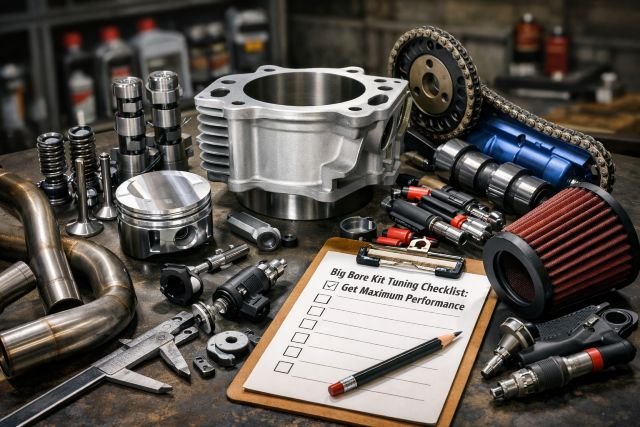
A big bore kit typically replaces the stock cylinder and piston with a larger-bore cylinder and matching piston, which increases engine displacement and usually boosts torque and responsiveness. That sounds simple, but the moment displacement changes, the engine’s airflow demand changes too, and that’s where performance either shows up or disappears.
- What a Big Bore Kit Changes, in Practical Terms
- Big Bore Kit Tuning Checklist Mindset: Build a Safe Baseline First
- Mechanical Verification Comes Before Fuel and Timing
- Fueling Capacity: Make Sure the Engine Can Actually Get the Fuel It Needs
- Wideband AFR Strategy: The Fastest Route to Safe, Maximum Performance
- Ignition Timing: Where Power Hides, and Where Damage Happens
- Heat Management: The Most Underrated “Power Mod” After a Big Bore Kit
- Break-In: The Part That Decides Ring Seal, Compression, and Long-Term Performance
- Validation: How You Know Your Big Bore Kit Tune Is Actually Finished
- Common Big Bore Kit Tuning Mistakes That Kill Performance
- Emissions Compliance Note
- Conclusion: Get Maximum Performance From Your Big Bore Kit Without Guessing
The most common disappointment story goes like this: someone installs a big bore kit, the bike starts and rides, and they assume the job is “done.” Then they notice it runs hot, feels flat up top, surges at cruise, or eats plugs. None of those are “normal big bore behavior.” They’re nearly always signs that fueling, ignition timing, temperature control, or break-in wasn’t matched to the new displacement.
This guide is written like a checklist, but in plain language. You’ll move from mechanical verification to fueling capacity, then to AFR strategy, timing safety, heat management, break-in, and finally validation. Follow the order and you’ll get what most people actually want from a big bore kit: stronger pull, cleaner throttle response, and power you can use every day without wondering what it’s doing inside the cylinder.
What a Big Bore Kit Changes, in Practical Terms
When bore increases, displacement rises quickly because bore is squared in the displacement formula. In general engine terms, displacement is calculated from bore, stroke, and cylinder count using the π/4 relationship that comes from cylinder volume. Even a modest bore increase can raise swept volume enough to change how much air the engine packs in per cycle, especially under load.
More air moving through the engine means you need a matching increase in fuel delivery to maintain the same combustion balance. If you don’t, you drift lean at the exact moments that create the most heat and stress. Richer mixtures under load are commonly used to help keep combustion temperatures down and reduce detonation risk.
So the big bore kit itself doesn’t “guarantee horsepower.” It creates the capacity for torque and response, and tuning unlocks it safely.
Big Bore Kit Tuning Checklist Mindset: Build a Safe Baseline First
Before chasing maximum performance, aim for a tune that is consistent, repeatable, and temperature-stable. A safe baseline makes more power than an unstable “spiky” setup because it lets you run harder for longer without heat soak, knock, or erratic fueling.
That means you’re not only tuning for peak numbers. You’re tuning for how the engine behaves at partial throttle, during roll-ons, in higher gears, and on hot days. Those are the conditions that expose weaknesses.
Mechanical Verification Comes Before Fuel and Timing
Confirm compression health and sealing potential
If sealing is weak, your tuning changes won’t behave consistently. Poor sealing typically shows up as soft torque, rising operating temps, and an engine that needs “extra fuel” just to feel normal. You don’t have to be a lab to check it, but you do need to be honest with the results. If compression is inconsistent between pulls or you suspect blow-by, it’s better to address sealing early than to tune around it.
Verify clearances and ring end gap using kit specifications
Every reputable piston and ring setup comes with guidance on ring end gap and fitment, and those specs exist for a reason. A ring that butts when hot can damage the cylinder quickly, and a piston that’s too tight can scuff during break-in. Wiseco’s guidance highlights that ring end-gap specs vary by ring set and emphasizes proper break-in for pistons and rings, reinforcing how closely mechanical prep and tuning are linked.
If you paid for a big bore kit, don’t let a rushed measurement step decide how long it lasts.
Eliminate intake leaks and exhaust leaks
Leaks create tuning illusions. An intake leak can make a carb look “too lean” no matter what jets you install. On EFI, unmetered air can shift trims and confuse load calculations. Exhaust leaks near the sensor can also contaminate readings and make you chase false AFR targets. Fix leaks first, then trust the data.
Fueling Capacity: Make Sure the Engine Can Actually Get the Fuel It Needs
Carbureted big bore kit setups: tune transitions, then tune power
Carb tuning is really throttle-position tuning. A big bore kit often changes airflow velocity and signal strength, which can shift how the pilot circuit, needle, and main jet behave. If you jump straight to wide-open throttle changes without stabilizing idle and the first part of throttle opening, you end up with a bike that is fast only when pinned and annoying everywhere else.
A clean approach is to get warm idle stable, then clean off-idle response, then steady mid-throttle, and only after that finalize wide-open fueling. This sequencing matters because each circuit blends into the next, and a mistake early can masquerade as a mistake later.
EFI big bore kit setups: don’t ignore injector duty cycle and fuel pressure
On EFI, the tune can only request what the hardware can deliver. If injectors are near their limit, the engine can go lean at high load even if the ECU map is “commanding” richer fueling. Fuel pressure stability matters too, especially on higher demand builds. If your system can’t keep pressure stable at high RPM and long pulls, your AFR will drift lean exactly where you need it most stable.
If you’re using closed-loop at cruise, remember that closed-loop corrections do not protect you at wide-open throttle unless your system is specifically configured that way. Wide-open is where you must be confident in your base map.
Wideband AFR Strategy: The Fastest Route to Safe, Maximum Performance
A narrowband oxygen sensor operates in a very small window around stoichiometric and can’t accurately report richer or leaner conditions outside that narrow band. A wideband sensor, by contrast, reports a usable AFR range, which is why it’s the preferred tool for performance tuning and validation.
Start with stoichiometric knowledge, then tune for load
For gasoline, stoichiometric AFR is commonly referenced at about 14.7:1, meaning the theoretical “perfect” balance for complete combustion under ideal conditions. Real engines don’t run stoich everywhere. Under acceleration and high load, richer mixtures are often used to help reduce combustion temperatures and detonation risk.
Here’s the practical tuning mindset: aim for efficient, stable cruise behavior near stoich when appropriate, then target richer mixtures under heavy load where your big bore kit is actually doing its work. The exact number depends on your engine, fuel, compression, cooling, and ignition timing, but the direction is consistent. If you’re trying to get maximum performance, the wideband is your truth meter.
Log the conditions that actually break engines
If you only check idle and cruising AFR, you’re tuning the easiest part of the drive cycle. Big bore kits stress the engine under load. You want data during roll-ons, higher gear pulls, and sustained throttle where heat builds. That’s also the data that makes your article stronger because it demonstrates an expert workflow rather than a “swap parts and hope” approach.
Ignition Timing: Where Power Hides, and Where Damage Happens
Fueling mistakes usually make an engine feel weak or hot. Timing mistakes can make it fail fast.
A bigger displacement can change burn speed and cylinder pressure behavior, particularly if compression changes with the kit or with a head/cam combination. The safest approach is to begin conservatively, then creep toward best performance while watching AFR, temperature, and any audible or logged knock behavior.
Spark plug reading can help, but it should not be your only feedback. Plug appearance is influenced by plug heat range, fuel additives, short-run conditions, and how the engine was operated before shutoff. It’s a useful supporting signal, not the full story.
If you want maximum performance without gambling, combine wideband AFR evidence with stable temperatures and repeatable pulls, and only then refine timing in small steps. That’s how you find real gains without buying a new top end.
Heat Management: The Most Underrated “Power Mod” After a Big Bore Kit
A big bore kit often produces more heat because you’re making more torque and moving more mixture. If cooling is marginal, you’ll see the classic pattern: the bike feels great for a short pull, then loses crispness, then begins to detonate or run ragged, especially on hot days or in traffic.
Heat management is not only about radiators and fans. It’s about ensuring the engine isn’t lean under load, isn’t over-advanced in timing, has proper oil condition, and has airflow and coolant capacity that match the new output. If your platform is known to run hot, improving cooling is often the difference between a tune that holds power and one that fades.
Break-In: The Part That Decides Ring Seal, Compression, and Long-Term Performance
Break-in isn’t folklore. It’s about seating rings to the cylinder so they seal well, control blow-by, and transfer heat correctly. MAHLE Motorsports explicitly frames ring seating and proper break-in as essential for long life and highest performance, which is exactly the outcome big bore kit buyers want.
A useful way to think about break-in is controlled load and heat cycles. You want enough cylinder pressure to help rings seat, but not so much heat and friction that you scuff the new surfaces. Guidance varies by manufacturer and application, but reputable sources consistently center ring-to-bore seating as the objective.
Wiseco-related guidance also reinforces that new pistons and rings require a proper break-in period with moderate operation rather than immediate sustained hard use.
If you’re chasing maximum performance, you should care deeply about ring seal because it shows up as stronger torque, cleaner throttle response, and better temperature behavior. A poorly seated setup can feel “lazy” and run hotter, and no amount of clever fueling will fully compensate for lost compression.
Validation: How You Know Your Big Bore Kit Tune Is Actually Finished
A tune is not “done” when the bike feels fast on one ride. It’s done when it repeats the same behavior across multiple pulls, across temperatures, and across riding conditions without drifting lean or overheating.
Wideband logs should show stable AFR under load. Cruise behavior should be smooth and predictable. Hot restarts should be clean. If you have access to a dyno, it’s one of the best ways to verify the tune under controlled load, and it also gives you proof content that tends to perform well in SEO because readers love charts and before/after comparisons.
You also want to validate mechanically after some run time. A follow-up compression check can reveal whether ring seal improved as expected. If compression drops or oil consumption rises, that’s your signal to stop “tuning” and inspect the build.
Common Big Bore Kit Tuning Mistakes That Kill Performance
The most common mistake is treating a big bore kit like a bolt-on that doesn’t require calibration. A bike can start and ride while still being too lean at heavy load, and “it runs” is not the same thing as “it’s safe.”
Another common mistake is chasing idle perfection and ignoring the load zones. Narrowband sensors can make this worse because they encourage a false sense of confidence around stoich without showing what happens when the engine is richer or leaner.
Finally, many people blame tuning when the underlying issue is mechanical, especially leaks and ring seal problems. If you take anything from this checklist, let it be this: validate the hardware, then trust data, then refine.
Emissions Compliance Note
If your big bore kit project includes changes that remove or defeat emissions controls, be aware that tampering with emissions control systems and manufacturing or installing defeat devices is illegal under the U.S. Clean Air Act, and the EPA actively enforces these provisions. Local laws may also apply depending on where the vehicle is used.
Conclusion: Get Maximum Performance From Your Big Bore Kit Without Guessing
A big bore kit can deliver the torque and throttle response people dream about, but maximum performance comes from matching the new displacement with correct fueling, sensible ignition timing, stable temperatures, and a break-in process that produces strong ring seal. The displacement math explains why the engine’s appetite changes after the upgrade, and wideband AFR evidence explains what the engine is actually receiving under load.
If you follow this big bore kit tuning checklist in order, you avoid the most expensive traps: tuning around leaks, running lean at wide-open throttle, overheating under sustained load, and losing power to poor ring seating. You end up with what “maximum performance” should mean in real life: stronger pull that stays consistent ride after ride, not just a quick hit that fades.