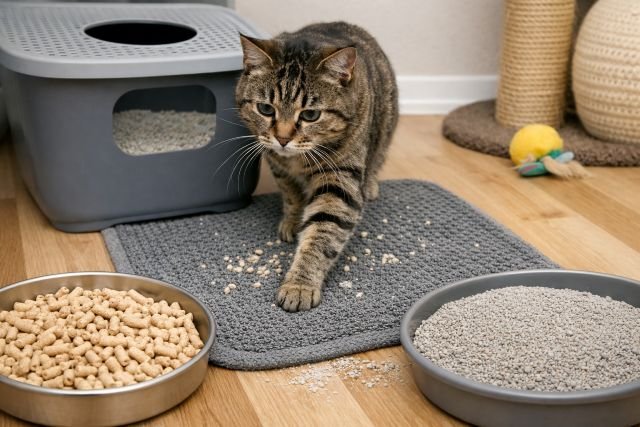
If you’re tired of finding litter “confetti” in the hallway, on the couch, and somehow in your bed, you’re not alone. The good news is that the right cat litter for cats can dramatically reduce tracking—without sacrificing odor control, easy scooping, or your cat’s comfort. The not-so-good news: no litter is truly zero-track, because cats have fur, paws, and a talent for chaos.
- What “low-tracking” cat litter actually means
- Why some cats prefer the litter that tracks the most
- Cat litter for cats that doesn’t track everywhere: which materials work best
- How to choose the best low-tracking litter based on your home and your cat
- Set up your litter area to reduce tracking, even with the same litter
- How to switch to a low-tracking litter without causing accidents
- Real-world scenarios: what low-tracking looks like at home
- FAQ for featured snippets
- Conclusion
This guide breaks down what actually causes tracking, which litter materials stay put best, and how to choose a low-tracking option your cat will actually use (because the cleanest floor in the world won’t matter if your cat protests outside the box).
What “low-tracking” cat litter actually means
Low-tracking litter is designed to reduce how much litter leaves the box on your cat’s paws and coat. In real homes, tracking is usually driven by particle size, texture, static, and how your cat exits the box.
Fine, sand-like granules cling to paw pads and get wedged into fur. Larger granules and pellet shapes tend to drop off quickly because they’re heavier and don’t stick as easily. That’s why many of the best low-tracking options feel more like small pellets than beach sand.
Why some cats prefer the litter that tracks the most
Here’s the frustrating reality: many cats prefer the feel of fine-grain clumping litter, which is also one of the biggest trackers. Veterinary guidance from AAHA notes that cats can have individual litter preferences and that offering different litters in separate boxes can help identify what your cat prefers. AAHA also notes that for cats with a history of urinary problems, unscented clumping litter may be preferred.
This matters because reducing tracking is great, but litter box refusal is not. The best low-tracking strategy is often a balance between what stays in the box and what your cat consistently uses.
Cat litter for cats that doesn’t track everywhere: which materials work best
Pellet litter for low tracking and cleaner floors
Pellet litter is one of the most reliable answers to tracking because the pieces are larger and heavier. Wood pellets, paper pellets, and many tofu litters fall into this category. The main reason pellet litter performs well is simple: it doesn’t cling to paws like fine granules do, so it tends to stay in the box and drop onto the mat instead of traveling across the home.
Tofu litter is often pellet-shaped and commonly described as lower tracking for that reason, though it isn’t universally loved by every cat. Independent pet-review sites frequently note the pellet shape as a tracking advantage for tofu litter.
Pellets can be a game-changer for long-haired cats, because longer fur acts like Velcro for fine-grain litter. If you’ve got a fluffy cat and tracking is extreme, pellets are usually the biggest single improvement you can make.
Paper litter for sensitive paws and minimal mess
Recycled paper litter is typically low dust and low tracking, especially in pellet form or larger crumbles. It’s often chosen when cats or people in the home are sensitive to dust, or when you need a gentler texture during recovery periods.
The tradeoff is that paper litter may not clump as strongly as clay clumping litter, depending on the formula. Odor control can also vary widely, so the best results typically come from consistent scooping and keeping the litter depth appropriate.
Low-tracking clumping clay for picky cats who won’t compromise
If your cat refuses pellets or paper, low-tracking clumping clay is often the “middle path.” These products typically use heavier granules designed to reduce what sticks to paws. They usually track less than ultra-fine clay, while maintaining a texture many cats accept without drama.
This is also where many multi-cat homes land because clumping performance makes daily maintenance easier and helps keep boxes inviting, which is important for preventing avoidance behaviors.
Crystal litter for odor control with moderate tracking
Silica crystal litter often excels at absorbing moisture and managing odor, and larger crystals can track less than fine clay. However, tracking depends heavily on crystal size. Some crystal litters contain smaller fragments that can still migrate.
Dust is another factor households consider when choosing litter. CDC/NIOSH and OSHA both describe the serious health risks of respirable crystalline silica exposure in occupational settings. This isn’t the same as saying a specific cat litter will cause those outcomes in typical home use, but it’s one reason many people prioritize low-dust products and gentle pouring techniques.
Tofu litter for a low-dust, lower-tracking clumping option
Tofu litter has grown in popularity because many formulas clump well while using a pellet shape that reduces tracking. Cats.com, for example, notes tofu litter is generally low dust and that the pellet shape makes it less likely to track.
The biggest practical consideration is your environment. In very humid homes, some plant-based litters can be more prone to storage issues if left unsealed. In dry homes, tofu pellets can feel like a best-of-both-worlds option: cleaner floors than clay, with clumping that feels familiar.
How to choose the best low-tracking litter based on your home and your cat
If your cat is picky or has a history of litter box issues
Start with low-tracking clumping clay, especially if your cat has always used clay. Then reduce tracking through setup changes like a better mat and a larger box. If you want to experiment, AAHA suggests testing preferences by offering different litters in separate boxes, which can reduce the risk of suddenly forcing an unwanted texture.
If you have a long-haired cat and tracking is severe
Go straight to pellet-style litter if your cat will accept it. Pellets are heavier, so they’re less likely to cling and travel. Pair this with a litter-trapping mat and, if needed, a small paw-fur trim to stop litter from hitchhiking.
If dust is a major concern in your household
Paper and many pellet litters are often chosen for low dust. Pour slowly, avoid dumping from high height, and store litter sealed. These small habits can reduce airborne particles regardless of material.
If odor control is your top priority but you still want less tracking
Crystal and clumping options tend to perform well on odor, but the best odor control also comes from maintenance. Veterinary organizations emphasize litter box management as part of keeping elimination behavior normal and preventing problems. AAHA points owners toward the AAFP/ISFM house-soiling guidelines for detailed litter box design and management.
Set up your litter area to reduce tracking, even with the same litter
The litter type matters, but your setup often matters just as much. A bigger box gives your cat room to turn and dig without launching litter over the edge. A high-sided box can reduce scatter for vigorous diggers, but some cats dislike covered boxes, so focus first on size and comfort.
A litter-trapping mat placed at the main exit point is often the most noticeable improvement for tracking because it catches what falls off paws immediately. Positioning the box so your cat has to take a few steps across the mat before reaching open floor makes a difference.
Regular scooping also reduces frantic digging and helps keep the box appealing. Many humane society and veterinary resources emphasize that cleanliness supports consistent box use, and some materials work best when scooped frequently.
How to switch to a low-tracking litter without causing accidents
A fast switch is the most common reason a “better” litter fails. Most cats do best with a gradual transition that lets them adjust to the new texture and smell.
Mix a small amount of the new litter into the old litter and increase slowly over a couple of weeks. If your cat hesitates, pause at the current mix ratio for a few extra days before increasing again. For especially sensitive cats, the preference-test approach from AAHA can be even safer because it lets your cat choose rather than forcing change.
If you see avoidance, sudden house-soiling, or straining, it’s worth checking with a veterinarian because medical causes and stress can drive changes in elimination behavior. The AAFP/ISFM house-soiling guidelines emphasize that these problems are not “spite,” and that health and environmental needs should be assessed.
Real-world scenarios: what low-tracking looks like at home
In a small apartment with hard floors, fine clay can turn into a daily sweep routine because it clings to paws and spreads. Switching to pellets often changes the pattern from “everywhere” to “mostly at the mat,” which is a huge quality-of-life upgrade. You may still see a few pieces nearby, but it stops feeling like a constant gritty film.
In a long-haired household, tracking often comes from fur rather than paws alone. Even a “low-tracking” clay may still travel because particles cling to the fur between toes. Pellet litters reduce that because fewer pieces stick in the first place, and what does stick drops off quickly due to weight.
In multi-cat homes, the best low-tracking solution is often whichever litter keeps everyone reliably using the box. Some households succeed with pellets in one box and low-tracking clumping clay in another, then transition based on which box gets used most.
FAQ for featured snippets
What is the best cat litter for cats that doesn’t track everywhere?
Pellet litter is usually the best low-tracking option because larger pieces don’t cling to paws and fur as easily. If your cat refuses pellets, a low-tracking clumping clay with heavier granules is often the best compromise.
Why does litter track so much even with a “low-tracking” label?
Tracking depends on particle size, your cat’s coat, humidity/static, digging behavior, and the box setup. Low-tracking products reduce carry-out, but an undersized box, no mat, or a very fluffy cat can still cause tracking.
How do I keep litter off my couch and bed?
Use a litter-trapping mat at the box exit, choose larger-particle litter like pellets if your cat tolerates it, and consider trimming paw fur for long-haired cats. Also place the box where your cat must walk across the mat before reaching open floor.
Is unscented litter better for cats?
Many cats prefer unscented litter, and AAHA notes that for cats with urinary history, unscented clumping litter may be preferred.
Conclusion
Choosing cat litter for cats that doesn’t track everywhere comes down to matching material and texture to your cat’s preferences. If tracking is your biggest headache, pellet-style litters, including wood, paper, and many tofu options, tend to stay put because the pieces are heavier and less likely to cling. If your cat is picky, low-tracking clumping clay is often the easiest transition while still reducing the gritty trail.
Whichever route you pick, you’ll get the best results when you pair the right litter with a bigger, comfortable box, a litter-trapping mat at the exit, and consistent scooping. That combination is what turns “some improvement” into the kind of clean floors you actually notice day to day.