If your front sight base looks slightly “leaned” when you shoulder the rifle, that small visual annoyance can turn into a big zeroing problem. A canted front sight doesn’t just offend your sense of symmetry. It can push your rear sight windage far off center, make your holds feel inconsistent, and trigger the classic range-day spiral where every adjustment seems to create a new problem.
- What a Front Sight Base Does and Why Alignment Matters
- The Two Types of Cant You Need to Distinguish
- Front Sight Base Alignment Tips That Don’t Require Guesswork
- Why Canting Creates Zeroing Headaches, Even When Groups Look “Good”
- How to Zero in a Way That Exposes Cant Instead of Hiding It
- Common Mechanical Causes of a Canted Front Sight Base
- Common Shooter Causes That Mimic a Canted Front Sight Base
- A Real-World Scenario That Shows You What to Do Next
- When to Fix It Yourself and When to Hand It Off
- FAQ for Featured Snippets
- Conclusion: Keep the Front Sight Base Straight and Zeroing Gets Simple Again
The upside is that most canting and zeroing headaches are diagnosable with calm, repeatable checks. You don’t need to guess, and you don’t need to burn half a case of ammo trying to “walk” a zero into place. With the right approach, you can separate shooter-driven cant from true mechanical misalignment, confirm what’s actually happening, and decide whether you can live with it, correct it, or hand it to a qualified armorer.
This guide focuses on practical alignment methods that work in the real world, plus a zeroing workflow that keeps you from masking a hardware issue with endless clicks. Along the way, you’ll see why fundamentals still matter here. The Civilian Marksmanship Program and the U.S. Army Marksmanship Unit repeatedly emphasize that consistent sight alignment and trigger control are foundational. If those drift, they can mimic “hardware problems” even when the rifle is fine.
What a Front Sight Base Does and Why Alignment Matters
On many AR-pattern rifles with an A-frame front assembly, the front sight base is more than a place to hold the front sight post. It often also serves as the gas block and is physically anchored to the barrel. That makes it a major reference point for your sight picture and your zero.
When the front sight base is rotated slightly around the barrel axis, the front sight post is no longer truly vertical relative to the rifle. Your rear sight still assumes that the front post is upright. The result is a mismatch between how the sights are designed to work and how they’re actually positioned on your rifle.
This is why a canted front sight base so often shows up as a windage problem. You end up dialing the rear sight to one side just to compensate for a rotated front reference. It can still “zero,” but the rear sight may sit near an extreme, and your adjustments can feel oddly sensitive or inconsistent across distances.
Cant also matters because it can create left-right error that increases with range. A technical way to think about it is that cant couples the vertical drop component into a horizontal component as the rifle is rolled. A simplified physics treatment shows how this horizontal error grows with distance and the amount of cant. A commonly quoted rule-of-thumb is that typical amounts of cant can produce roughly an inch of horizontal error per 100 yards, depending on the direction of the cant and other factors. Treat that as an order-of-magnitude intuition, not a law of nature, but it helps explain why a rifle that seems “mostly fine” at 25 or 50 yards can feel increasingly annoying at 100 and beyond.
The Two Types of Cant You Need to Distinguish
Before you touch a screw or blame the barrel, it helps to name the two culprits clearly.
Mechanical cant is when the front sight base itself is rotated relative to the barrel and receiver. This is the “hardware is clocked” problem, and it often reveals itself through extreme windage requirements or a front post that cannot be visually aligned with true vertical when the rifle is level.
Shooter cant is when the rifle is held rolled in your hands during firing. This is far more common than many people want to admit, especially from awkward positions or when a shooter is rushing the shot. Marksmanship sources consistently emphasize that stable position and consistent sight alignment are what keep your groups honest. If your hold varies, the rifle’s apparent “problem” will vary too.
The goal is to identify which one you have, because the fixes are completely different.
Front Sight Base Alignment Tips That Don’t Require Guesswork
Level the Rifle First, or Every Visual Check Lies
The biggest mistake people make when diagnosing a canted front sight base is inspecting it while the rifle is floating in mid-air. Your shoulders, your head tilt, and even the way you’re standing can rotate the rifle without you realizing it. That turns “diagnosis” into a magic trick.
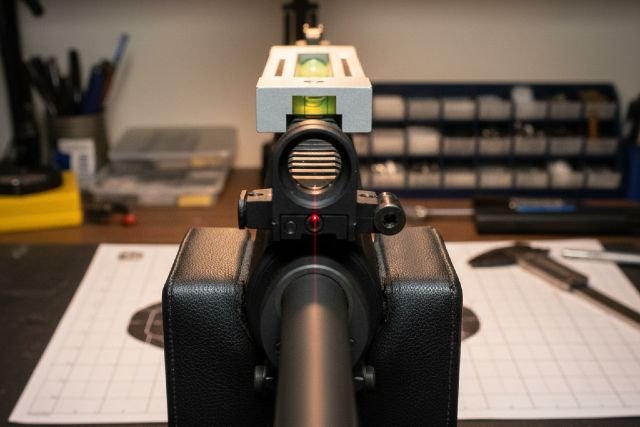
A better method starts by leveling the rifle on a stable support. Use a small bubble level on a known-flat reference surface such as the upper receiver rail. The point is not perfection to the tenth of a degree. The point is to create a repeatable, objective “rifle is level” baseline so your eyes stop getting fooled.
Once the rifle is level, look at the front sight post and the ears of the front sight base. If it still looks leaned, you now have reason to continue. If it suddenly looks fine, you may have been seeing shooter cant or a perspective illusion.
Use a Plumb Line to Confirm True Vertical
If you want a definitive, low-tech check, a plumb line is hard to beat. Hang a string with a small weight several feet in front of a plain background. Level the rifle again on the receiver or rail. Then align your sight picture so the front sight post overlays the plumb line.
When the rifle is level, a properly aligned front sight post should track that vertical reference cleanly. If the post “leans off” the plumb line, that’s a strong indicator that something is mechanically rotated or that your leveling reference isn’t actually parallel to the bore.
This one test is a huge time-saver because it removes your brain’s tendency to “correct” what it expects to see.
Confirm the Rear Sight Isn’t the Real Source of the Problem
A surprising number of “canted front sight” complaints end up being rear-sight related. A rear sight can be mounted slightly skewed on the rail. A carry handle or detachable rear can be out of spec. A shooter can start with windage already off-center because they never returned to mechanical center after a previous session.
The simplest sanity check is to return the rear sight to mechanical center based on its adjustment scheme. Then ensure it is mounted squarely and tightened properly. After that, see how much windage you actually need during a controlled zero.
This aligns with standard marksmanship guidance that focuses on maintaining correct sight alignment and using consistent, repeatable aiming. If your rear sight is the crooked piece in the chain, you can chase cant forever and never fix it.
Watch for “Windage Near the Limit” as Your Hard Stop Signal
A practical field indicator is how far you need to push windage to get centered at your chosen zero distance. If you find yourself marching toward the extreme end of the rear sight windage range just to get on paper, treat that as a stop sign. At that point, it’s smarter to pause and re-run the level-and-plumb-line checks than to keep clicking.
On many rifles, a workable zero should not require the rear sight to live near its mechanical limits under normal conditions. If it does, it is often pointing you toward a mechanical misalignment, not a “keep trying” problem.
Don’t Use Brute Force “Twist It Until It Pops” Advice
You’ll find plenty of forum posts recommending improvised levering or twisting of a canted front sight base to “fix” it. Some posters describe using long bars and brute force to rotate the base. Even if that sometimes appears to work, it is not a safe best practice. It risks damaging parts, creating gas leakage issues, or introducing new alignment problems you can’t see until later.
If you confirm true mechanical cant and it’s significant, the responsible path is correction with proper fixtures and methods, or by a qualified armorer.
Why Canting Creates Zeroing Headaches, Even When Groups Look “Good”
Many shooters first notice a cant issue because their groups are tight but stubbornly off-center. That’s frustrating because tight groups usually mean the rifle and ammo are capable, and your fundamentals are at least somewhat consistent. So why can’t you just “dial it in”?
Canting creates a mismatch between your adjustment inputs and the geometry of the sights. A rear sight windage adjustment is intended to move point of impact left-right in a predictable way under the assumption that the front post is vertical. When the front is rotated, your “vertical” and “horizontal” axes are no longer cleanly separated. Adjustments can feel like they’re doing two things at once, and you may end up compensating for geometry rather than simply zeroing.
At longer distances, canting also produces a more subtle effect. As bullet drop grows with range, any cant angle can translate some of that vertical drop into horizontal error. A technical article on estimating cant-induced shot error explains this relationship and why the horizontal deflection increases with distance and cant angle. A commonly repeated field estimate frames typical cant errors as on the order of an inch per 100 yards, which helps illustrate why the effect becomes more obvious as distances stretch.
How to Zero in a Way That Exposes Cant Instead of Hiding It
If you suspect a front sight base alignment issue, your zeroing process should be designed to reveal it early. A sloppy zero can temporarily “work,” but it can also hide a mechanical problem behind a mountain of adjustments.
Start by choosing a distance you can shoot well. Many shooters favor 50 or 100 yards for iron sight zero confirmation because it reduces the noise of tiny aiming errors that show up at 25. Whichever you choose, keep the distance consistent during the diagnosis.
Next, commit to groups, not single shots. A single shot can be a flinch, a bad call, a weird wind puff, or a slight cant you didn’t notice. A short, well-executed group gives you a center you can trust.
As you shoot, keep your focus discipline strict. The U.S. Army Marksmanship Unit material repeatedly emphasizes that the shooter must concentrate on maintaining the correct relationship between front and rear sight, with focus on the front sight during the shot process. That matters because inconsistent sight alignment can look like “wandering” mechanical offset.
As you adjust, keep your roles clean. On many iron-sight setups, elevation is corrected at the front post and windage at the rear. If you adjust both ends randomly, it becomes almost impossible to tell whether you’re solving a real offset or just changing two variables at once.
Finally, use windage position as your diagnostic clue. If your zero is arriving with windage far off-center, stop and re-check alignment using the level and plumb line method. If windage is close to center and your groups settle, your “cant” may have been shooter-induced or an initial mounting issue.
Common Mechanical Causes of a Canted Front Sight Base
One common cause is pinning or installation variation. A-frame front sight bases are often pinned, and small rotational differences during drilling or assembly can show up as cant. Community discussions often describe the root cause bluntly as “pinned crooked,” and while that’s informal, it reflects a real-world failure mode.
Another cause is parts stacking from a build or barrel swap. If a barrel, upper, or front sight base was changed, the relationship between the indexing surfaces can shift. Sometimes the issue isn’t just the base; it can be the barrel extension index relationship or other alignment tolerances that add up. This is why “it was fine before the swap” is a meaningful clue.
A third cause is a rotated reference surface. A handguard or rail that is slightly clocked can make the front sight appear canted, especially if you’re using the rail as your leveling reference. That’s why it’s worth leveling on a consistent receiver reference and verifying mounting.
Common Shooter Causes That Mimic a Canted Front Sight Base
The most common shooter cause is unconscious roll of the rifle, especially when rushing a shot or shooting from an improvised position. If you don’t have an objective reference like a bubble level, your brain may “square up” the sights in a way that actually rotates the rifle.
Another cause is inconsistent cheek weld and head position. A small change in how your eye centers the rear aperture can create a sight picture that makes the front appear off, even when it isn’t. This is why structured marksmanship teaching puts so much emphasis on consistent position and repeatable sight alignment.
If you’re diagnosing cant, it helps to shoot a few groups deliberately focusing on keeping the rifle truly vertical through the shot. If the windage need changes depending on your attention to rifle roll, you’ve found a technique lever to pull.
A Real-World Scenario That Shows You What to Do Next
Imagine you buy an upper and take it to the range. Your groups are tight at 50 yards, but they land left. You dial windage right. They still land left. Soon your rear sight is living near the edge of its adjustment, and you’re wondering if the rifle is defective.
In that situation, the smartest move is to stop trying to “click your way out” and diagnose. Level the rifle on a stable support, then compare the front sight post to a plumb line. If it doesn’t align with true vertical when the rifle is level, you likely have a mechanical cant issue. If it aligns just fine, return the rear sight to mechanical center, confirm the rear is mounted squarely, and then re-shoot groups with extra attention to keeping the rifle from rolling.
This approach saves you from confusing a technique issue with a hardware issue, and it matches the way formal marksmanship instruction prioritizes consistent alignment and control factors.
When to Fix It Yourself and When to Hand It Off
If your rear sight windage must be pushed near an extreme to zero, that is usually the threshold where professional correction becomes the sensible choice. Correcting a pinned front sight base often requires proper tools and procedures to avoid damaging the barrel, pins, or gas system. Improvised force-based methods are widely discussed online, but they are not a safe default.
If the cant is minor and you can still zero with windage reasonably close to center, you may decide it’s acceptable for your use case. For short-range training, a slight offset that doesn’t drive you into adjustment limits might be more annoyance than functional failure. For longer distances or any environment where consistency matters, removing cant as a variable is usually worth it.
FAQ for Featured Snippets
What is a canted front sight base?
A canted front sight base is a front sight assembly that is rotated slightly around the barrel so the front sight post is not truly vertical when the rifle is level. This often forces unusual windage adjustments during zeroing.
How do I check if my front sight base is canted?
Level the rifle on a stable support using the receiver or rail as a reference, then compare the front sight post to a plumb line. If the rifle is level but the post does not match true vertical, the front sight base or your reference surface is likely rotated.
Does rifle cant really affect point of impact?
Yes. Cant can create left-right error that grows with distance because some of the vertical drop component can become a horizontal component when the rifle is rolled. Technical and field references describe this effect and why it becomes more noticeable as range increases.
Can I still zero with a slightly canted front sight base?
Often you can, especially at shorter distances, as long as you have enough windage adjustment range. If you must push windage near the limit to zero, that is a strong sign the cant is significant enough to warrant correction.
Is it always the hardware?
No. Shooter-induced cant is common, especially from awkward positions or rushed shots. That’s why marksmanship instruction emphasizes consistent sight alignment and focus on the front sight, because inconsistency can mimic mechanical offset.
Conclusion: Keep the Front Sight Base Straight and Zeroing Gets Simple Again
A well-aligned front sight base makes zeroing feel straightforward because your adjustments stay logical and centered. When canting creeps in, the rifle can still shoot tight groups, but you pay for it with windage drift, odd adjustment behavior, and growing frustration as distance increases. The fastest path back to sanity is objective diagnosis: level the rifle, confirm vertical with a plumb line, verify the rear sight is mounted squarely and centered, and then zero with disciplined groups and consistent sight alignment. Those steps prevent you from masking a real alignment problem with endless clicks, and they help you avoid the zeroing headaches that keep so many shooters stuck at the range.
If you want, tell me whether your setup is an A2-style pinned front sight base or a separate gas block with a rail-mounted front sight, and what zero distance you’re targeting. I’ll rewrite the zeroing section to match that exact configuration.