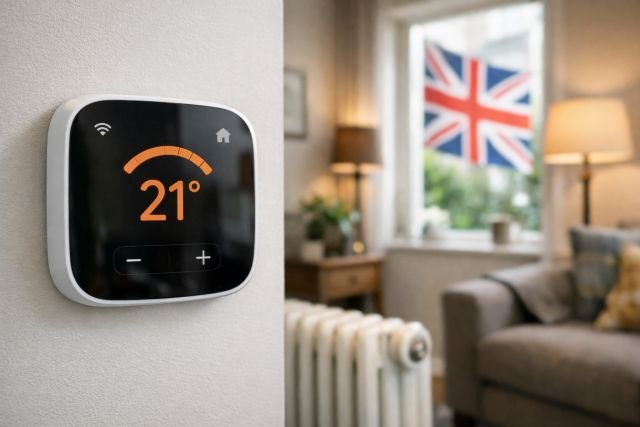
If you’re shopping for the best smart thermostat UK households can rely on, you’re probably chasing two things at once: better comfort and lower heating waste. In Britain, that matters because gas heating is still the norm, and typical households in Great Britain use around 11,500 kWh of gas per year (plus about 2,700 kWh electricity).
- Quick answer: what is the best smart thermostat in the UK right now?
- How we picked the best smart thermostat UK buyers should consider
- Best smart thermostat UK shortlist (top models for British homes)
- What features matter most in British homes (and what’s mostly marketing)
- Installation tips (UK-specific and practical)
- Cost and payback: what savings are realistic?
- FAQs
- Conclusion: choosing the best smart thermostat UK buyers will keep long-term
A smart thermostat can’t change your insulation overnight, but it can tighten control: smarter schedules, remote tweaks when plans change, and (in the best setups) room-by-room zoning and boiler modulation. In this guide, you’ll see which models make sense for British boilers, flats, Victorian terraces, and larger multi-zone homes — plus what features are genuinely worth paying for.
Quick answer: what is the best smart thermostat in the UK right now?
For most British homes, tado° (especially the newer tado° X range) is often the best all-rounder because it combines strong automation, good multi-room expansion, and broad platform support (including Matter/Thread on X).
If you want a “set it and forget it” thermostat with a beautiful wall display and learning behaviour, Google Nest Learning Thermostat (3rd gen) remains a popular premium pick — but pay close attention to long-term support: Nest 1st/2nd gen lost app connectivity on 25 Oct 2025, which is a useful reminder to avoid older hardware.
If you want the easiest route with UK-centric support and installation options, Hive is a strong choice (especially if you like the British Gas-backed install ecosystem).
And if you want a value-led, expandable system that works brilliantly with smart TRVs for zoning, Drayton Wiser is hard to ignore.
How we picked the best smart thermostat UK buyers should consider
A “top rated” smart thermostat isn’t just about app design. In the UK, your heating system type decides what you can actually control.
Boiler and system compatibility comes first
Most UK homes have one of these:
Combi boiler (no hot water cylinder), system boiler (with cylinder), or heat-only/regular boiler (with cylinder and tanks). The right thermostat must match your wiring and control style (common setups include S-Plan and Y-Plan). This is why many brands include compatibility checkers and why installers ask so many questions.
tado° explicitly notes it works with most boilers using standard relay (on/off) connections, which covers a huge chunk of UK installs.
Modulation vs on/off control
Basic thermostats are “on/off”: the boiler fires at full rate until the set temperature is reached. More advanced control uses modulation (for compatible boilers/protocols), which can smooth temperatures and reduce cycling.
Independent UK testing commissioned by BEAMA and carried out at the University of Salford looked at advanced/modulating thermostat controls versus standard on/off thermostats. It’s exactly the kind of evidence worth paying attention to when you’re choosing features that claim “efficiency”.
Zoning is where big real-world gains often happen
If you can heat only the rooms you use (especially with smart radiator valves), you often cut waste in real homes. A peer-reviewed UK study examining domestic zonal heating controls provides robust evidence on how zoning can affect energy demand and temperatures in gas-heated homes.
Reliability and long-term support
Smart thermostats are software products. A cautionary tale: Google ended smart/app support for Nest 1st and 2nd gen units on 25 October 2025 (they still work locally, but lose cloud/app features).
So “best” also means: will it still be smart in five years?
Best smart thermostat UK shortlist (top models for British homes)
1) tado° Smart Thermostat X (best for future-proof smart homes)
If you’re building a modern smart home and want the most future-proof option, tado° X is a standout. The X range supports Matter/Thread, which helps it play nicer across platforms and can improve local reliability in the smart home ecosystem.
It’s also built around tado’s strengths: automation, multi-room control, and the kind of “helpful nags” that actually reduce waste (for example, prompts and insights around heating behaviour and indoor conditions).
Best for: tech-forward households, people who want multi-room later, homes where schedules change a lot.
Scenario: You work hybrid. Some days you’re home by 4pm, other days 7pm. Instead of heating the whole house “just in case,” you let the schedule adapt and only boost when it’s actually needed.
2) Google Nest Learning Thermostat (3rd gen) (best premium “learning” choice)
Nest’s appeal is simple: it looks premium, it’s polished, and it reduces the “thermostat admin” many people hate. Features like True Radiant (timing optimisation so your home hits the temperature when you want it) show Nest’s focus on comfort and control.
But here’s the key UK buyer tip: don’t buy older Nest generations used/cheap. Google’s official support notice confirms that affected older generations lost app connectivity from 25 Oct 2025.
If you’re buying Nest, stick to supported models and check compatibility carefully.
Best for: design-led buyers, people who want a thermostat that learns and doesn’t need constant tweaking.
Scenario: In a draughty terrace, you often overshoot and then open a window. Nest-style timing optimisation helps reduce that “too hot then too cold” cycle by learning heat-up behaviour.
3) Hive Thermostat (best for UK-first simplicity and installation options)
Hive remains a UK household name for a reason: it’s approachable, widely installed, and tightly integrated into the UK market. Hive positions the thermostat as working “in the background” and highlights straightforward control via device dial or app.
If you value a guided purchasing and installation experience (especially in homes with older wiring), Hive’s ecosystem can reduce the “will this work in my house?” anxiety.
Best for: people who want a familiar brand, a clean app experience, and an easy purchase-to-install journey.
Scenario: You rent out a property and want a system many engineers recognise. A mainstream UK product can make servicing and handovers easier.
4) Drayton Wiser (best value for expandable zoned heating)
Wiser is a favourite for UK homes that want zoning without going fully bespoke. Drayton’s Wiser thermostat kits are designed around common UK setups (for example, a combi boiler kit) and are built to expand with smart radiator thermostats for independent room control.
Wiser also references UK research and industry statistics around potential savings when upgrading from basic controls, pointing readers toward the broader evidence base for smarter heating control.
Best for: families heating different rooms at different times, larger houses, and anyone who wants strong ROI through zoning.
Scenario: Kids’ bedrooms need heat early evening, but the home office doesn’t. Wiser + smart TRVs lets you heat the rooms you use, not the rooms you don’t.
5) Honeywell Home / Resideo T6R (best for “no-fuss” scheduling + geofencing)
The T6R is a solid, brand-trust option with broad smart home compatibility via the Resideo ecosystem, and it supports geofencing-style automation so your heating responds to your location and routine.
Honeywell/Resideo also appeals to buyers who prefer established heating-control heritage and straightforward programmability over flashy “learning” claims.
Best for: practical buyers who want dependable controls, families who want multiple devices on the app, and people who like automation but not complexity.
What features matter most in British homes (and what’s mostly marketing)
Hot water control: crucial for system/regular boilers
If you have a hot water cylinder, make sure the thermostat system supports stored hot water scheduling. Some ecosystems are much better at this than others, and it changes whether you can time hot water efficiently (especially on busy family mornings).
Multi-room control: the comfort upgrade you’ll feel daily
Room-by-room is where people feel the difference. Instead of fighting over one hallway thermostat reading, you heat the living room to a cosy level while keeping bedrooms cooler. This is also where the evidence around zonal controls becomes relevant.
Boiler modulation: worth it if your boiler supports it
If your boiler supports modulating control and the thermostat can use it, you may get smoother comfort and less cycling. The Salford/BEAMA work on advanced controls helps explain why modulation is a meaningful technical distinction, not just a buzzword.
Long-term support and security: don’t ignore it
Smart thermostats need ongoing updates. Google’s Nest end-of-support notice is a real-world example of why you should avoid older generations and buy with lifecycle in mind.
Installation tips (UK-specific and practical)
Many smart thermostats are DIY-friendly only if your existing wiring and boiler setup are straightforward. If your current controller handles both heating and hot water (or you have multiple zones), professional installation can save hours of trial-and-error.
A good rule: if you have a hot water cylinder, an older programmer, or you’re not sure whether you’re S-Plan/Y-Plan, consider installer support.
Also, remember that good controls are only one part of efficient heating. The Energy Saving Trust’s guidance on thermostats and heating controls reinforces that correct setup and sensible control choices reduce waste while keeping comfort.
Cost and payback: what savings are realistic?
A smart thermostat pays back fastest when it stops unnecessary heating: warming an empty home, overheating rooms, or running longer than needed.
Evidence varies by household and setup, but UK-focused research and trials around advanced controls and zoning show measurable reductions in energy use under real conditions.
To sanity-check your upside, start with your baseline. Ofgem’s typical annual usage figures (including ~11,500 kWh gas) give a reference point for many homes.
If you’re above typical — large house, poor insulation, long heating hours — better control usually has more headroom.
FAQs
What is the best smart thermostat UK homes can buy?
For most households, tado° (especially tado° X for Matter/Thread) is one of the best all-round choices, while Nest (3rd gen) is a premium learning thermostat pick, Hive is strong for UK-first simplicity, and Drayton Wiser is excellent for value-led zoning.
Do smart thermostats work with combi boilers in the UK?
Yes — many smart thermostats are designed for combi boilers, but you must match the correct kit (wired/wireless) and receiver type. Drayton’s Wiser Thermostat Kit 1, for example, is explicitly positioned as suitable for combi boilers.
Will a smart thermostat save me money in Britain?
It can, especially if it prevents heating when nobody is home, tightens schedules, and enables zoning. Independent UK testing commissioned by BEAMA and carried out at the University of Salford examined energy-saving potential from advanced room thermostat controls.
Should I buy an old/used Nest thermostat?
Be careful. Google ended app/cloud functionality for Nest 1st and 2nd gen units on 25 October 2025, meaning they no longer work in the Nest/Home app and lose connected features. Stick to supported models if you want smart features long-term.
Conclusion: choosing the best smart thermostat UK buyers will keep long-term
The best smart thermostat UK homeowners should pick isn’t always the most famous — it’s the one that matches your boiler setup, supports the kind of control you’ll actually use, and won’t be abandoned in a couple of years.
If you want the most future-proof ecosystem with modern smart home standards, start with tado° X.
If you want a premium learning thermostat and you’re careful to buy a supported generation, Nest (3rd gen) is still a compelling choice.
If you want UK-first simplicity and an easy ownership path, Hive is a safe bet.
And if you want strong value with a clear path to zoned heating, Drayton Wiser is one of the smartest upgrades you can make.